Turning effects of forces
Key idea: Moments, rotational equilibrium, the principle of moments and centre of gravity.
Continue where you stopped
The core idea
Syllabus and review details
Focus on moments, equilibrium and centre of gravity. Stability is studied in standalone G3 Physics, not in this Science course.
- K326 / K327 Science Physics componentK326 / K327 · 2027Checked against the syllabus · complete topic coverageK326/K327 2027 syllabus, Turning Effects of Forces topic 5
A moment describes a force’s turning effect
The moment of a force about a pivot measures how strongly that force tends to rotate an object. State whether the effect is clockwise or anticlockwise about the chosen pivot.
Clockwise moment
The force tends to turn the object in the same direction as a clock’s hands.
Anticlockwise moment
The force tends to turn the object in the opposite direction.
Use force and perpendicular distance
The moment depends on the force and the perpendicular distance from the pivot to the force’s line of action.
- M
- moment in newton metres (N m)
- F
- force in newtons (N)
- d
- perpendicular distance in metres (m)
A moment measures a turning effect, not an energy transfer. Write its unit as N m. The joule also has dimensions N m, but it names an energy quantity, so it is not the unit name used for a moment.
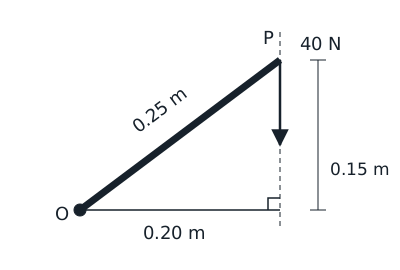
Try the decision: identify the pivot and line of action, then choose between 0.25 m, 0.20 m and 0.15 m. Calculate the moment and state its turning sense.
Check the distance and moment
O is the pivot. The force's line of action is the vertical line through P, so its perpendicular separation from O is the horizontal 0.20 m. The moment is 40 × 0.20 = 8.0 N m clockwise. OP = 0.25 m reaches the force's point of application but is not perpendicular to the force. The vertical 0.15 m runs parallel to the force, so it is not the moment arm either.
For equilibrium, clockwise and anticlockwise moments balance
The principle of moments states that, for a body in equilibrium, the total clockwise moment about a pivot equals the total anticlockwise moment about that pivot.
A balanced object can still have several forces acting on it. Equilibrium describes the combined effect, not the absence of forces.
Complete static equilibrium also requires zero resultant force. Two equal upward forces at equal distances either side of a bar's centre have opposite moments about that centre, but their forces add upward. Balanced moments alone therefore do not prove that the bar stays at rest.
Choose a pivot without losing a force
A horizontal beam of negligible weight is supported at O. A 36 N downward force acts 0.25 m to O's left and an unknown downward force F acts 0.60 m to O's right. The support force R acts upward through O.
Taking moments about O gives 36 × 0.25 = F × 0.60, so F = 15 N. R has zero moment about O because its line of action passes through O. That removes R from this moment equation, not from the forces acting on the beam.
Now check the forces: what value of R is needed for the beam to remain at rest? What would happen to the resultant force if R were omitted?
Check the support force
The downward forces total 36 + 15 = 51 N, so R = 51 N upward. Omitting R leaves a 51 N downward resultant even though the two applied moments balance about O.
Apply the principle of moments methodically
- Choose and mark one pivot.
- Identify each force and its perpendicular distance from that pivot.
- Convert every distance to metres before calculating moments.
- Label each moment clockwise or anticlockwise.
- For equilibrium, equate the totals and solve for the unknown.
- Check that the answer has the requested force, distance or moment unit.
Treat the whole weight as acting at the centre of gravity
The centre of gravity is the single point through which a body’s whole weight may be taken to act. In a moments calculation, draw one downward weight arrow through that point.
Uniform metre rule
For a straight rule with uniform mass per unit length in a uniform gravitational field, equal lengths on either side carry equal weight. Its centre of gravity is therefore at the 50 cm mark, so its weight acts there.
Loaded beam
Include the beam’s own weight at its centre of gravity as well as any added loads.
Balance a uniform metre rule
A uniform metre rule weighs 1.2 N and is pivoted at the 40 cm mark. What downward force at the 10 cm mark balances the rule?
The rule’s weight acts at its centre of gravity, the 50 cm mark.
Anticlockwise distance: 40 − 10 = 30 cm = 0.30 m.
Clockwise distance: 50 − 40 = 10 cm = 0.10 m.
F(0.30) = 1.2(0.10)
F = 0.40 N downward.
A loaded or nonuniform object need not have its centre of gravity at the midpoint. Use its supplied or measured centre of gravity; the object's total length alone cannot locate it.
| Feature | Position / m |
|---|---|
| Left end | 0.00 |
| Pivot | 0.50 |
| Measured centre of gravity | 0.80 |
| Right end | 1.20 |
Try the weight model: the rod weighs 20 N. A learner puts its weight at the 0.60 m midpoint. Correct the placement, state the weight's direction, then calculate its moment about the pivot.
Check the placement and calculation
The weight acts downward through 0.80 m, the measured centre of gravity. This is 0.80 − 0.50 = 0.30 m to the right of the pivot, so the weight's moment is 20 × 0.30 = 6.0 N m clockwise. The midpoint assumption would give 2.0 N m, but is unjustified for this nonuniform rod.
Common mistakes
- “Use the distance from the pivot to where the force is applied.”
- Use the perpendicular distance from the pivot to the force’s line of action.
- “The bigger force always creates the bigger moment.”
- Compare the product of force and perpendicular distance.
- “Balanced moments mean no forces act.”
- Several forces may act; their clockwise and anticlockwise moments balance.
- “A beam’s own weight can be ignored.”
- Include it through the beam’s centre of gravity unless the question says it is negligible.
Worked applications
Calculate one moment
A 24 N force acts at a perpendicular distance of 0.35 m from a pivot. Find its moment.
M = Fd
M = 24 N × 0.35 m = 8.4 N m
Include a beam's weight in an unfamiliar arrangement
A uniform 2.0 m plank weighs 120 N and is pivoted 0.75 m from its left end. A 200 N load hangs 0.20 m from the left end. Find the downward force at the right end needed for equilibrium.
The load acts 0.55 m left of the pivot, giving an anticlockwise moment.
The plank's weight acts at its 1.0 m midpoint, 0.25 m right of the pivot.
The right end is 1.25 m from the pivot.
200(0.55) = 120(0.25) + F(1.25)
110 = 30 + 1.25F, so F = 64 N downward.
Check: the added force must act clockwise because the load alone produces the larger anticlockwise moment.
Correct a line-of-action error
A student multiplies a 40 N force by the 0.25 m distance from a nut to the student's hand. The shortest distance from the nut to the force's line of action is actually 0.18 m. The correct moment is 40 × 0.18 = 7.2 N m, not 10 N m.
Practise this independently
- A 15 N force acts 0.40 m perpendicularly from a pivot. Calculate its moment.
- State the principle of moments.
- A 30 N load acts 0.20 m left of a pivot. Find the downward force required 0.50 m right of the pivot for equilibrium, then the upward pivot force. Neglect the beam’s weight.
- A uniform 1.5 m rod weighs 24 N and is pivoted 0.25 m from its left end. Place the rod’s weight, justify its position, and find its moment about the pivot.
- A learner uses 50 × 0.30 for a force applied 0.30 m from a pivot. Its line of action passes only 0.18 m from the pivot. Identify the first error and calculate the corrected moment.
Check your answers
- M = 15 × 0.40 = 6.0 N m.
- Total clockwise moment equals total anticlockwise moment about the pivot.
- 30(0.20) = F(0.50), so F = 12 N. The upward pivot force is 30 + 12 = 42 N.
- Uniform mass per unit length places the centre of gravity at the 0.75 m midpoint. The 24 N weight acts downward there, 0.50 m right of the pivot, so its moment is 24 × 0.50 = 12 N m clockwise.
- The learner chose the distance to the application point instead of the perpendicular distance to the force’s line of action. Use M = 50 × 0.18 = 9.0 N m.
Try this next
A 9.0 N force gives an anticlockwise moment at 0.60 m from a pivot. What clockwise force at 0.30 m balances it?
Show the answer
9.0(0.60) = F(0.30), so F = 18 N.
Practise this topic
Finish the lesson and self-check first. Then try the short course-specific check, review any idea that was difficult and return later for another attempt.
Start the Turning Effects of Forces check
Your result is saved on this device so you can continue later.
Continue with the next resource in this course.
Course and syllabus information
- Course
- SEC G3 Combined Science Physics component
- Edition
- SEC G3 Combined Science Physics component 2027