How a load changes a potential divider
Key idea: A load across a divider's output is in parallel with its output resistor. Their lower combined resistance reduces the output voltage and increases the supply current.
Offline pages
Saved on this device only. Connect at least once every 30 days to confirm Premium. Sign-out or a change of account removes saved copies.
Loading guide controls…
Guided lessons · coming soon
Guided lesson
Guided steps
- Identify the new parallel branch before applying the divider rule.
- Follow the unloaded output, loaded equivalent and branch currents.
- Compare outputs for high and low load resistance.
- Explain why supply current rises while the output voltage falls.
- Find the unloaded voltage, parallel resistance and meter reading.
- Choose the meter that causes the least loading.
- Find the minimum load resistance and the allowed values.
- Find device voltage, supply current and device current.
On this page
You stopped at:
ContinueAn unloaded potential divider gives the voltage set by its two series resistors. Connecting a load changes the circuit you must analyse. The device you connect draws current, and the output voltage drops. Even a voltmeter can do this, so the reading you see may be lower than the voltage that was there before you measured it.
Loading a potential divider
Connecting a load of resistance RL across the output adds a parallel branch to the lower resistor R₂. The two now act as one resistor,
in series with the upper resistor R₁, so the output becomes
Rₚ is smaller than R₂, so the lower part of the divider now takes a smaller share of the supply p.d.: the output falls. The current through R₁ splits between R₂ and the load.
Worked example 1
Before and after loading
Problem
A potential divider across a 12.0 V supply has R₁ = 2.00 kΩ and R₂ = 4.00 kΩ. Find the output across R₂, then the output when a 4.00 kΩ load is connected across R₂.
Show full solution
Unloaded output
Reason
With no load, the same current flows through both resistors.Working
Answer
Vₒᵤₜ = 12.0 × 4.00/(2.00 + 4.00) = 8.00 V
Load and lower resistor
Method
Combine R₂ and the load in parallel.Reason
They are connected across the same two points.Working
Answer
Rₚ = (4.00)(4.00)/(4.00 + 4.00) = 2.00 kΩ
Loaded output
Working
Answer
Vₒᵤₜ = 12.0 × 2.00/(2.00 + 2.00) = 6.00 V
Quick check
The current in R₁ is (12.0-6.00)/(2.00 kΩ) = 3.00 mA, which splits into 1.50 mA in R₂ and 1.50 mA in the load.
The effect of the load resistance
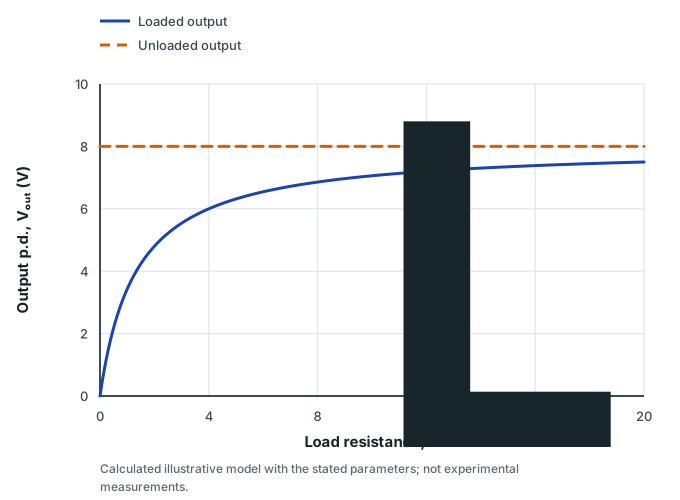
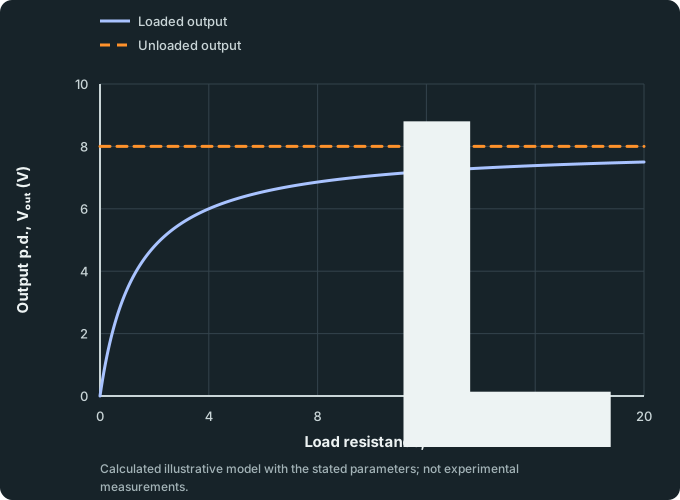
The larger the load resistance, the less current it draws and the less it lowers the output. The graph shows the divider in the worked example with loads of different resistance: as RL becomes very large, the output approaches the unloaded 8.00 V. A load whose resistance is much larger than the divider’s resistors hardly changes the output; a small one pulls it towards zero.
Divider output and load resistance
Loaded output increases from zero as load resistance increases and approaches the horizontal unloaded value of 8 V from below.
Scroll across the figure to read all labels.
View figure data
| Load resistance, RL (kΩ) | Loaded output | Unloaded output |
|---|---|---|
| 0.00 | 0.0000 | 8 |
| 0.05 | 0.2892 | 8 |
| 0.10 | 0.5581 | 8 |
| 0.15 | 0.8090 | 8 |
| 0.20 | 1.0435 | 8 |
| 0.25 | 1.2632 | 8 |
| 0.30 | 1.4694 | 8 |
| 0.35 | 1.6634 | 8 |
| 0.40 | 1.8462 | 8 |
| 0.45 | 2.0187 | 8 |
| 0.50 | 2.1818 | 8 |
| 0.55 | 2.3363 | 8 |
| 0.60 | 2.4828 | 8 |
| 0.65 | 2.6218 | 8 |
| 0.70 | 2.7541 | 8 |
| 0.75 | 2.8800 | 8 |
| 0.80 | 3.0000 | 8 |
| 0.85 | 3.1145 | 8 |
| 0.90 | 3.2239 | 8 |
| 0.95 | 3.3285 | 8 |
| 1.00 | 3.4286 | 8 |
| 1.05 | 3.5245 | 8 |
| 1.10 | 3.6164 | 8 |
| 1.15 | 3.7047 | 8 |
| 1.20 | 3.7895 | 8 |
| 1.25 | 3.8710 | 8 |
| 1.30 | 3.9494 | 8 |
| 1.35 | 4.0248 | 8 |
| 1.40 | 4.0976 | 8 |
| 1.45 | 4.1677 | 8 |
| 1.50 | 4.2353 | 8 |
| 1.55 | 4.3006 | 8 |
| 1.60 | 4.3636 | 8 |
| 1.65 | 4.4246 | 8 |
| 1.70 | 4.4835 | 8 |
| 1.75 | 4.5405 | 8 |
| 1.80 | 4.5957 | 8 |
| 1.85 | 4.6492 | 8 |
| 1.90 | 4.7010 | 8 |
| 1.95 | 4.7513 | 8 |
| 2.00 | 4.8000 | 8 |
| 2.05 | 4.8473 | 8 |
| 2.10 | 4.8932 | 8 |
| 2.15 | 4.9378 | 8 |
| 2.20 | 4.9811 | 8 |
| 2.25 | 5.0233 | 8 |
| 2.30 | 5.0642 | 8 |
| 2.35 | 5.1041 | 8 |
| 2.40 | 5.1429 | 8 |
| 2.45 | 5.1806 | 8 |
| 2.50 | 5.2174 | 8 |
| 2.55 | 5.2532 | 8 |
| 2.60 | 5.2881 | 8 |
| 2.65 | 5.3222 | 8 |
| 2.70 | 5.3554 | 8 |
| 2.75 | 5.3878 | 8 |
| 2.80 | 5.4194 | 8 |
| 2.85 | 5.4502 | 8 |
| 2.90 | 5.4803 | 8 |
| 2.95 | 5.5097 | 8 |
| 3.00 | 5.5385 | 8 |
| 3.05 | 5.5665 | 8 |
| 3.10 | 5.5940 | 8 |
| 3.15 | 5.6208 | 8 |
| 3.20 | 5.6471 | 8 |
| 3.25 | 5.6727 | 8 |
| 3.30 | 5.6978 | 8 |
| 3.35 | 5.7224 | 8 |
| 3.40 | 5.7465 | 8 |
| 3.45 | 5.7700 | 8 |
| 3.50 | 5.7931 | 8 |
| 3.55 | 5.8157 | 8 |
| 3.60 | 5.8378 | 8 |
| 3.65 | 5.8595 | 8 |
| 3.70 | 5.8808 | 8 |
| 3.75 | 5.9016 | 8 |
| 3.80 | 5.9221 | 8 |
| 3.85 | 5.9421 | 8 |
| 3.90 | 5.9618 | 8 |
| 3.95 | 5.9811 | 8 |
| 4.00 | 6.0000 | 8 |
| 4.05 | 6.0186 | 8 |
| 4.10 | 6.0368 | 8 |
| 4.15 | 6.0547 | 8 |
| 4.20 | 6.0723 | 8 |
| 4.25 | 6.0896 | 8 |
| 4.30 | 6.1065 | 8 |
| 4.35 | 6.1232 | 8 |
| 4.40 | 6.1395 | 8 |
| 4.45 | 6.1556 | 8 |
| 4.50 | 6.1714 | 8 |
| 4.55 | 6.1870 | 8 |
| 4.60 | 6.2022 | 8 |
| 4.65 | 6.2173 | 8 |
| 4.70 | 6.2320 | 8 |
| 4.75 | 6.2466 | 8 |
| 4.80 | 6.2609 | 8 |
| 4.85 | 6.2749 | 8 |
| 4.90 | 6.2888 | 8 |
| 4.95 | 6.3024 | 8 |
| 5.00 | 6.3158 | 8 |
| 5.05 | 6.3290 | 8 |
| 5.10 | 6.3420 | 8 |
| 5.15 | 6.3548 | 8 |
| 5.20 | 6.3673 | 8 |
| 5.25 | 6.3797 | 8 |
| 5.30 | 6.3920 | 8 |
| 5.35 | 6.4040 | 8 |
| 5.40 | 6.4158 | 8 |
| 5.45 | 6.4275 | 8 |
| 5.50 | 6.4390 | 8 |
| 5.55 | 6.4504 | 8 |
| 5.60 | 6.4615 | 8 |
| 5.65 | 6.4726 | 8 |
| 5.70 | 6.4834 | 8 |
| 5.75 | 6.4941 | 8 |
| 5.80 | 6.5047 | 8 |
| 5.85 | 6.5151 | 8 |
| 5.90 | 6.5253 | 8 |
| 5.95 | 6.5355 | 8 |
| 6.00 | 6.5455 | 8 |
| 6.05 | 6.5553 | 8 |
| 6.10 | 6.5650 | 8 |
| 6.15 | 6.5746 | 8 |
| 6.20 | 6.5841 | 8 |
| 6.25 | 6.5934 | 8 |
| 6.30 | 6.6026 | 8 |
| 6.35 | 6.6117 | 8 |
| 6.40 | 6.6207 | 8 |
| 6.45 | 6.6296 | 8 |
| 6.50 | 6.6383 | 8 |
| 6.55 | 6.6469 | 8 |
| 6.60 | 6.6555 | 8 |
| 6.65 | 6.6639 | 8 |
| 6.70 | 6.6722 | 8 |
| 6.75 | 6.6804 | 8 |
| 6.80 | 6.6885 | 8 |
| 6.85 | 6.6965 | 8 |
| 6.90 | 6.7045 | 8 |
| 6.95 | 6.7123 | 8 |
| 7.00 | 6.7200 | 8 |
| 7.05 | 6.7276 | 8 |
| 7.10 | 6.7352 | 8 |
| 7.15 | 6.7426 | 8 |
| 7.20 | 6.7500 | 8 |
| 7.25 | 6.7573 | 8 |
| 7.30 | 6.7645 | 8 |
| 7.35 | 6.7716 | 8 |
| 7.40 | 6.7786 | 8 |
| 7.45 | 6.7856 | 8 |
| 7.50 | 6.7925 | 8 |
| 7.55 | 6.7992 | 8 |
| 7.60 | 6.8060 | 8 |
| 7.65 | 6.8126 | 8 |
| 7.70 | 6.8192 | 8 |
| 7.75 | 6.8257 | 8 |
| 7.80 | 6.8321 | 8 |
| 7.85 | 6.8385 | 8 |
| 7.90 | 6.8448 | 8 |
| 7.95 | 6.8510 | 8 |
| 8.00 | 6.8571 | 8 |
| 8.05 | 6.8632 | 8 |
| 8.10 | 6.8693 | 8 |
| 8.15 | 6.8752 | 8 |
| 8.20 | 6.8811 | 8 |
| 8.25 | 6.8870 | 8 |
| 8.30 | 6.8927 | 8 |
| 8.35 | 6.8985 | 8 |
| 8.40 | 6.9041 | 8 |
| 8.45 | 6.9097 | 8 |
| 8.50 | 6.9153 | 8 |
| 8.55 | 6.9207 | 8 |
| 8.60 | 6.9262 | 8 |
| 8.65 | 6.9316 | 8 |
| 8.70 | 6.9369 | 8 |
| 8.75 | 6.9421 | 8 |
| 8.80 | 6.9474 | 8 |
| 8.85 | 6.9525 | 8 |
| 8.90 | 6.9577 | 8 |
| 8.95 | 6.9627 | 8 |
| 9.00 | 6.9677 | 8 |
| 9.05 | 6.9727 | 8 |
| 9.10 | 6.9776 | 8 |
| 9.15 | 6.9825 | 8 |
| 9.20 | 6.9873 | 8 |
| 9.25 | 6.9921 | 8 |
| 9.30 | 6.9969 | 8 |
| 9.35 | 7.0016 | 8 |
| 9.40 | 7.0062 | 8 |
| 9.45 | 7.0108 | 8 |
| 9.50 | 7.0154 | 8 |
| 9.55 | 7.0199 | 8 |
| 9.60 | 7.0244 | 8 |
| 9.65 | 7.0288 | 8 |
| 9.70 | 7.0332 | 8 |
| 9.75 | 7.0376 | 8 |
| 9.80 | 7.0419 | 8 |
| 9.85 | 7.0462 | 8 |
| 9.90 | 7.0504 | 8 |
| 9.95 | 7.0547 | 8 |
| 10.00 | 7.0588 | 8 |
| 10.05 | 7.0630 | 8 |
| 10.10 | 7.0671 | 8 |
| 10.15 | 7.0711 | 8 |
| 10.20 | 7.0751 | 8 |
| 10.25 | 7.0791 | 8 |
| 10.30 | 7.0831 | 8 |
| 10.35 | 7.0870 | 8 |
| 10.40 | 7.0909 | 8 |
| 10.45 | 7.0948 | 8 |
| 10.50 | 7.0986 | 8 |
| 10.55 | 7.1024 | 8 |
| 10.60 | 7.1061 | 8 |
| 10.65 | 7.1099 | 8 |
| 10.70 | 7.1136 | 8 |
| 10.75 | 7.1172 | 8 |
| 10.80 | 7.1209 | 8 |
| 10.85 | 7.1245 | 8 |
| 10.90 | 7.1281 | 8 |
| 10.95 | 7.1316 | 8 |
| 11.00 | 7.1351 | 8 |
| 11.05 | 7.1386 | 8 |
| 11.10 | 7.1421 | 8 |
| 11.15 | 7.1455 | 8 |
| 11.20 | 7.1489 | 8 |
| 11.25 | 7.1523 | 8 |
| 11.30 | 7.1557 | 8 |
| 11.35 | 7.1590 | 8 |
| 11.40 | 7.1623 | 8 |
| 11.45 | 7.1656 | 8 |
| 11.50 | 7.1688 | 8 |
| 11.55 | 7.1721 | 8 |
| 11.60 | 7.1753 | 8 |
| 11.65 | 7.1784 | 8 |
| 11.70 | 7.1816 | 8 |
| 11.75 | 7.1847 | 8 |
| 11.80 | 7.1878 | 8 |
| 11.85 | 7.1909 | 8 |
| 11.90 | 7.1940 | 8 |
| 11.95 | 7.1970 | 8 |
| 12.00 | 7.2000 | 8 |
| 12.05 | 7.2030 | 8 |
| 12.10 | 7.2060 | 8 |
| 12.15 | 7.2089 | 8 |
| 12.20 | 7.2118 | 8 |
| 12.25 | 7.2147 | 8 |
| 12.30 | 7.2176 | 8 |
| 12.35 | 7.2205 | 8 |
| 12.40 | 7.2233 | 8 |
| 12.45 | 7.2261 | 8 |
| 12.50 | 7.2289 | 8 |
| 12.55 | 7.2317 | 8 |
| 12.60 | 7.2344 | 8 |
| 12.65 | 7.2372 | 8 |
| 12.70 | 7.2399 | 8 |
| 12.75 | 7.2426 | 8 |
| 12.80 | 7.2453 | 8 |
| 12.85 | 7.2479 | 8 |
| 12.90 | 7.2506 | 8 |
| 12.95 | 7.2532 | 8 |
| 13.00 | 7.2558 | 8 |
| 13.05 | 7.2584 | 8 |
| 13.10 | 7.2610 | 8 |
| 13.15 | 7.2635 | 8 |
| 13.20 | 7.2661 | 8 |
| 13.25 | 7.2686 | 8 |
| 13.30 | 7.2711 | 8 |
| 13.35 | 7.2736 | 8 |
| 13.40 | 7.2760 | 8 |
| 13.45 | 7.2785 | 8 |
| 13.50 | 7.2809 | 8 |
| 13.55 | 7.2833 | 8 |
| 13.60 | 7.2857 | 8 |
| 13.65 | 7.2881 | 8 |
| 13.70 | 7.2905 | 8 |
| 13.75 | 7.2928 | 8 |
| 13.80 | 7.2952 | 8 |
| 13.85 | 7.2975 | 8 |
| 13.90 | 7.2998 | 8 |
| 13.95 | 7.3021 | 8 |
| 14.00 | 7.3043 | 8 |
| 14.05 | 7.3066 | 8 |
| 14.10 | 7.3089 | 8 |
| 14.15 | 7.3111 | 8 |
| 14.20 | 7.3133 | 8 |
| 14.25 | 7.3155 | 8 |
| 14.30 | 7.3177 | 8 |
| 14.35 | 7.3199 | 8 |
| 14.40 | 7.3220 | 8 |
| 14.45 | 7.3242 | 8 |
| 14.50 | 7.3263 | 8 |
| 14.55 | 7.3284 | 8 |
| 14.60 | 7.3305 | 8 |
| 14.65 | 7.3326 | 8 |
| 14.70 | 7.3347 | 8 |
| 14.75 | 7.3368 | 8 |
| 14.80 | 7.3388 | 8 |
| 14.85 | 7.3409 | 8 |
| 14.90 | 7.3429 | 8 |
| 14.95 | 7.3449 | 8 |
| 15.00 | 7.3469 | 8 |
| 15.05 | 7.3489 | 8 |
| 15.10 | 7.3509 | 8 |
| 15.15 | 7.3529 | 8 |
| 15.20 | 7.3548 | 8 |
| 15.25 | 7.3568 | 8 |
| 15.30 | 7.3587 | 8 |
| 15.35 | 7.3606 | 8 |
| 15.40 | 7.3625 | 8 |
| 15.45 | 7.3644 | 8 |
| 15.50 | 7.3663 | 8 |
| 15.55 | 7.3682 | 8 |
| 15.60 | 7.3701 | 8 |
| 15.65 | 7.3719 | 8 |
| 15.70 | 7.3738 | 8 |
| 15.75 | 7.3756 | 8 |
| 15.80 | 7.3774 | 8 |
| 15.85 | 7.3792 | 8 |
| 15.90 | 7.3810 | 8 |
| 15.95 | 7.3828 | 8 |
| 16.00 | 7.3846 | 8 |
| 16.05 | 7.3864 | 8 |
| 16.10 | 7.3881 | 8 |
| 16.15 | 7.3899 | 8 |
| 16.20 | 7.3916 | 8 |
| 16.25 | 7.3934 | 8 |
| 16.30 | 7.3951 | 8 |
| 16.35 | 7.3968 | 8 |
| 16.40 | 7.3985 | 8 |
| 16.45 | 7.4002 | 8 |
| 16.50 | 7.4019 | 8 |
| 16.55 | 7.4035 | 8 |
| 16.60 | 7.4052 | 8 |
| 16.65 | 7.4069 | 8 |
| 16.70 | 7.4085 | 8 |
| 16.75 | 7.4101 | 8 |
| 16.80 | 7.4118 | 8 |
| 16.85 | 7.4134 | 8 |
| 16.90 | 7.4150 | 8 |
| 16.95 | 7.4166 | 8 |
| 17.00 | 7.4182 | 8 |
| 17.05 | 7.4198 | 8 |
| 17.10 | 7.4213 | 8 |
| 17.15 | 7.4229 | 8 |
| 17.20 | 7.4245 | 8 |
| 17.25 | 7.4260 | 8 |
| 17.30 | 7.4275 | 8 |
| 17.35 | 7.4291 | 8 |
| 17.40 | 7.4306 | 8 |
| 17.45 | 7.4321 | 8 |
| 17.50 | 7.4336 | 8 |
| 17.55 | 7.4351 | 8 |
| 17.60 | 7.4366 | 8 |
| 17.65 | 7.4381 | 8 |
| 17.70 | 7.4396 | 8 |
| 17.75 | 7.4410 | 8 |
| 17.80 | 7.4425 | 8 |
| 17.85 | 7.4440 | 8 |
| 17.90 | 7.4454 | 8 |
| 17.95 | 7.4468 | 8 |
| 18.00 | 7.4483 | 8 |
| 18.05 | 7.4497 | 8 |
| 18.10 | 7.4511 | 8 |
| 18.15 | 7.4525 | 8 |
| 18.20 | 7.4539 | 8 |
| 18.25 | 7.4553 | 8 |
| 18.30 | 7.4567 | 8 |
| 18.35 | 7.4581 | 8 |
| 18.40 | 7.4595 | 8 |
| 18.45 | 7.4608 | 8 |
| 18.50 | 7.4622 | 8 |
| 18.55 | 7.4635 | 8 |
| 18.60 | 7.4649 | 8 |
| 18.65 | 7.4662 | 8 |
| 18.70 | 7.4676 | 8 |
| 18.75 | 7.4689 | 8 |
| 18.80 | 7.4702 | 8 |
| 18.85 | 7.4715 | 8 |
| 18.90 | 7.4728 | 8 |
| 18.95 | 7.4741 | 8 |
| 19.00 | 7.4754 | 8 |
| 19.05 | 7.4767 | 8 |
| 19.10 | 7.4780 | 8 |
| 19.15 | 7.4793 | 8 |
| 19.20 | 7.4805 | 8 |
| 19.25 | 7.4818 | 8 |
| 19.30 | 7.4830 | 8 |
| 19.35 | 7.4843 | 8 |
| 19.40 | 7.4855 | 8 |
| 19.45 | 7.4868 | 8 |
| 19.50 | 7.4880 | 8 |
| 19.55 | 7.4892 | 8 |
| 19.60 | 7.4904 | 8 |
| 19.65 | 7.4917 | 8 |
| 19.70 | 7.4929 | 8 |
| 19.75 | 7.4941 | 8 |
| 19.80 | 7.4953 | 8 |
| 19.85 | 7.4965 | 8 |
| 19.90 | 7.4976 | 8 |
| 19.95 | 7.4988 | 8 |
| 20.00 | 7.5000 | 8 |
A voltmeter is a load too. An ideal voltmeter has infinite resistance and draws no current, but a real one with a resistance similar to the divider’s resistors reads less than the unloaded output.
Check your understanding 1 Lower output, lower currents?
When a load is connected, the output voltage falls. Does the current from the supply fall too?
Show answer
No, it rises. The extra parallel branch lowers the total resistance of the circuit, so more current flows from the supply. The output falls because the lower part of the divider now has a smaller resistance and takes a smaller share of the supply p.d.
Guided practice 2
A voltmeter loading a divider
Problem
A potential divider across 9.0 V is made of two 10 kΩ resistors. A voltmeter of resistance 10 kΩ is connected across the lower resistor. Find the output before the meter is connected, the equivalent resistance of the lower arm and meter, and the reading after connection.
Find both values
Show the steps Optional working
Hints
Hint 1
the meter is a resistor
Which components share the same two connection points?
Show full solution
Both values
Working
Answer
Without the voltmeter: 4.5 V. With it: 9.0 × 5.0/(10 + 5.0) = 3.0 V. The meter reads a third less than the p.d. it was meant to measure.
Try it yourself 3
Choosing a voltmeter
Problem
You need to measure the output of a potential divider made of two 10 kΩ resistors as accurately as possible. Which voltmeter should you use?
Choose a voltmeter
Hints
Hint 1
parallel combination
Find the parallel combination of each meter with the 10 kΩ lower resistor. Which leaves it almost unchanged?
Show solution step by step
Compare the meters
Reason
The meter is in parallel with the lower resistor.Working
Answer
10 MΩ in parallel with 10 kΩ is still almost exactly 10 kΩ; the others lower it to 0.91 kΩ and 5 kΩ.
Choice
Working
Answer
The 10 MΩ voltmeter: its resistance is far larger than the divider’s resistors, so it barely loads the divider.
Check your understanding 2 Design for a minimum output
A 12.0 V supply feeds R₁ = 2.00 kΩ and R₂ = 4.00 kΩ. A load is connected across R₂. Find the minimum load resistance that keeps the output at or above 6.00 V. Decide whether larger or smaller loads satisfy the requirement.
Show the steps Optional working
Show answer
At Vₒᵤₜ = 6.00 V, the lower equivalent is Rₚ = 2.00 kΩ. In kΩ units, 1/2.00 = 1/4.00 + 1/RL, so RL = 4.00 kΩ. Increasing RL increases Rₚ and the output, so all larger values satisfy the requirement.
Exam-style question 1
A device across the lower resistor
Examination question
A potential divider across a 10.0 V supply has a 3.00 kΩ upper resistor and a 6.00 kΩ lower resistor. A device of resistance 3.00 kΩ is connected across the lower resistor.
(a) Calculate the p.d. across the device. [3 marks]
(b) Calculate the current from the supply and the current in the device. [2 marks]
Write your answer before viewing the mark scheme
Show solution step by step
(a) P.d.
3 marksMethod
Combine the lower resistor and the device, then use the divider rule.Reason
They are in parallel, and the combination is in series with the upper resistor.Working
Answer
Rₚ = (6.00)(3.00)/9.00 = 2.00 kΩ, so V = 10.0 × 2.00/(3.00 + 2.00) = 4.00 V
(b) Currents
2 marksWorking
Answer
Supply: 10.0/(5.00 kΩ) = 2.00 mA. Device: 4.00/(3.00 kΩ) = 1.33 mA
Self-mark with the mark scheme
Tick each mark point that your answer includes.
Tick each point only if your answer states it clearly.
Common mistakes
- Using the unloaded divider equation after a load has been connected.
- Giving the upper resistor, the lower resistor and the load all the same current.
- Thinking a load lowers every current in the circuit; the supply current rises.
- Treating a real voltmeter as if it drew no current.
Spotted an error? Report a correction
Syllabus and review details
- GCE A-Level H2 Physics 2027 · 2027
Content Overview, PDF pages 9–10; Subject Content, PDF pages 11–30
Last reviewed: