RC Circuits (Charging & Discharging)
Key idea: Use τ = RC and exponential equations to describe and calculate how charge, current and capacitor voltage change in RC charging/discharging circuits (A Level Physics).
Continue where you stopped
The core idea
On this page
Learning objectives
- Analyse charging and discharging in RC circuits using the time constant.
1. Definitions (Must Know)
A. RC circuit
An RC circuit is a circuit containing a resistor R and a capacitor C.
B. Time constant, τ
The time constant, τ, is:
τ = RC
Unit: s.
C. Capacitor voltage, V_C
V_C is the potential difference across the capacitor.
D. Final (steady) value
The final value is the limiting value as t → ∞. In the ideal exponential model, the capacitor approaches this value but does not reach it exactly in finite time.
2. Key Ideas (What Earns Marks)
The syllabus expects you to use equations of the form:
- decay: x = x₀ e^(-t/τ)
- growth: x = x₀[1-e^(-t/τ)]
For a capacitor charging from 0 through a resistor R from a d.c. source of e.m.f. ε:
- V_C(t) = ε[1-e^(-t/RC)]
- Q(t) = Cε[1-e^(-t/RC)]
- I(t) = (ε/R)e^(-t/RC)
For a capacitor discharging through a resistor R from initial capacitor voltage V₀:
- V_C(t) = V₀ e^(-t/RC)
- Q(t) = CV₀ e^(-t/RC)
- |I(t)| = (V₀/R)e^(-t/RC)
Key time-constant facts:
- at t = τ: charging reaches 0.63 of final; discharging falls to 0.37 of initial
- by t ≈ 5τ: the change is essentially complete (about 99%)
At t = τ, charging reaches 1-e⁻¹ = 0.63 of its final value and discharging falls to e⁻¹ = 0.37 of its initial value.
3. Detailed Explanations
A. Charging (what changes with time)
At t = 0 (uncharged capacitor):
- V_C = 0
- current is maximum: I₀ = ε/R
As time increases:
- Q and V_C increase towards their final values (Q_f = Cε, V_C → ε)
- current decreases towards 0
RC charging and discharging (voltage vs time, scaled)
Scaled RC curves: charging rises as 1−e^(−t/τ) and discharging falls as e^(−t/τ).
Scroll across the graph to read all labels.
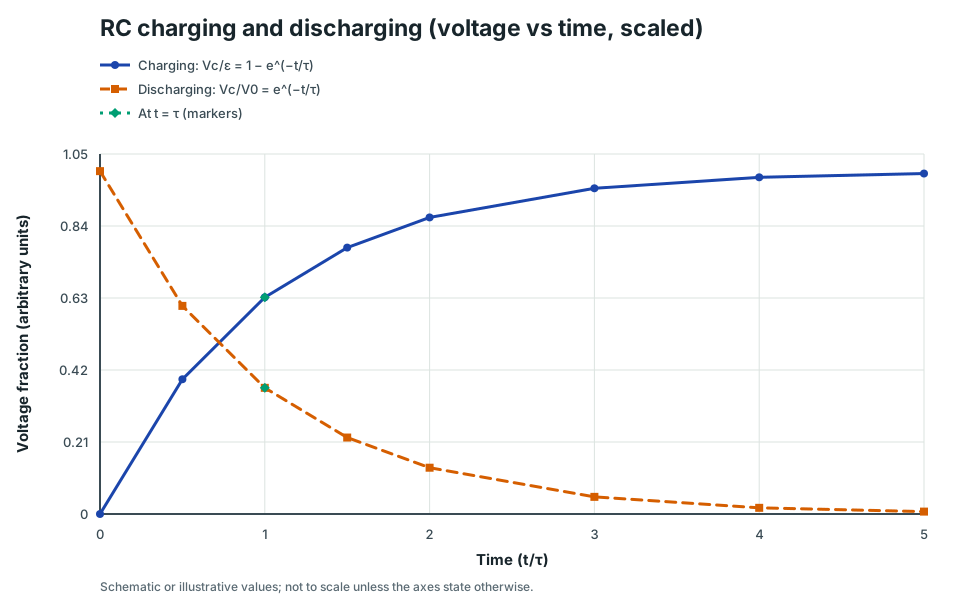
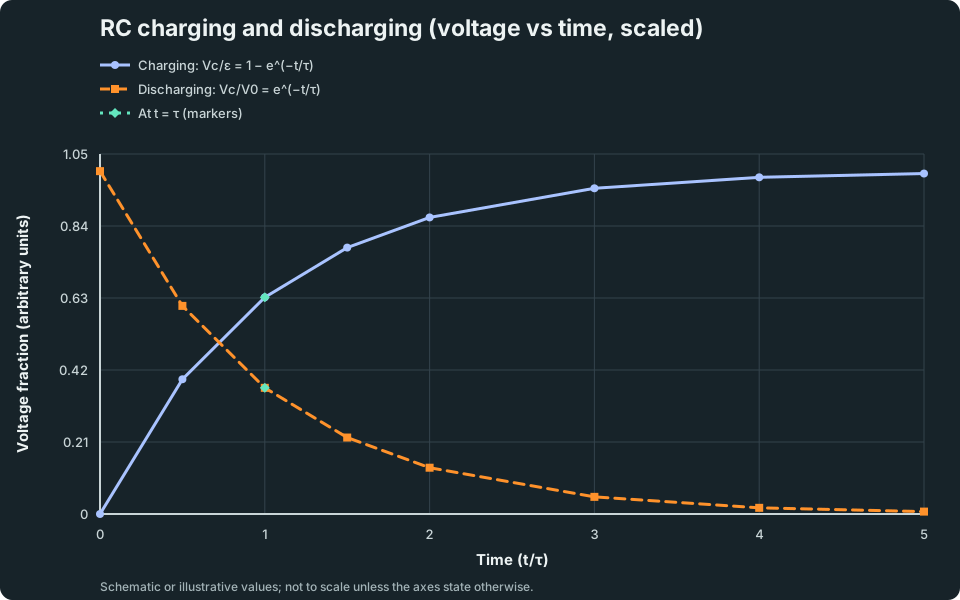
View figure data
| Series | Time (t/τ) | Time uncertainty | Voltage fraction (arbitrary units) | Voltage fraction uncertainty |
|---|---|---|---|---|
| Charging: Vc/ε = 1 − e^(−t/τ) | 0 | 0 | ||
| Charging: Vc/ε = 1 − e^(−t/τ) | 0.5 | 0.393 | ||
| Charging: Vc/ε = 1 − e^(−t/τ) | 1 | 0.632 | ||
| Charging: Vc/ε = 1 − e^(−t/τ) | 1.5 | 0.777 | ||
| Charging: Vc/ε = 1 − e^(−t/τ) | 2 | 0.865 | ||
| Charging: Vc/ε = 1 − e^(−t/τ) | 3 | 0.95 | ||
| Charging: Vc/ε = 1 − e^(−t/τ) | 4 | 0.982 | ||
| Charging: Vc/ε = 1 − e^(−t/τ) | 5 | 0.993 | ||
| Discharging: Vc/V0 = e^(−t/τ) | 0 | 1 | ||
| Discharging: Vc/V0 = e^(−t/τ) | 0.5 | 0.607 | ||
| Discharging: Vc/V0 = e^(−t/τ) | 1 | 0.368 | ||
| Discharging: Vc/V0 = e^(−t/τ) | 1.5 | 0.223 | ||
| Discharging: Vc/V0 = e^(−t/τ) | 2 | 0.135 | ||
| Discharging: Vc/V0 = e^(−t/τ) | 3 | 0.05 | ||
| Discharging: Vc/V0 = e^(−t/τ) | 4 | 0.018 | ||
| Discharging: Vc/V0 = e^(−t/τ) | 5 | 0.007 | ||
| At t = τ (markers) | 1 | 0.632 | ||
| At t = τ (markers) | 1 | 0.368 |
B. Discharging (what changes with time)
At t = 0 (initially charged):
- V_C = V₀
- current magnitude is maximum: |I₀| = V₀/R
As time increases:
- Q, V_C, and |I| all decrease exponentially towards 0
C. Why the graphs are exponential (qualitative)
As the capacitor charges, V_C increases, so the resistor voltage V_R = ε-V_C decreases. Since I = V_R/R, the current decreases with time, so the charging rate slows down.
For discharging, V_C decreases with time, so the current magnitude decreases with time.
Log-graph skill: straight line for discharge
From V_C = V₀ e^(-t/τ), take natural logs: ln(V_C/V₀) = -t/τ
So a plot of ln(V_C/V₀) against t is a straight line with gradient -1/τ.
Linearising RC discharge: ln(V/V0) vs time (scaled)
A straight-line plot of ln(V/V0) against t/τ with gradient −1.
Scroll across the graph to read all labels.
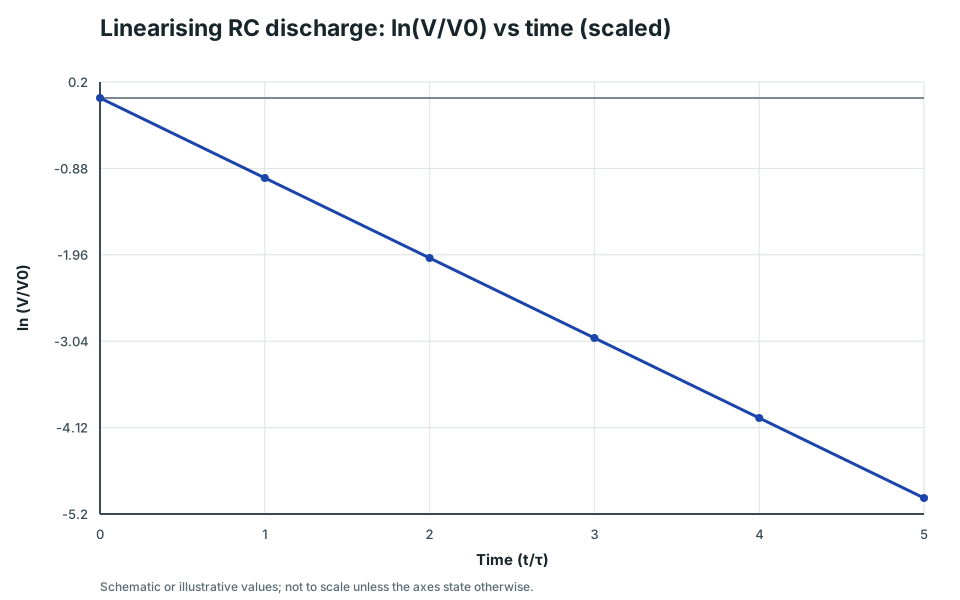
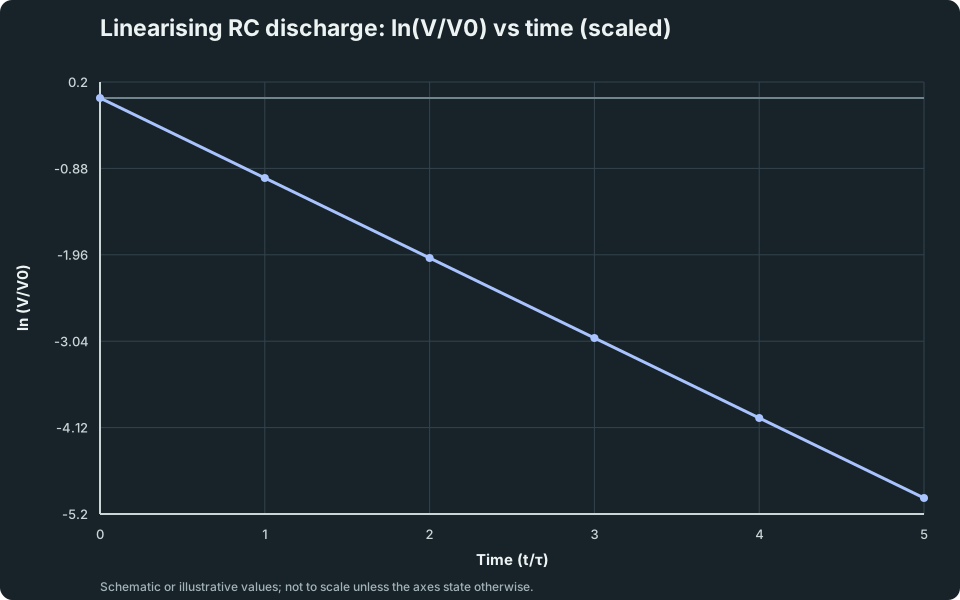
View figure data
| Time (t/τ) | ln(V/V0) = −t/τ |
|---|---|
| 0 | 0 |
| 1 | -1 |
| 2 | -2 |
| 3 | -3 |
| 4 | -4 |
| 5 | -5 |
4. Common Mistakes
- Using τ = R/C instead of τ = RC.
- Using t/τ without checking t is in seconds.
- Using the “growth” equation for discharging (or vice versa).
- Forgetting that current direction may be opposite to your chosen sign convention (use magnitudes if unsure).
5. Exam Tips
- Rearrangement you will use a lot:
- e^(-t/τ) = x/x₀ ⇒ t = τ ln(x₀/x)
- Charging to a target voltage V_T:
- V_T = ε[1-e^(-t/τ)]
- t = -τ ln(1-V_T/ε)
- Quote τ explicitly before substituting numbers.
6. Worked Examples
Modelled example 1
Find the time constant
Problem
Study the worked solution
Convert to SI units
Method
Express resistance in ohms and capacitance in farads.Reason
The product Ω F is seconds when SI prefixes are included correctly.Working
R = 1.00 × 10⁵ Ω and C = 1.0 × 10⁻⁵ F.Calculate the time constant
Method
Use τ = RC.Reason
The circuit’s exponential time scale is the resistance–capacitance product.Working
τ = (1.00 × 10⁵)(1.0 × 10⁻⁵) = 1.0 s
Guided practice 2
Charging to a given capacitor voltage
Problem
Try this before viewing the solution
Hints
Hint 1: choose rise rather than decay
Hint 2: use elapsed time constants
View solution step by step
Substitute into the charging equation
Method
Use the exponential rise from zero.Reason
The final capacitor p.d. is the supply e.m.f.Working
V_C = 12[1-e^(-2.0/1.0)]Evaluate
Method
Obtain approximately 10.4 V.Reason
e⁻² = 0.135, leaving 86.5% of the rise completed.Working
V_C = 12(1-0.135) = 10.4 V
Common misconception 3
Discharging to a given voltage
Learner claim
Try this before viewing the solution
View solution step by step
Start from exponential decay
Method
Use V_C/V₀ = e^(-t/τ).Reason
The remaining fraction decreases from one.Working
3.0/9.0 = e^(-t/0.50)Handle the negative exponent
Method
Use t = τ ln(V₀/V_C).Reason
Multiplying the logarithm by -τ reverses the ratio.Working
t = 0.50 ln(9.0/3.0) = 0.50 ln 3 = 0.55 s
Examiner practice 4
Current during discharge
Examination question
Try this before viewing the solution
View solution step by step
Find the time constant
1 markMethod
Multiply resistance and capacitance.Reason
τ = RC sets the decay scale.Working
τ = (2.0 × 10³)(220 × 10⁻⁶) = 0.44 sFind initial current
1 markMethod
Use the initial capacitor p.d. across R.Reason
At t = 0, its magnitude is V₀/R.Working
|I₀| = 12/2000 = 6.0 mAApply one-time-constant decay
1 markMethod
Multiply by e⁻¹.Reason
Discharge current magnitude follows the same exponential.Working
|I(τ)| = e⁻¹(6.0) = 2.2 mAState the direction convention
1 markMethod
Distinguish magnitude from signed current.Reason
The algebraic sign depends on the chosen reference direction.Working
Magnitude 2.2 mA; direction is the discharge direction.
Self-mark with the mark scheme
Compare your response with each mark point. Select a point only when your response contains that evidence.
Self-mark time constant, initial current, decayed current and direction statement.
Challenge 5
Time to reach 90% of final voltage (charging)
Independent transfer
Try this before viewing the solution
Hints
Hint 1: isolate the remaining gap
View solution step by step
Find the remaining fraction
Method
Subtract the completed rise from one.Reason
At 9.0 V, 10% of the final gap remains.Working
e^(-t/τ) = 1-9.0/10 = 0.10Solve for time
Method
Take the natural logarithm.Reason
t/τ = - ln(0.10) = ln 10.Working
t = 0.80 ln 10 = 1.84 sState the time-constant multiple
Method
Give t = 2.30τ.Reason
ln 10 = 2.303.Working
t/τ = 2.30.
7. Mind Stretchers
Mind stretcher 1: Time for a capacitor to charge from 10% to 90%Extension
Show that the time taken to go from 0.10ε to 0.90ε is t = τ ln 9.
Show Answer
Charging: V_C = ε[1-e^(-t/τ)].
At V_C = 0.10ε: 0.10 = 1-e^(-t₁/τ) ⇒ e^(-t₁/τ) = 0.90
At V_C = 0.90ε: 0.90 = 1-e^(-t₂/τ) ⇒ e^(-t₂/τ) = 0.10
Divide the two exponential factors:
e^((t₂-t₁)/τ) = 0.90/0.10 = 9
Therefore t₂-t₁ = τ ln 9.
Mind stretcher 2: Why is “about 5τ” considered complete?Extension
Explain why people often say an RC charging/discharging process is “essentially complete” after about 5τ.
Show Answer
For exponential decay, at t = 5τ: e^(-t/τ) = e⁻⁵ = 0.0067 So only about 0.67% of the initial value remains (or, for charging, it is within about 0.67% of the final value). That is “close enough” for many practical and exam purposes.
Mind stretcher 3: Optional (Enrichment)Extension
A. Where the exponential comes from (differential equation)
Charging:
ε = IR + V_C
With I = dQ/dt and V_C = Q/C:
ε = RdQ/dt + Q/C
This has the solution:
Q(t) = Cε[1-e^(-t/RC)]
Discharging:
0 = IR + V_C = RdQ/dt + Q/C
This has the solution:
Q(t) = Q₀ e^(-t/RC)
Continue with the next resource in this course.
Course and syllabus information
- Course
- GCE A-Level H2 Physics
- Edition
- GCE A-Level H2 Physics 2027