Capacitors In Series And Parallel
Key idea: Find the combined capacitance of capacitors in series and parallel, and solve charge/voltage distribution problems (A Level Physics).
Continue where you stopped
The core idea
On this page
Learning objectives
- Combine capacitors in series and parallel.
1. Definitions (Must Know)
A. Capacitance, C
Capacitance, C, is charge stored per unit potential difference:
C = Q/V
Unit: farad (F) = C V⁻¹.
B. Equivalent (combined) capacitance, C_eq
C_eq is the capacitance of a single capacitor that can replace a capacitor network between two terminals.
C. Parallel capacitors
Capacitors are in parallel if they are connected across the same two nodes. They have the same potential difference.
D. Series capacitors
Capacitors are in series if they are connected end-to-end and the junction between them has no other connections.
In series, the magnitude of charge on each capacitor is the same.
2. Key Ideas (What Earns Marks)
- Parallel:
- same V across each capacitor
- charges add: Qₜₒₜₐₗ = Q₁ + Q₂ + …
- C_eq = C₁ + C₂ + …
- Series:
- same charge magnitude on each capacitor: Q₁ = Q₂ = … = Q
- voltages add: Vₜₒₜₐₗ = V₁ + V₂ + …
- 1/C_eq = 1/C₁ + 1/C₂ + …
- Quick checks:
- series: C_eq is smaller than the smallest capacitor
- parallel: C_eq is larger than the largest capacitor
Series capacitors: use the “reciprocal sum”. Parallel capacitors: direct sum.
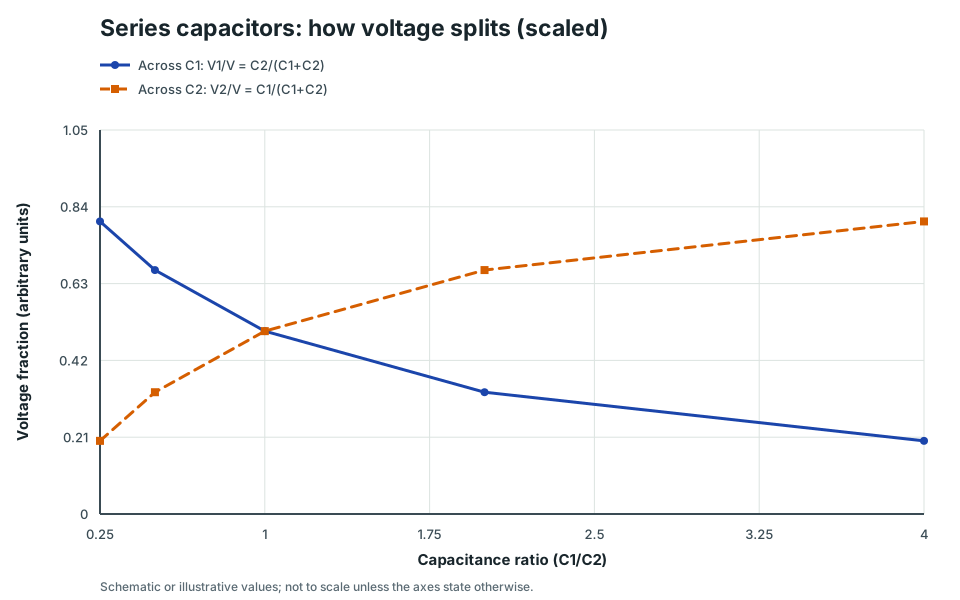
Series capacitors: how voltage splits (scaled)
Two curves showing the fraction of total voltage across each capacitor in a two-capacitor series pair as the capacitance ratio changes.
Scroll across the graph to read all labels.
View figure data
| Capacitance ratio (C1/C2) | Across C1: V1/V = C2/(C1+C2) | Across C2: V2/V = C1/(C1+C2) |
|---|---|---|
| 0.25 | 0.8 | 0.2 |
| 0.5 | 0.667 | 0.333 |
| 1 | 0.5 | 0.5 |
| 2 | 0.333 | 0.667 |
| 4 | 0.2 | 0.8 |
3. Detailed Explanations
A. Derivation (parallel)
In parallel, the potential difference is the same: V₁ = V₂ = … = V
Using Q = CV: Qₜₒₜₐₗ = Q₁ + Q₂ + …
Since Qᵢ = CᵢV,
Qₜₒₜₐₗ = (C₁ + C₂ + …)V
So: Qₜₒₜₐₗ = (C₁ + C₂ + …)V
Hence C_eq = Qₜₒₜₐₗ/V = C₁ + C₂ + ….
B. Derivation (series)
In series, charge cannot accumulate at the isolated junction. The same charge magnitude appears on each capacitor: Q₁ = Q₂ = … = Q
Voltages add: Vₜₒₜₐₗ = V₁ + V₂ + …
Using V = Q/C: Vₜₒₜₐₗ = Q/C₁ + Q/C₂ + …
Vₜₒₜₐₗ = Q(1/C₁ + 1/C₂ + …)
But Vₜₒₜₐₗ = Q/C_eq, so: 1/C_eq = 1/C₁ + 1/C₂ + …
C. Workflow for mixed networks
- Identify any capacitors that share the same two nodes (parallel).
- Identify any capacitors that are end-to-end with an isolated junction (series).
- Reduce step-by-step until one C_eq remains.
- If the network is connected to a supply, use Q = C_eqV to find the total charge, then work back to find charges/voltages on individual capacitors.
4. Common Mistakes
- Treating capacitors like resistors (series/parallel rules are reversed).
- Forgetting to convert μF or nF into F before calculations.
- Saying “series” when the junction has a third connection (then it is not series).
- For series capacitors: assuming the voltage is the same (it is not).
- For parallel capacitors: assuming the charge is the same (it is not).
5. Exam Tips
- For series, start with “Q is the same”, then use V = Q/C.
- For parallel, start with “V is the same”, then use Q = CV.
- If one capacitor in series has a much smaller C, it gets a much larger share of the total voltage.
6. Worked Examples
Modelled example 1
Two capacitors in series
Problem
Study the worked solution
Use the series rule
Method
Add reciprocal capacitances.Reason
Series capacitors carry equal charge while their p.d.s add.Working
1/C_eq = 1/4.0 + 1/6.0 = 5/12 μF⁻¹Invert the result
Method
Obtain 2.4 μF.Reason
The sum calculated is the reciprocal of equivalent capacitance.Working
C_eq = 12/5 = 2.4 μF
Guided practice 2
Voltages across series capacitors
Problem
Try this before viewing the solution
Hints
Hint 1: start with the network
Hint 2: split voltage by capacitance
View solution step by step
Find the shared charge
Method
Use the equivalent capacitance with total p.d.Reason
Each series capacitor acquires the same charge magnitude.Working
Q = (2.4 μF)(12 V) = 28.8 μCFind both p.d.s
Method
Divide the shared charge by each capacitance.Reason
V = Q/C.Working
V₁ = 28.8/4.0 = 7.2 V, V₂ = 28.8/6.0 = 4.8 V
Common misconception 3
Two capacitors in parallel
Learner claim
Try this before viewing the solution
View solution step by step
Find equivalent capacitance
Method
Add parallel capacitances.Reason
Charges add at a common p.d.Working
C_eq = 2.0 + 3.0 = 5.0 μFUse the shared p.d.
Method
Apply Qᵢ = CᵢV separately.Reason
Both capacitors have 12 V, but their capacitances differ.Working
Q₁ = 24 μC and Q₂ = 36 μC.Check total charge
Method
Add the branch charges.Reason
Parallel charge contributions combine.Working
Qₜₒₜₐₗ = 60 μC = (5.0 μF)(12 V).
Examiner practice 4
Three capacitors in series
Examination question
Try this before viewing the solution
View solution step by step
Write the series relation
1 markMethod
Add all three reciprocals.Reason
There is no two-component shortcut for three branches.Working
1/C_eq = 1/2.0 + 1/3.0 + 1/6.0Evaluate the reciprocal
1 markMethod
Obtain 1.0 μF⁻¹.Reason
3/6 + 2/6 + 1/6 = 1.Working
1/C_eq = 1.0 μF⁻¹.Invert and check
1 markMethod
State C_eq = 1.0 μF.Reason
It is smaller than the smallest series capacitor.Working
C_eq = 1.0 μF.
Self-mark with the mark scheme
Compare your response with each mark point. Select a point only when your response contains that evidence.
Self-mark reciprocal rule, evaluation and checked result.
Challenge 5
Voltage across a small capacitor in series
Independent transfer
Try this before viewing the solution
Hints
Hint 1: use the shared series charge
View solution step by step
Find equivalent capacitance
Method
Reduce the series pair.Reason
The source sees the series equivalent.Working
C_eq = (1.0)(9.0)/(1.0 + 9.0) = 0.90 μFFind the shared charge
Method
Use the total p.d.Reason
Both series capacitors carry this charge magnitude.Working
Q = (0.90 μF)(10 V) = 9.0 μCFind and interpret V₁
Method
Obtain 9.0 V across the smaller capacitor.Reason
At fixed series charge, V = Q/C, so smaller C receives larger p.d.Working
V₁ = (9.0 μC)/(1.0 μF) = 9.0 V
7. Mind Stretchers
Mind stretcher 1: Mixed series-parallelExtension
C₁ = 2.0 μF and C₂ = 4.0 μF are in parallel. This parallel combination is then in series with C₃ = 3.0 μF. Find C_eq of the whole network.
Show Answer
Parallel first: C₁₂ = C₁ + C₂ = 6.0 μF
Now series with C₃: 1/C_eq = 1/6.0 + 1/3.0; = 1/6 + 2/6 = 3/6 = 1/2; C_eq = 2.0 μF
Mind stretcher 2: Why does the smaller series capacitor get more voltage?Extension
Explain (using V = Q/C) why, in a series pair, the capacitor with smaller capacitance has a larger potential difference across it.
Show Answer
In series, the charge magnitude Q on each capacitor is the same.
Since V = Q/C, a smaller C gives a larger V for the same Q. So the smaller capacitor takes a larger share of the total voltage.
Mind stretcher 3: Optional (Enrichment)Extension
A. Energy stored in a combined network
Once you have C_eq for a network connected to a supply V, the total energy stored is:
U = (1/2)C_eqV²
To find energy in individual capacitors, you must first find each capacitor’s V (parallel) or Q (series), then use U = (1/2)CV².
Continue with the next resource in this course.
Course and syllabus information
- Course
- GCE A-Level H2 Physics
- Edition
- GCE A-Level H2 Physics 2027