Constant-acceleration equations
Key idea: Constant-acceleration equations link signed displacement, velocity and time. At the top of a vertical throw, velocity is zero but acceleration remains downward.
Offline pages
Saved on this device only. Connect at least once every 30 days to confirm Premium. Sign-out or a change of account removes saved copies.
Loading guide controls…
Guided lessons · coming soon
Guided lesson
Guided steps
- Predict velocity and acceleration at the top of the throw.
- Derive the equations for constant acceleration from the graph.
- Derive the equations on paper and compare your reasoning.
- Find average velocity and explain why the endpoint method fails.
- Choose the time-free equation and calculate stopping time.
- Find signed velocity and displacement, then compare speeds.
- Set downward positive and calculate landing time and speed.
- Follow the position graph through both passages.
- Form the displacement equation and find both positive times.
- Find turning time and explain both roots using signed velocities.
- Solve the downward launch and explain the discarded time root.
On this page
You stopped at:
ContinueWhen an object’s acceleration stays constant, five quantities describe its motion over a time interval, and four equations link them. This lesson derives the equations from the definitions of velocity and acceleration, shows how to pick the right one, and deals with the two cases that most often cause errors: a turning point, and two answers for the time.
Predict motion at a turning point
Check your understanding 1
A ball is thrown vertically upwards near Earth’s surface. Neglect air resistance and take upward as positive. At the highest point, what are its velocity and acceleration?
Show answer
At the top v = 0, but a = -9.81 m s⁻². Gravity continues to change the velocity, so the ball begins to move down.
The five quantities
Choose a positive direction. Then, over one interval of constant acceleration:
| Symbol | Meaning | SI unit |
|---|---|---|
| u | velocity at the start | m s⁻¹ |
| v | velocity at the end | m s⁻¹ |
| a | constant acceleration | m s⁻² |
| t | time taken | s |
| s | displacement | m |
u, v, a and s are vectors and carry signs. s is a displacement, not a distance travelled.
Deriving the equations
Acceleration is the rate of change of velocity. With constant acceleration,
The velocity–time graph is then a straight line from u to v. Displacement is the area under it, a trapezium, so the average velocity is halfway between u and v:
This still holds if the line crosses zero, because the trapezium formula counts area below the axis as negative. Substituting v = u + at gives
To remove t, multiply s = (1/2)(u + v)t by 2a and use at = v-u:
Squaring loses the sign of v. If you take a square root later, use the motion to decide the sign.
Check your understanding 2
Cover the derivation above. Starting from the definitions of velocity and acceleration, derive v = u + at, s = (1/2)(u + v)t, s = ut + (1/2)at² and v² = u² + 2as. State the condition on acceleration. Work on paper; you can record the key steps below without transcribing every line.
Show answer
For straight-line motion with constant acceleration, a = (v-u)/t, so v = u + at. Velocity varies linearly, making its average (u + v)/2. Signed velocity–time area then gives s = (u + v)t/2, even if velocity changes sign. Substituting v = u + at gives s = ut + at²/2. Finally 2as = (u + v)at = (u + v)(v-u) = v²-u². Compare your work for the constant acceleration condition, the signed-area argument, substitution and elimination of time; a formula list alone misses the derivation.
Check your understanding 3
A car stays at rest for 3.0 s, then accelerates uniformly to 12 m s⁻¹ in the next 1.0 s. A learner averages the initial and final velocities and obtains 6.0 m s⁻¹ for the whole interval. Find the actual average velocity in metres per second and choose the error in the endpoint method.
Show the steps Optional working
Show answer
The velocity–time area is (1/2)(1.0)(12) = 6.0 m, so the average velocity is 6.0/4.0 = 1.5 m s⁻¹. The velocity does not change uniformly over all four seconds: the three seconds at rest lower the average. Averaging the endpoint velocities works for a single straight velocity–time line.
Choosing an equation
Each equation leaves out one quantity. List what you know, with signs, and choose the equation that leaves out the quantity you neither know nor need.
| Equation | Leaves out |
|---|---|
| v = u + at | s |
| s = (1/2)(u + v)t | a |
| s = ut + (1/2)at² | v |
| v² = u² + 2as | t |
Worked example 1
A train braking to rest
Problem
A train moving at 25 m s⁻¹ brakes uniformly to rest in 200 m. Find its acceleration and the time it takes to stop.
Show full solution
List the known values
Method
Take the direction of motion as positive.Reason
Uniform braking means constant acceleration, so the equations apply.Working
Answer
u = +25 m s⁻¹, v = 0, s = +200 m; a and t unknown.
Find a without t
Reason
v² = u² + 2as leaves out the unknown time.Working
Answer
0 = 25² + 2a(200), so a = -1.5625 m s⁻², about -1.6 m s⁻².
Find t
Working
Answer
t = (v-u)/a = (0-25)/(-1.5625) = 16 s
Quick check
The negative acceleration opposes the motion, as braking should. Check: average velocity 12.5 m s⁻¹ for 16 s gives 200 m.
Check your understanding 4
An object starts with velocity -3.0 m s⁻¹ and has constant acceleration -2.0 m s⁻². Find its velocity and displacement after 4.0 s. Choose an equation for displacement that does not need final velocity. Enter signed velocity and displacement, then decide how speed changes.
Show answer
v = -3.0 + (-2.0)(4.0) = -11 m s⁻¹ and s = (-3.0)(4.0) + (1/2)(-2.0)(4.0)² = -28 m. The speed increases from 3.0 to 11 m s⁻¹, because velocity and acceleration point the same way.
Free fall
Near the Earth’s surface, a body falling with no air resistance has a constant acceleration g = 9.81 m s⁻² downward, whether it is moving up, down or is momentarily at rest. With upward as positive, a = -9.81 m s⁻² for the whole flight. At the top of a throw v = 0 for an instant, but the acceleration is still 9.81 m s⁻² downward, so the body does not stay there.
Check your understanding 5
A ball is dropped from rest from the top of a 45.0 m cliff. Neglecting air resistance, take downward as positive. Enter the initial velocity and signed displacement, then find the time to the bottom and the speed just before landing. Give time and speed to three significant figures.
Show the steps Optional working
Show answer
Take downward as positive: u = 0, a = +9.81 m s⁻², s = +45.0 m. From s = (1/2)at², t = square root of (2(45.0)/9.81) = 3.03 s. From v² = 2as, v = square root of 2(9.81)(45.0) = 29.7 m s⁻¹.
Two times at one position
An object that turns back can pass a position on both sides of its turning point. An equation for time can then have two positive roots, both describing the motion. A root before the stated start or after the model stops applying must be rejected for that physical interval.
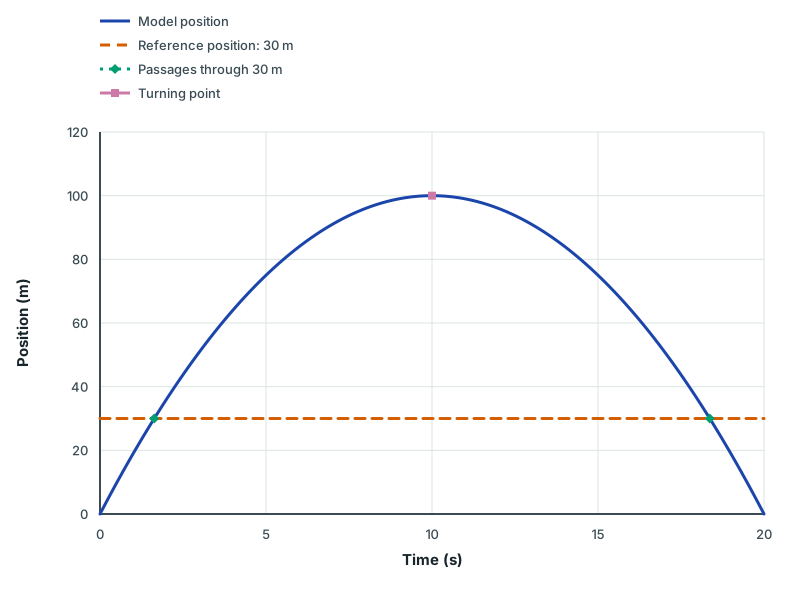
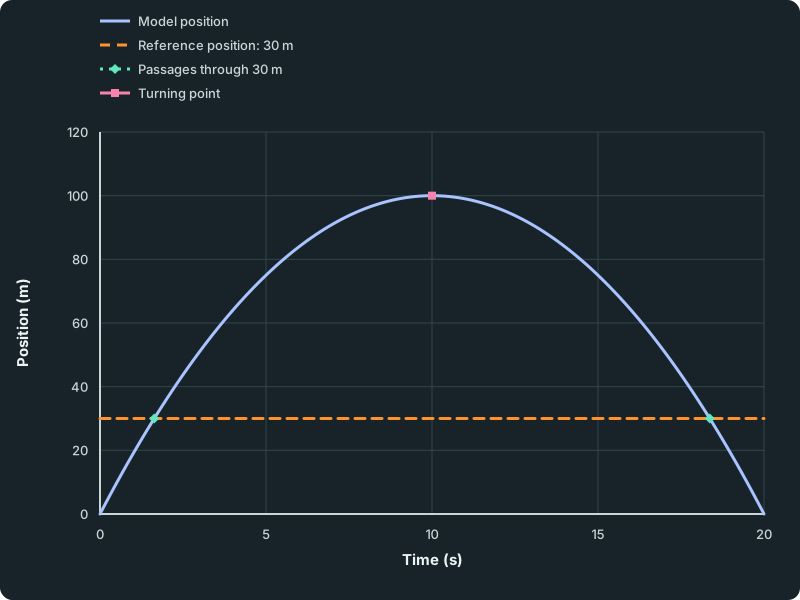
Two times at the same position
Modelled position–time curve with a horizontal reference at 30 m and markers at the two intersections. The curve rises to 100 m at 10 s, then falls to the starting position at 20 s.
Scroll across the figure to read all labels.
View figure data
| Series | Time (s) | Position (m) |
|---|---|---|
| Model position | 0.0000 | 0.00 |
| Model position | 0.1000 | 1.99 |
| Model position | 0.2000 | 3.96 |
| Model position | 0.3000 | 5.91 |
| Model position | 0.4000 | 7.84 |
| Model position | 0.5000 | 9.75 |
| Model position | 0.6000 | 11.64 |
| Model position | 0.7000 | 13.51 |
| Model position | 0.8000 | 15.36 |
| Model position | 0.9000 | 17.19 |
| Model position | 1.0000 | 19.00 |
| Model position | 1.1000 | 20.79 |
| Model position | 1.2000 | 22.56 |
| Model position | 1.3000 | 24.31 |
| Model position | 1.4000 | 26.04 |
| Model position | 1.5000 | 27.75 |
| Model position | 1.6000 | 29.44 |
| Model position | 1.6334 | 30.00 |
| Model position | 1.7000 | 31.11 |
| Model position | 1.8000 | 32.76 |
| Model position | 1.9000 | 34.39 |
| Model position | 2.0000 | 36.00 |
| Model position | 2.1000 | 37.59 |
| Model position | 2.2000 | 39.16 |
| Model position | 2.3000 | 40.71 |
| Model position | 2.4000 | 42.24 |
| Model position | 2.5000 | 43.75 |
| Model position | 2.6000 | 45.24 |
| Model position | 2.7000 | 46.71 |
| Model position | 2.8000 | 48.16 |
| Model position | 2.9000 | 49.59 |
| Model position | 3.0000 | 51.00 |
| Model position | 3.1000 | 52.39 |
| Model position | 3.2000 | 53.76 |
| Model position | 3.3000 | 55.11 |
| Model position | 3.4000 | 56.44 |
| Model position | 3.5000 | 57.75 |
| Model position | 3.6000 | 59.04 |
| Model position | 3.7000 | 60.31 |
| Model position | 3.8000 | 61.56 |
| Model position | 3.9000 | 62.79 |
| Model position | 4.0000 | 64.00 |
| Model position | 4.1000 | 65.19 |
| Model position | 4.2000 | 66.36 |
| Model position | 4.3000 | 67.51 |
| Model position | 4.4000 | 68.64 |
| Model position | 4.5000 | 69.75 |
| Model position | 4.6000 | 70.84 |
| Model position | 4.7000 | 71.91 |
| Model position | 4.8000 | 72.96 |
| Model position | 4.9000 | 73.99 |
| Model position | 5.0000 | 75.00 |
| Model position | 5.1000 | 75.99 |
| Model position | 5.2000 | 76.96 |
| Model position | 5.3000 | 77.91 |
| Model position | 5.4000 | 78.84 |
| Model position | 5.5000 | 79.75 |
| Model position | 5.6000 | 80.64 |
| Model position | 5.7000 | 81.51 |
| Model position | 5.8000 | 82.36 |
| Model position | 5.9000 | 83.19 |
| Model position | 6.0000 | 84.00 |
| Model position | 6.1000 | 84.79 |
| Model position | 6.2000 | 85.56 |
| Model position | 6.3000 | 86.31 |
| Model position | 6.4000 | 87.04 |
| Model position | 6.5000 | 87.75 |
| Model position | 6.6000 | 88.44 |
| Model position | 6.7000 | 89.11 |
| Model position | 6.8000 | 89.76 |
| Model position | 6.9000 | 90.39 |
| Model position | 7.0000 | 91.00 |
| Model position | 7.1000 | 91.59 |
| Model position | 7.2000 | 92.16 |
| Model position | 7.3000 | 92.71 |
| Model position | 7.4000 | 93.24 |
| Model position | 7.5000 | 93.75 |
| Model position | 7.6000 | 94.24 |
| Model position | 7.7000 | 94.71 |
| Model position | 7.8000 | 95.16 |
| Model position | 7.9000 | 95.59 |
| Model position | 8.0000 | 96.00 |
| Model position | 8.1000 | 96.39 |
| Model position | 8.2000 | 96.76 |
| Model position | 8.3000 | 97.11 |
| Model position | 8.4000 | 97.44 |
| Model position | 8.5000 | 97.75 |
| Model position | 8.6000 | 98.04 |
| Model position | 8.7000 | 98.31 |
| Model position | 8.8000 | 98.56 |
| Model position | 8.9000 | 98.79 |
| Model position | 9.0000 | 99.00 |
| Model position | 9.1000 | 99.19 |
| Model position | 9.2000 | 99.36 |
| Model position | 9.3000 | 99.51 |
| Model position | 9.4000 | 99.64 |
| Model position | 9.5000 | 99.75 |
| Model position | 9.6000 | 99.84 |
| Model position | 9.7000 | 99.91 |
| Model position | 9.8000 | 99.96 |
| Model position | 9.9000 | 99.99 |
| Model position | 10.0000 | 100.00 |
| Model position | 10.1000 | 99.99 |
| Model position | 10.2000 | 99.96 |
| Model position | 10.3000 | 99.91 |
| Model position | 10.4000 | 99.84 |
| Model position | 10.5000 | 99.75 |
| Model position | 10.6000 | 99.64 |
| Model position | 10.7000 | 99.51 |
| Model position | 10.8000 | 99.36 |
| Model position | 10.9000 | 99.19 |
| Model position | 11.0000 | 99.00 |
| Model position | 11.1000 | 98.79 |
| Model position | 11.2000 | 98.56 |
| Model position | 11.3000 | 98.31 |
| Model position | 11.4000 | 98.04 |
| Model position | 11.5000 | 97.75 |
| Model position | 11.6000 | 97.44 |
| Model position | 11.7000 | 97.11 |
| Model position | 11.8000 | 96.76 |
| Model position | 11.9000 | 96.39 |
| Model position | 12.0000 | 96.00 |
| Model position | 12.1000 | 95.59 |
| Model position | 12.2000 | 95.16 |
| Model position | 12.3000 | 94.71 |
| Model position | 12.4000 | 94.24 |
| Model position | 12.5000 | 93.75 |
| Model position | 12.6000 | 93.24 |
| Model position | 12.7000 | 92.71 |
| Model position | 12.8000 | 92.16 |
| Model position | 12.9000 | 91.59 |
| Model position | 13.0000 | 91.00 |
| Model position | 13.1000 | 90.39 |
| Model position | 13.2000 | 89.76 |
| Model position | 13.3000 | 89.11 |
| Model position | 13.4000 | 88.44 |
| Model position | 13.5000 | 87.75 |
| Model position | 13.6000 | 87.04 |
| Model position | 13.7000 | 86.31 |
| Model position | 13.8000 | 85.56 |
| Model position | 13.9000 | 84.79 |
| Model position | 14.0000 | 84.00 |
| Model position | 14.1000 | 83.19 |
| Model position | 14.2000 | 82.36 |
| Model position | 14.3000 | 81.51 |
| Model position | 14.4000 | 80.64 |
| Model position | 14.5000 | 79.75 |
| Model position | 14.6000 | 78.84 |
| Model position | 14.7000 | 77.91 |
| Model position | 14.8000 | 76.96 |
| Model position | 14.9000 | 75.99 |
| Model position | 15.0000 | 75.00 |
| Model position | 15.1000 | 73.99 |
| Model position | 15.2000 | 72.96 |
| Model position | 15.3000 | 71.91 |
| Model position | 15.4000 | 70.84 |
| Model position | 15.5000 | 69.75 |
| Model position | 15.6000 | 68.64 |
| Model position | 15.7000 | 67.51 |
| Model position | 15.8000 | 66.36 |
| Model position | 15.9000 | 65.19 |
| Model position | 16.0000 | 64.00 |
| Model position | 16.1000 | 62.79 |
| Model position | 16.2000 | 61.56 |
| Model position | 16.3000 | 60.31 |
| Model position | 16.4000 | 59.04 |
| Model position | 16.5000 | 57.75 |
| Model position | 16.6000 | 56.44 |
| Model position | 16.7000 | 55.11 |
| Model position | 16.8000 | 53.76 |
| Model position | 16.9000 | 52.39 |
| Model position | 17.0000 | 51.00 |
| Model position | 17.1000 | 49.59 |
| Model position | 17.2000 | 48.16 |
| Model position | 17.3000 | 46.71 |
| Model position | 17.4000 | 45.24 |
| Model position | 17.5000 | 43.75 |
| Model position | 17.6000 | 42.24 |
| Model position | 17.7000 | 40.71 |
| Model position | 17.8000 | 39.16 |
| Model position | 17.9000 | 37.59 |
| Model position | 18.0000 | 36.00 |
| Model position | 18.1000 | 34.39 |
| Model position | 18.2000 | 32.76 |
| Model position | 18.3000 | 31.11 |
| Model position | 18.3666 | 30.00 |
| Model position | 18.4000 | 29.44 |
| Model position | 18.5000 | 27.75 |
| Model position | 18.6000 | 26.04 |
| Model position | 18.7000 | 24.31 |
| Model position | 18.8000 | 22.56 |
| Model position | 18.9000 | 20.79 |
| Model position | 19.0000 | 19.00 |
| Model position | 19.1000 | 17.19 |
| Model position | 19.2000 | 15.36 |
| Model position | 19.3000 | 13.51 |
| Model position | 19.4000 | 11.64 |
| Model position | 19.5000 | 9.75 |
| Model position | 19.6000 | 7.84 |
| Model position | 19.7000 | 5.91 |
| Model position | 19.8000 | 3.96 |
| Model position | 19.9000 | 1.99 |
| Model position | 20.0000 | 0.00 |
| Reference position: 30 m | 0.0000 | 30.00 |
| Reference position: 30 m | 20.0000 | 30.00 |
| Passages through 30 m | 1.6334 | 30.00 |
| Passages through 30 m | 18.3666 | 30.00 |
| Turning point | 10.0000 | 100.00 |
This graph shows x = 20t-t², in SI units. The object reaches x = 30 m on the way out, turns at t = 10 s, and passes x = 30 m again on the way back. The next problem uses different numbers; the same rising-then-falling shape explains its two times.
Exam-style question 1
Two times for one displacement
Examination question
A particle has initial velocity 24.0 m s⁻¹ and constant acceleration -2.00 m s⁻². Find both times at which its displacement from the start is 44.0 m, and explain why there are two. [5 marks]
Find both times
Choose the equation you must solve and enter both times to three significant figures. The explanation is a separate comparison task below.
Show solution step by step
Form the equation
2 marksMethod
Use s = ut + (1/2)at² with signed values.Reason
The acceleration is constant and the time is unknown.Working
Answer
44.0 = 24.0t-1.00t², so t²-24.0t + 44.0 = 0.
Solve
2 marksMethod
Use the quadratic formula.Reason
A quadratic can have two roots.Working
Answer
t = (24.0± square root of (576-176))/2 = 24.0±20.0/2 = 2.00 s or 22.0 s
Explain
1 markWorking
Answer
The velocity v = 24.0-2.00t is zero at t = 12.0 s, between the two times. The particle passes 44.0 m on the way out, turns round, and passes it again on the way back.
Self-mark with the mark scheme
Tick each mark point that your answer includes.
Self-mark the equation, the two roots and the explanation.
Check your understanding 6
For the 24.0 m s⁻¹ particle above, explain why both 2.00 s and 22.0 s are valid. Find the turning time and the signed velocity at each passage. Relate them to the position–time curve; work on paper if you prefer.
Show answer
The velocity is v = 24.0-2.00t, so the turning time is 12.0 s. At 2.00 s, v = +20.0 m s⁻¹; at 22.0 s, v = -20.0 m s⁻¹. Both times are after the start and straddle the turning point: the particle crosses s = 44.0 m going out and again returning. Compare your answer for the turning time, both signed velocities and the two passages. The plotted x = 20t-t² model has different numbers but the same rising-then-falling shape.
Check your understanding 7
A ball is thrown vertically downward at 5.00 m s⁻¹ from a balcony 20.0 m above the ground. Take upward as positive, neglect air resistance and use g = 9.81 m s⁻². Find its landing time and signed velocity just before landing. Show your equation and explain the meaning of any discarded time root. Give the results to three significant figures; work on paper if you prefer.
Show answer
Here u = -5.00 m s⁻¹, a = -9.81 m s⁻² and s = -20.0 m. Thus -20.0 = -5.00t-4.905t², giving t = 1.572922… s or -2.592290… s. The negative root extrapolates the model before release; it is not a landing after the throw. The landing time is 1.57 s and v = -5.00-9.81(1.572922…) = -20.4 m s⁻¹, downward. Check independently with v² = u² + 2as = 417.4 m² s⁻², choosing the negative square root because the ball moves downward throughout. Compare signs, the nonzero initial velocity, both roots and their interpretation, guard digits and the final direction.
Common mistakes
- Using the equations over an interval in which the acceleration changes. Split the motion into stages and carry the final velocity of one stage into the next.
- Treating s as a distance when the object turns back.
- Saying the acceleration is zero at the top of a throw.
- Rejecting the larger root of a quadratic without checking whether it describes the return journey.
Spotted an error? Report a correction
Syllabus and review details
- GCE A-Level H2 Physics 2027 · 2027
Content Overview, PDF pages 9–10; Subject Content, PDF pages 11–30