Drag Force (Air Resistance)
Key idea: Explain drag force (air resistance) qualitatively and use forces + energy to describe terminal velocity (A Level Physics).
Continue where you stopped
The core idea
On this page
Learning objectives
- Describe normal, frictional, buoyant and viscous forces qualitatively.
1. Definitions (Must Know)
A. Drag force, F_d
Drag force (air resistance) is a resistive force that acts opposite to an object’s motion through a fluid (air or water).
B. Terminal velocity
Terminal velocity is the constant speed reached when drag equals weight, so the resultant force is zero and acceleration is zero.
O Level foundation: Free Fall (g) & Terminal Velocity.
2. Key Ideas (What Earns Marks)
- Drag acts opposite the direction of motion.
- Drag increases with speed; it also depends on shape, area, and the fluid.
- With drag, the acceleration of a falling object is less than g and decreases as speed increases.
- At terminal velocity:
- F_d = W = mg
- resultant force = 0
- a = 0 and velocity is constant
- Energy view at terminal velocity: the rate of loss of gravitational potential energy equals the rate of energy transfer to the surroundings (work done against drag).
3. Detailed Explanations
A. Forces on a falling object (with air resistance)
For an object falling through air, the main forces are:
- weight W = mg (downwards, approximately constant near Earth)
- drag F_d (upwards, increases with speed)
At the start, speed is low so drag is small. The resultant force is downwards, so the object accelerates downwards.
As speed increases, drag increases, so the resultant force decreases, so the acceleration decreases.
B. Terminal velocity (force explanation)
Terminal velocity is reached when:
F_d = mg ⇒ Fᵣₑₛᵤₗₜₐₙₜ = 0 ⇒ a = 0
The object continues falling at a constant speed.
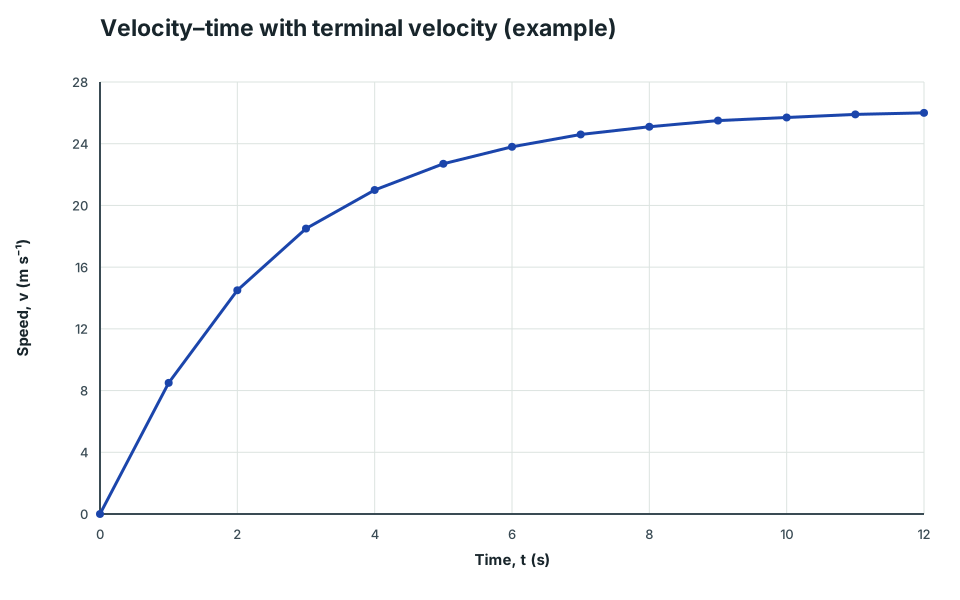
Velocity–time with terminal velocity (example)
As speed increases, drag increases and acceleration decreases, so the velocity–time graph flattens towards a constant terminal speed.
Scroll across the graph to read all labels.
View figure data
| Time, t (s) | Speed (with drag) |
|---|---|
| 0 | 0 |
| 1 | 8.5 |
| 2 | 14.5 |
| 3 | 18.5 |
| 4 | 21 |
| 5 | 22.7 |
| 6 | 23.8 |
| 7 | 24.6 |
| 8 | 25.1 |
| 9 | 25.5 |
| 10 | 25.7 |
| 11 | 25.9 |
| 12 | 26 |
C. Terminal velocity (energy explanation)
As the object falls:
- gravitational potential energy decreases,
- energy is transferred to the surroundings by work done against drag (mostly heating the air/object).
At terminal velocity, kinetic energy is no longer increasing. The rate of loss of gravitational potential energy equals the power dissipated by drag.
At terminal velocity, F_d = mg, so: P = F_d v = mgv
D. Factors that affect drag (qualitative)
Drag usually increases when:
- speed increases,
- cross-sectional area increases,
- the object is less streamlined,
- the fluid is “thicker” (higher viscosity/density, depending on model).
4. Common Mistakes
- Saying “drag disappears at terminal velocity” (it equals weight; it does not vanish).
- Saying “terminal velocity means no forces act” (forces act, but they balance).
- Assuming acceleration is always g in air (only true when drag is negligible).
- Forgetting drag reverses direction when the motion reverses.
5. Exam Tips
- Draw a quick free-body diagram and label directions.
- If the object is speeding up while moving down: resultant force is downwards.
- If the object is slowing down while moving down: resultant force is upwards (drag > weight).
- At terminal velocity: write the chain explicitly: F_d = mg ⇒ Fᵣₑₛᵤₗₜₐₙₜ = 0 ⇒ a = 0.
6. Worked Examples
Modelled example 1
Falling but slowing down
Problem
Study the worked solution
Separate velocity from acceleration
Method
Velocity is downward but acceleration is upward.Reason
An object slowing while moving downward must accelerate opposite to its velocity.Working
vector v: down; vector a: upUse the resultant-force direction
Method
The resultant force is upward.Reason
Newton’s second law makes resultant force parallel to acceleration.Working
∑ vector F = m vector aCompare the two forces
Method
Drag is greater than weight.Reason
Upward drag must exceed downward mg to produce an upward resultant.Working
F_d-mg > 0 ⇒ F_d > mg
Guided practice 2
Terminal velocity conditions
Problem
Try this before viewing the solution
Hints
Hint 1: start from constant velocity
View solution step by step
Balance drag and weight
Method
F_d = mg.Reason
Terminal speed occurs when the upward and downward forces balance.Working
∑ F = mg-F_d = 0State the acceleration
Method
a = 0.Reason
Zero resultant force gives zero acceleration.Working
0 = ma ⇒ a = 0Distinguish velocity
Method
The object still moves downward at constant non-zero speed.Reason
Zero acceleration means unchanged velocity, not necessarily rest.Working
v = vₜₑᵣₘᵢₙₐₗ = constant
Common misconception 3
Vehicle reaching a steady speed (analogy)
Learner claim
Try this before viewing the solution
View solution step by step
Track the changing resultant
Method
The forward resultant decreases as the vehicle speeds up.Reason
Drag increases while the stated driving force remains constant.Working
Fᵣₑₛᵤₗₜₐₙₜ = F_drive-F_dIdentify the steady-state condition
Method
Eventually F_d = F_drive.Reason
The forces balance at the limiting speed.Working
Fᵣₑₛᵤₗₜₐₙₜ = 0Correct the claim
Method
The vehicle continues at constant speed with both forces acting.Reason
Zero resultant gives zero acceleration; the driving force has not vanished.Working
a = 0, v = constant
Examiner practice 4
Finding the drag at terminal velocity
Examination question
Try this before viewing the solution
View solution step by step
Apply terminal force balance
1 markMethod
F_d = mg.Reason
Terminal velocity means zero acceleration and zero resultant force.Working
F_d-mg = 0Calculate
1 markMethod
F_d = 7.85 × 10² N.Reason
Drag has the same magnitude as the skydiver’s weight.Working
F_d = 80(9.81) = 784.8 N ≈ 785 N
Self-mark with the mark scheme
Compare your response with each mark point. Select a point only when your response contains that evidence.
Self-mark the terminal-force condition and calculated drag.
Challenge 5
Acceleration when drag is known
Independent transfer
Try this before viewing the solution
Hints
Hint 1: form the signed resultant
View solution step by step
Choose downward positive
Method
Weight is positive and drag is negative.Reason
The forces act in opposite directions.Working
∑ F = mg-F_dCalculate resultant force
Method
The resultant is 286.7 N downward.Reason
Weight 686.7 N exceeds the 400 N drag.Working
70(9.81)-400 = 286.7 NCalculate and interpret acceleration
Method
a = 4.10 m s⁻² downward.Reason
The positive signed result follows the chosen downward axis.Working
a = 286.7/70 = 4.10 m s⁻²
7. Mind Stretchers
Mind stretcher 1: Two terminal velocitiesExtension
A skydiver reaches a terminal velocity before opening a parachute.
After opening the parachute, they reach a new terminal velocity that is much smaller.
Explain why, using forces.
Click here to show/hide answer
Opening the parachute increases drag for any given speed (larger area/less streamlined).
Immediately after opening, drag becomes much larger than weight, giving an upward resultant force, so the skydiver slows down.
They slow until drag decreases to equal weight again, which happens at a lower speed, giving a lower terminal velocity.
Mind stretcher 2: Optional (Enrichment)Extension
A. Drag models (F_d ∝ v and F_d ∝ v²)
Some problems specify a drag model:
- low-speed / laminar flow: F_d ∝ v
- higher-speed / turbulent flow: F_d ∝ v²
If the model is not stated, treat drag qualitatively (increases with speed).
Mind stretcher 3: Why is terminal velocity lower in water than in air?Extension
An object falls in air and reaches a terminal velocity. It falls in water and reaches a much smaller terminal velocity.
Explain why using the idea “drag increases with speed”.
Click here to show/hide answer
For an object falling at terminal velocity, drag must balance weight (F_d = mg).
In water, for the same speed, drag is typically much larger than in air (different fluid properties and flow). So the speed required for drag to build up to mg is smaller.
Therefore the terminal velocity in water is lower.
Continue with the next resource in this course.
Course and syllabus information
- Course
- GCE A-Level H2 Physics
- Edition
- GCE A-Level H2 Physics 2027