A Level Forces & Dynamics Hub
Build an exam-safe route through forces, Hooke's law, moments, equilibrium, momentum and one-dimensional collisions for H2 Physics 9478.
Learning goals
- Explain inertia and momentum, then apply Newton's laws using free-body diagrams.
- Describe normal, frictional, buoyant and viscous forces qualitatively.
- Apply Hooke's law within the limit of proportionality.
- Apply moments, couples and force-and-torque equilibrium using free-body diagrams and vector triangles.
- show an understanding that the weight of a body may be taken as acting at a single point known as its centre of gravity
- apply the principle of moments to new situations or to solve related problems
Forces change momentum and can also produce turning effects. This route separates the two equilibrium conditions, then connects Newton’s laws to impulse and collisions.
Prerequisites:
- O-Level Forces for basic force identification
- Vector Addition & Components for resolving forces
- Kinematics Graphs for acceleration and graph-area reasoning
Study order: use the learning path above from Newton’s laws through collisions. The final two lessons are labelled optional because coefficients of friction and variable-mass systems are not required by syllabus 9478.
Friction, upthrust and viscous force are required qualitatively. Hooke’s law, moments, couples, equilibrium, impulse and one-dimensional collisions are core. Coefficients of friction, coefficients of restitution, two-dimensional collisions and variable-mass systems are extension material.
Lessons
Work through these lessons in order.
- Field, contact and elastic forces
- Moments, couples and centre of gravity
- Translational and rotational equilibrium
- Hooke's Law
Apply F = kx, interpret force–extension graphs, distinguish proportional and elastic limits, and calculate elastic energy.
- Torque & Couples (A Level)
Define moment (torque), apply the principle of moments, and solve equilibrium problems involving couples (A Level Physics).
- Centre Of Gravity (A Level)
Use centre of gravity as the point where weight acts; optional sections extend to centre-of-mass calculations, laminas and stability.
- Newton’s Laws (Vectors & Problem Solving)
Apply all three Newton's laws, inertia and momentum using free-body diagrams, vector components and equilibrium triangles.
- Apparent Weight
Use Newton’s 2nd law to relate apparent weight (normal reaction) to acceleration in lifts and free fall (A Level Physics).
- Drag Force (Air Resistance)
Explain drag force (air resistance) qualitatively and use forces + energy to describe terminal velocity (A Level Physics).
- Upthrust & Archimedes’ Principle
Explain buoyant force qualitatively for H2 Physics, then optionally extend to Archimedes' principle, floating fractions and apparent weight.
Revision
Quick reference
- Newton’s second law: ∑ vector F = (d vector p)/dt, reducing to ∑ vector F = m vector a for constant mass.
- Hooke’s law: F = kx within the limit of proportionality.
- Moment: τ = Fd_⊥; equilibrium requires both ∑ vector F = 0 and ∑ τ = 0.
- Impulse: vector J = Δ vector p; it is the signed area under a force–time graph.
- Elastic collision: momentum and kinetic energy are conserved; in one dimension, relative speed of approach equals relative speed of separation.
- Inelastic collision: momentum is conserved for a closed system, but kinetic energy is transferred to other stores.
Problem Templates (fast marks)
Newton’s laws (slopes / connected bodies)
- Choose axes (often parallel/perpendicular to slope) and state sign convention.
- Draw a clean FBD (forces on the object only).
- Resolve forces into components.
- Write ∑ Fₓ = maₓ and ∑ F_y = ma_y (or equilibrium in a direction).
- Solve systematically (one object at a time; link via constraints like same acceleration/tension if applicable).
Momentum / impulse (collisions)
- Define the system and state: “external impulse negligible ⇒ momentum conserved”.
- Choose a positive direction and use signs consistently.
- Use conservation: ∑ p_before = ∑ p_after with signed one-dimensional velocities.
- If force/time given: use J = Δ p and “area under F–t” for impulse.
- For perfectly inelastic collisions: bodies move together after collision (common constraint).
Graph skills (exam and practical)
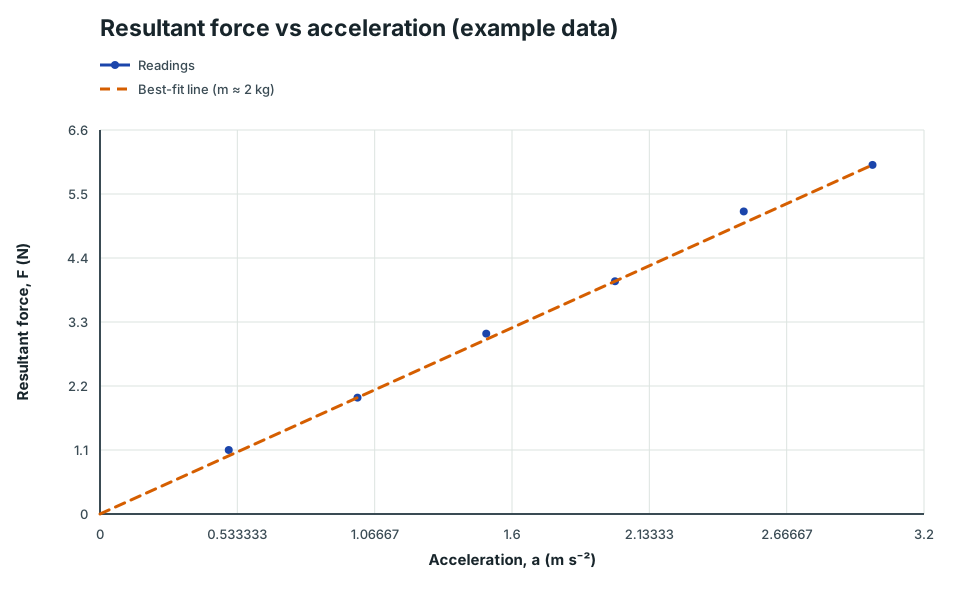
Newton’s 2nd Law: gradient gives mass
If mass is constant, Fₙₑₜ = ma. A plot of Fₙₑₜ against a is a straight line through the origin with gradient m.
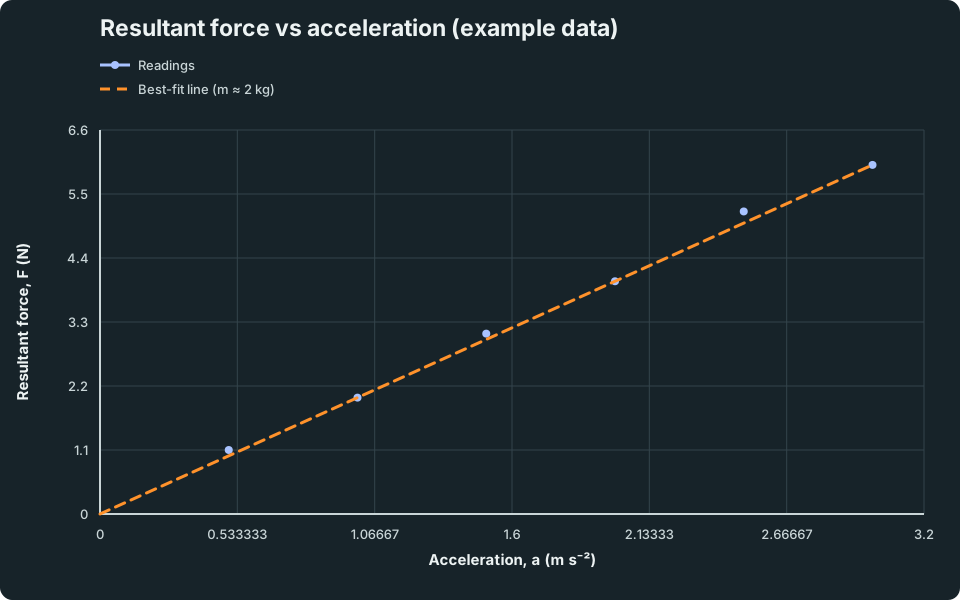
Resultant force vs acceleration (example data)
Scatter readings with a best-fit line through the origin. The gradient of F vs a gives mass.
Scroll across the graph to read all labels.
View figure data
| Series | Acceleration, a (m s⁻²) | Acceleration, a uncertainty | Resultant force, F (N) | Resultant force, F uncertainty |
|---|---|---|---|---|
| Readings | 0.5 | 1.1 | ||
| Readings | 1 | 2 | ||
| Readings | 1.5 | 3.1 | ||
| Readings | 2 | 4 | ||
| Readings | 2.5 | 5.2 | ||
| Readings | 3 | 6 | ||
| Best-fit line (m ≈ 2 kg) | 0 | 0 | ||
| Best-fit line (m ≈ 2 kg) | 3 | 6 |
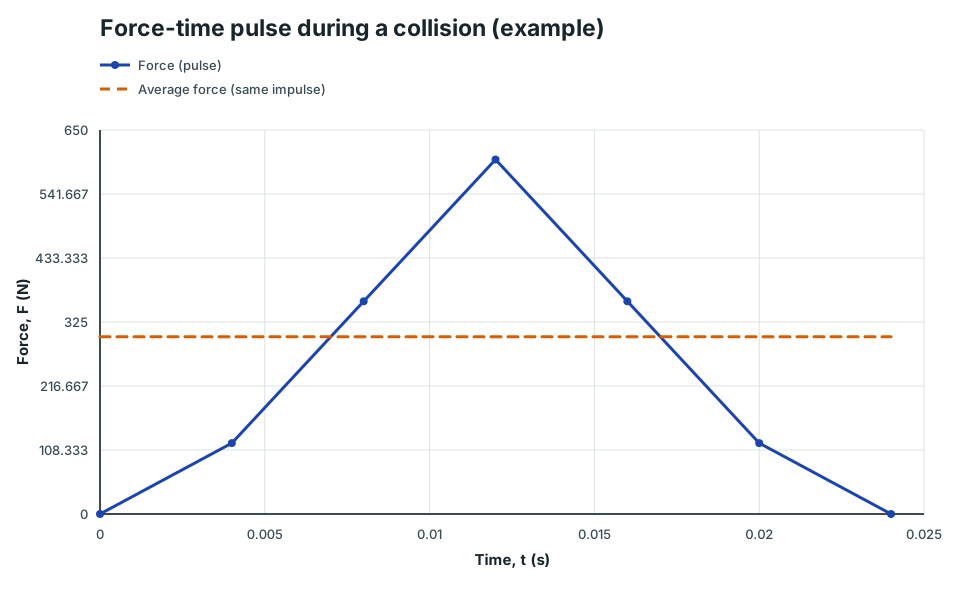
Impulse: area under the force-time graph
Impulse is the area under a force-time graph: J = ∫ F dt (or F_avgΔ t).
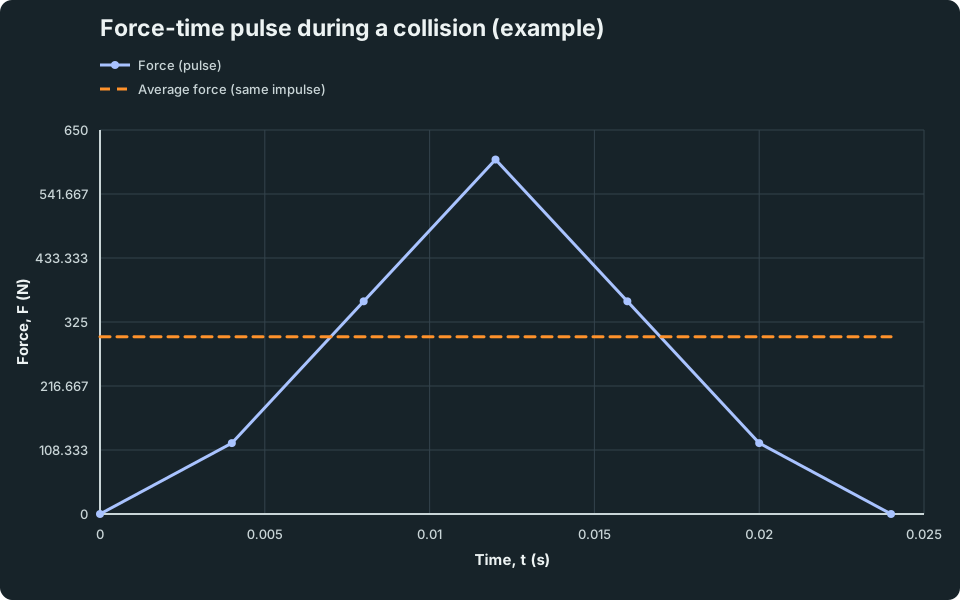
Force-time pulse during a collision (example)
A collision produces a force pulse over a short time. The area under the curve equals impulse (change in momentum).
Scroll across the graph to read all labels.
View figure data
| Series | Time, t (s) | Time, t uncertainty | Force, F (N) | Force, F uncertainty |
|---|---|---|---|---|
| Force (pulse) | 0 | 0 | ||
| Force (pulse) | 0.004 | 120 | ||
| Force (pulse) | 0.008 | 360 | ||
| Force (pulse) | 0.012 | 600 | ||
| Force (pulse) | 0.016 | 360 | ||
| Force (pulse) | 0.02 | 120 | ||
| Force (pulse) | 0.024 | 0 | ||
| Average force (same impulse) | 0 | 300 | ||
| Average force (same impulse) | 0.024 | 300 |
Energy in collisions: conserved vs lost
Momentum is conserved in both elastic and inelastic collisions (if the system is isolated), but kinetic energy is only conserved in elastic collisions.
Data table
| Category | Initial KE | Final KE |
|---|---|---|
| Elastic collision | 2 | 2 |
| Perfectly inelastic | 2 | 1 |
Definitions to recall precisely
- Conservation of momentum: the total momentum of a closed system remains constant.
- Newton’s second law: the rate of change of momentum of a body is proportional to the resultant force and is in the force’s direction.
- Elastic collision: an interaction in which total kinetic energy is conserved.
- Couple: a pair of equal, opposite and parallel forces with different lines of action, producing rotation only.
Top exam traps
- One body per free-body diagram: a third-law pair acts on two bodies, so its two forces never belong on one diagram.
- Normal force is not automatically mg: calculate it from the perpendicular equation of motion.
- Moment arm: use the perpendicular distance to the force’s line of action.
- Momentum condition: define the system and state why the external impulse is zero or negligible.
- Collision type: do not conserve kinetic energy unless the interaction is stated to be perfectly elastic.
Practice
Use the A-Level Forces & Dynamics Quiz to diagnose the weak subtopic, then complete the structured Forces & Dynamics set without notes. Return to the specific lesson for any error you cannot explain.
Next hub: Work, Energy & Power
Continue with the next resource in this course.
Course and syllabus information
- Course
- GCE A-Level H2 Physics
- Edition
- GCE A-Level H2 Physics 2027