Apparent Weight
Key idea: Use Newton’s 2nd law to relate apparent weight (normal reaction) to acceleration in lifts and free fall (A Level Physics).
Continue where you stopped
The core idea
On this page
Learning objectives
- Explain inertia and momentum, then apply Newton's laws using free-body diagrams.
- Describe normal, frictional, buoyant and viscous forces qualitatively.
- Apply moments, couples and force-and-torque equilibrium using free-body diagrams and vector triangles.
1. Definitions (Must Know)
A. Apparent weight, R
Apparent weight is the normal reaction force R measured by a scale (the force the scale exerts on you).
True weight is W = mg (gravitational force).
B. Weightlessness
Weightlessness means apparent weight is zero:
R = 0
This happens in free fall when the only force is weight.
2. Key Ideas (What Earns Marks)
- Pick a sign convention (commonly upwards +).
- For a person in a lift:
- forces: R up, mg down
- apply Newton’s 2nd law: ∑ F_y = ma
- If lift accelerates upward: R > mg (you feel heavier).
- If lift accelerates downward: R < mg (you feel lighter).
- If the lift is in free fall (a = g downward): R = 0 (weightlessness).
Keep one sign convention from start to end. If up is positive, downward acceleration must be entered as a negative value in R - mg = ma.
3. Detailed Explanations
A. Core equation (upwards positive)
Take upwards as positive.
Forces on the person:
- R (normal reaction) upwards
- mg downwards
Newton’s 2nd law:
∑ F_y = ma ⇒ R - mg = ma
So:
R = m(g + a)
This single equation covers all lift cases as long as you use the correct sign for a.
B. Interpreting the cases
- Lift accelerating upward: a > 0 ⇒ R > mg
- Lift accelerating downward: a < 0 ⇒ R < mg
- Lift moving at constant speed: a = 0 ⇒ R = mg
- Lift in free fall: a = -g ⇒ R = 0
C. Visual: how R changes with acceleration
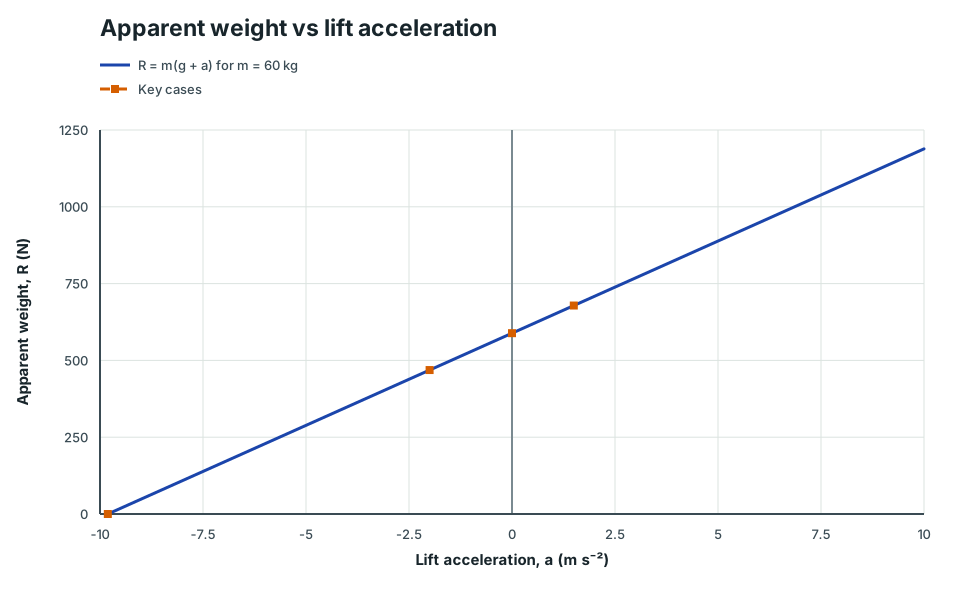
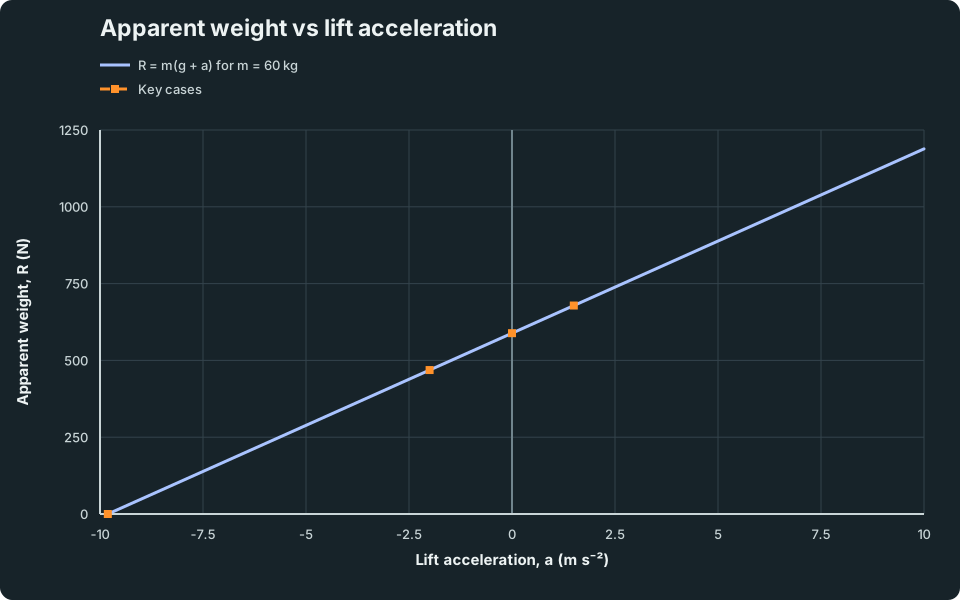
For a given person, R = m(g + a) is a straight-line relationship between apparent weight and lift acceleration.
Apparent weight vs lift acceleration
As acceleration increases upward, the scale reading increases. At free fall (a = -g), the scale reads zero.
Scroll across the graph to read all labels.
View figure data
| Series | Lift acceleration, a (m s⁻²) | Lift acceleration, a uncertainty | Apparent weight, R (N) | Apparent weight, R uncertainty |
|---|---|---|---|---|
| R = m(g + a) for m = 60 kg | -9.81 | 0 | ||
| R = m(g + a) for m = 60 kg | 10 | 1188.6 | ||
| Key cases | -9.81 | 0 | ||
| Key cases | 0 | 588.6 | ||
| Key cases | 1.5 | 678.6 | ||
| Key cases | -2 | 468.6 |
4. Common Mistakes
- Mixing up weight mg with apparent weight R (the scale reads R, not mg).
- Using R = mg± ma without stating a sign convention (easy to flip signs).
- Saying “no gravity” for weightlessness (gravity still acts; R is what becomes zero).
- Forgetting that “slowing down” means acceleration is opposite the velocity direction.
5. Exam Tips
- Write: “take upwards as positive” before your equations.
- Always start from R - mg = ma (or the equivalent with your sign choice).
- If the lift is slowing while moving upward, acceleration is downward, so a < 0.
- Sanity check: if you are “heavier”, your scale reading must be larger.
6. Worked Examples
Modelled example 1
Lift accelerating upwards
Problem
Study the worked solution
Identify the scale reading
Method
The scale reads the upward normal reaction R, not the person’s weight mg.Reason
A scale measures the contact force it exerts on the person.Working
R upward, mg downwardApply Newton's second law
Method
R = m(g + a).Reason
Taking upward as positive, the resultant upward force produces the stated positive acceleration.Working
R-mg = ma ⇒ R = m(g + a)Calculate the reading
Method
R ≈ 6.79 × 10² N.Reason
The upward acceleration requires the normal reaction to exceed the person’s weight.Working
R = 60(9.81 + 1.5) = 678.6 N ≈ 679 N
Guided practice 2
Lift accelerating downwards
Problem
Try this before viewing the solution
Hints
Hint 1: give acceleration its sign
View solution step by step
Use the signed acceleration
Method
a = -2.0 m s⁻².Reason
The chosen positive direction remains upward throughout the calculation.Working
a = -2.0 m s⁻²Calculate the normal reaction
Method
R ≈ 4.69 × 10² N.Reason
A downward resultant requires the upward scale force to be less than weight.Working
R = m(g + a) = 60(9.81-2.0) = 468.6 N
Common misconception 3
Free fall (weightlessness)
Learner claim
Try this before viewing the solution
View solution step by step
Retain the gravitational force
Method
The person’s weight mg still acts downward.Reason
Free fall is acceleration caused by gravity, not absence of gravity.Working
∑ F_y = -mg when upward is positive.Use free-fall acceleration
Method
The normal reaction is zero.Reason
Both person and scale accelerate downward at g, so the scale does not need to push on the person.Working
R-mg = m(-g) ⇒ R = 0Interpret the reading
Method
The scale reads 0 N.Reason
Apparent weight is the normal contact force.Working
R = 0 N while W = mg remains non-zero.
Examiner practice 4
Find the lift’s acceleration from a scale reading
Examination question
Try this before viewing the solution
View solution step by step
Write the force equation
1 markMethod
R-mg = ma with upward positive.Reason
The scale reaction is upward and weight is downward.Working
R-mg = maSubstitute the reading
1 markMethod
450-588.6 = 60a.Reason
The stated scale reading is R.Working
450-60(9.81) = 60aCalculate signed acceleration
1 markMethod
a = -2.31 m s⁻².Reason
The negative result is relative to the upward-positive convention.Working
a = (-138.6)/60 = -2.31 m s⁻²State magnitude and direction
1 markMethod
The lift accelerates downward at 2.31 m s⁻².Reason
A complete vector answer translates the sign into a direction.Working
|a| = 2.31 m s⁻², downward.
Self-mark with the mark scheme
Compare your response with each mark point. Select a point only when your response contains that evidence.
Self-mark the force equation, substitution, signed value, and stated direction.
Challenge 5
Moving downward but slowing down
Independent transfer
Try this before viewing the solution
Hints
Hint 1: separate velocity from acceleration
View solution step by step
Infer the acceleration direction
Method
The acceleration is upward.Reason
The downward velocity is decreasing in magnitude, so acceleration opposes it.Working
a = +1.2 m s⁻² for upward positive.Calculate the scale reading
Method
R ≈ 771 N.Reason
The upward acceleration requires R to exceed mg even though the lift is moving downward.Working
R = m(g + a) = 70(9.81 + 1.2) = 770.7 N
7. Mind Stretchers
Mind stretcher 1: “Slowing down” sign trapExtension
A lift is moving upward but slowing down.
Is R greater than, equal to, or less than mg? Explain.
Show Answer
Moving upward but slowing down means acceleration is downward (a < 0 if upwards is positive).
So R = m(g + a) < mg. You feel lighter.
Mind stretcher 2: Optional (Enrichment)Extension
A. Impulse reminders (belongs to Momentum)
If you see force–time graphs and “average force”, that is impulse/momentum content:
- impulse is area under F–t,
- F_avg = Δ p/Δ t.
See: Momentum & Impulse.
Mind stretcher 3: Can the scale reading be “negative”?Extension
Some calculations can produce R < 0 (e.g. if you assume the lift accelerates downward faster than g). What does that mean physically?
Show Answer
The scale reading is the normal reaction R, and a contact force cannot pull you downward (it can only push up), so R cannot be negative.
If your equation gives R < 0, it means you would lose contact with the scale. In that case, the correct physical situation is R = 0 (weightlessness) and your acceleration would be g downward in free fall (until contact is regained).
Continue with the next resource in this course.
Course and syllabus information
- Course
- GCE A-Level H2 Physics
- Edition
- GCE A-Level H2 Physics 2027