X-ray photon energy limits
Use electron energy gain eV to calculate maximum X-ray photon energy and frequency, minimum wavelength and the voltage needed for a chosen cut-off (optional H2 extension).
On this page
These X-ray calculations are beyond the named 9478 quantum outcomes. Start with how the tube works, and recall photon energy E = hf = hc/λ and 1 eV = 1.60 × 10⁻¹⁹ J.
Start with the energy available
An electron gains kinetic energy eV through accelerating potential difference V, where e is the positive elementary-charge magnitude. We assume negligible initial kinetic energy, a steady accelerating voltage and an ideal energy limit; small recoil corrections are neglected.
A photon cannot receive more energy than the incoming electron supplies. Therefore
E_γ ≤ eV.
The limiting case gives the maximum photon energy, maximum frequency and minimum wavelength:
Eₘₐₓ = eV, fₘₐₓ = eV/h, λₘᵢₙ = hc/eV.
Most photons have less energy than this limit. Heating and multiple interactions describe typical energy sharing; they do not change the ideal energy-conservation bound into a statement about average photon energy. A spectrum can contain photons with longer wavelengths, but not shorter wavelengths than this bound in the stated model.
Choose one unit system
| Quantity | SI calculation | Electron-volt calculation |
|---|---|---|
| Electron energy gain | eV in joules, with V in volts | An electron gains V eV through V volts |
| Example: 50 kV | 8.0 × 10⁻¹⁵ J | 50 keV |
| Wavelength relation | λ = hc/E with E in joules | λ(nm) ≈ 1240/E(eV) |
A volt is a unit of potential difference. An electron-volt is a unit of energy. Their numerical correspondence for one electron does not make their units interchangeable. Use the same energy units as the supplied value of h or hc.
Check the direction of a change
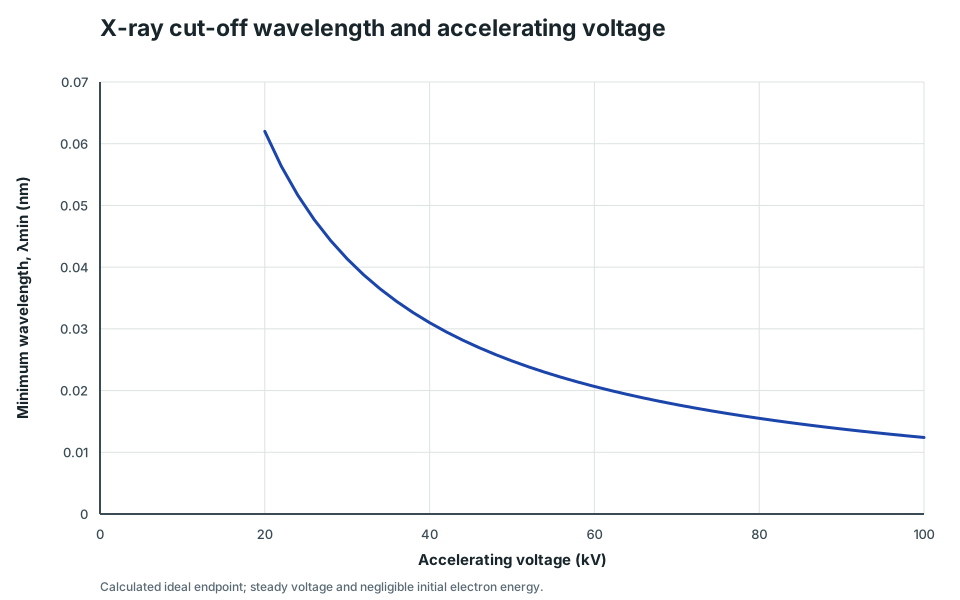
X-ray cut-off wavelength and accelerating voltage
The ideal minimum wavelength decreases inversely with accelerating voltage, from 0.0620 nm at 20 kV through 0.0248 nm at 50 kV to 0.0124 nm at 100 kV.
Scroll across the graph to read all labels.
View figure data
| Accelerating voltage (kV) | Ideal wavelength limit |
|---|---|
| 20 | 0.062 |
| 22 | 0.056363636363636366 |
| 24 | 0.051666666666666666 |
| 26 | 0.047692307692307694 |
| 28 | 0.04428571428571428 |
| 30 | 0.04133333333333333 |
| 32 | 0.03875 |
| 34 | 0.036470588235294116 |
| 36 | 0.034444444444444444 |
| 38 | 0.03263157894736842 |
| 40 | 0.031 |
| 42 | 0.029523809523809525 |
| 44 | 0.028181818181818183 |
| 46 | 0.026956521739130435 |
| 48 | 0.025833333333333333 |
| 50 | 0.0248 |
| 52 | 0.023846153846153847 |
| 54 | 0.022962962962962963 |
| 56 | 0.02214285714285714 |
| 58 | 0.021379310344827585 |
| 60 | 0.020666666666666667 |
| 62 | 0.02 |
| 64 | 0.019375 |
| 66 | 0.018787878787878787 |
| 68 | 0.018235294117647058 |
| 70 | 0.017714285714285714 |
| 72 | 0.017222222222222222 |
| 74 | 0.016756756756756756 |
| 76 | 0.01631578947368421 |
| 78 | 0.015897435897435898 |
| 80 | 0.0155 |
| 82 | 0.015121951219512195 |
| 84 | 0.014761904761904763 |
| 86 | 0.01441860465116279 |
| 88 | 0.014090909090909091 |
| 90 | 0.013777777777777778 |
| 92 | 0.013478260869565217 |
| 94 | 0.013191489361702127 |
| 96 | 0.012916666666666667 |
| 98 | 0.012653061224489795 |
| 100 | 0.0124 |
At fixed other conditions, doubling voltage doubles the ideal maximum photon energy and frequency, and halves the minimum wavelength. The graph uses hc ≈ 1240 eV nm, so λₘᵢₙ(nm) = 1.240/V(kV). The inverse curve helps distinguish this wavelength relation from a direct proportion.
If you are given a cut-off wavelength and asked for voltage, first obtain the maximum photon energy from hc/λₘᵢₙ, then equate it to eV.
Worked calculations
Worked example 1
Minimum wavelength from accelerating voltage
Problem
Worked solution
State the ideal maximum
Method
Set maximum photon energy equal to electron kinetic-energy gain.Reason
The ideal endpoint corresponds to one photon receiving the available electron energy, with recoil neglected.Working
hc/λₘᵢₙ = eVConvert voltage
Method
50 kV is 5.0 × 10⁴ V.Reason
SI substitution with charge in coulombs requires volts.Working
V = 5.0 × 10⁴ VCalculate
Method
Rearrange and substitute.Reason
The result is the shortest, highest-energy wavelength.Working
λₘᵢₙ = hc/eV = 2.5 × 10⁻¹¹ m = 0.025 nm
Guided practice 2
Maximum photon energy
Problem
Try this before viewing the solution
Hints
Hint 1: convert kilovolts
Show solution step by step
Convert
Method
Write kilovolts as volts.Reason
The coulomb-volt product gives joules.Working
30 kV = 3.0 × 10⁴ VCalculate
Method
Multiply by the elementary charge.Reason
This is the maximum electron energy available to one photon.Working
Eₘₐₓ = (1.60 × 10⁻¹⁹)(3.0 × 10⁴) = 4.8 × 10⁻¹⁵ J
Spot the mistake 3
Voltage needed for a target cut-off wavelength (eV·nm shortcut)
Learner claim
Try this before viewing the solution
Show solution step by step
Find photon energy
Method
Use the wavelength form in eV.Reason
The supplied constant pairs eV with nm.Working
Eₘₐₓ = 1240/0.020 = 6.2 × 10⁴ eV = 62 keVMap energy to voltage
Method
A single electron gains V eV through V volts.Reason
Electronvolt is an energy unit; volt is potential difference.Working
62 keV ↔ 62 kVState the answer
Method
The required accelerating potential is approximately 62 kV.Reason
That potential supplies up to 62 keV per electron.Working
V ≈ 62 kV
Guided practice 4
Maximum frequency from accelerating voltage
Try the calculation
Try this before viewing the solution
Hints
Hint 1: choose the energy relation
Show solution step by step
Convert voltage
Method
40 kV is 4.0 × 10⁴ V.Reason
Use SI units with coulombs.Working
V = 4.0 × 10⁴ VFind maximum energy
Method
Calculate eV.Reason
This is the ideal photon-energy maximum.Working
Eₘₐₓ = 6.4 × 10⁻¹⁵ JRelate energy and frequency
Method
Use Eₘₐₓ = hfₘₐₓ.Reason
Photon energy is proportional to frequency.Working
fₘₐₓ = Eₘₐₓ/hCalculate
Method
Evaluate and state hertz.Reason
Frequency has units s⁻¹.Working
fₘₐₓ = 9.7 × 10¹⁸ Hz
Try it yourself
Mind stretcher 1: Apply the same limit at 100 kVExtension
A tube runs at 100 kV. Find its ideal cut-off wavelength using h = 6.63 × 10⁻³⁴ J s, c = 3.00 × 10⁸ m s⁻¹ and e = 1.60 × 10⁻¹⁹ C. Is this the wavelength of every emitted photon?
Show reasoning
V = 1.00 × 10⁵ V and λₘᵢₙ = hc/(eV) ≈ 1.24 × 10⁻¹¹ m = 0.0124 nm. This is the shortest-wavelength limit; the tube emits a distribution containing longer wavelengths. Use the spectrum lesson to distinguish this endpoint from characteristic lines.
Syllabus and review details
No official syllabus alignment is listed for this lesson.