Measure specific heat capacity with electrical heating
Key idea: Heat a known mass electrically and measure its temperature rise to find c. Compare heating and cooling slopes at the same temperature to correct heat loss, then subtract the apparatus heat capacity.
Offline pages
Saved on this device only. Connect at least once every 30 days to confirm Premium. Sign-out or a change of account removes saved copies.
Loading guide controls…
Guided lessons · coming soon
Guided lesson
Guided steps
- Relate electrical power to heating and identify why the uncorrected estimate is too large.
- Subtract temperature-matched energy balances, then remove the apparatus capacity.
- Read the two local slopes and follow the capacity and loss-power calculation.
- Calculate the signed slope difference, heat capacity and specific heat capacity.
- Correct the cooling sign and calculate the total heat capacity.
- Choose temperature-matched cooling data and calculate the sample property and loss power.
- Explain the bias and produce the corrected heating-and-cooling method.
On this page
You stopped at:
ContinueThe simplest way to measure a specific heat capacity is to heat a block with an electrical heater and see how fast it warms. The catch is that not all the heater’s energy stays in the block: some warms the heater and container, and some leaks away to the room. Comparing how fast the block warms with how fast it cools separates these.
Measuring specific heat capacity electrically
An electrical heater of power P = VI, switched on for a time t, supplies energy Pt. If all of it went into a sample of mass m, warming it by Δθ,
In practice this gives a value of c that is too large, because part of Pt warms the apparatus (heater, container, thermometer) and part is lost to the surroundings. Insulating the sample reduces the losses, but does not remove them.
Correcting for the losses
Write Cₜₒₜ = mc + Cₐₚₚ for the total heat capacity of the sample and the apparatus that warms with it, and H for the power lost to the surroundings. While the heater is on, the temperature rises at a rate sₕₑₐₜ; after it is switched off, it falls at a rate s_cool, which is negative. The energy balances, per second, are
The power lost depends on how much hotter the sample is than the room. Use local gradients at the same sample temperature, with the same surroundings and apparatus, so H is the same in both. For a liquid, stir gently to keep its temperature uniform; for a block, ensure good thermal contact with the heater and thermometer. Short intervals approximate a local gradient; a whole heating run need not have one constant loss power. Subtracting the second balance from the first removes it:
Then subtract the heat capacity of the apparatus and divide by the mass of the sample: c = (Cₜₒₜ-Cₐₚₚ)/m.
Heating and cooling near the same temperature
Heating rises from 40 to 44 degrees Celsius over twenty seconds; cooling falls from 40 to 39 degrees Celsius over the same interval.
Scroll across the figure to read all labels.
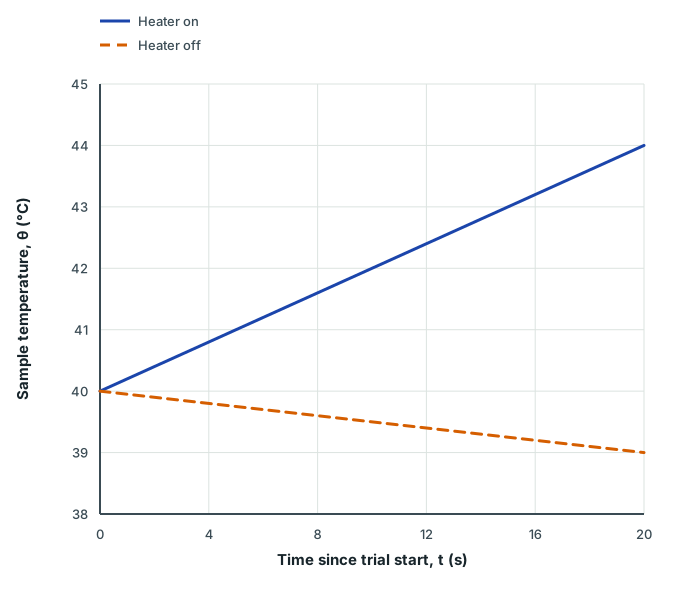
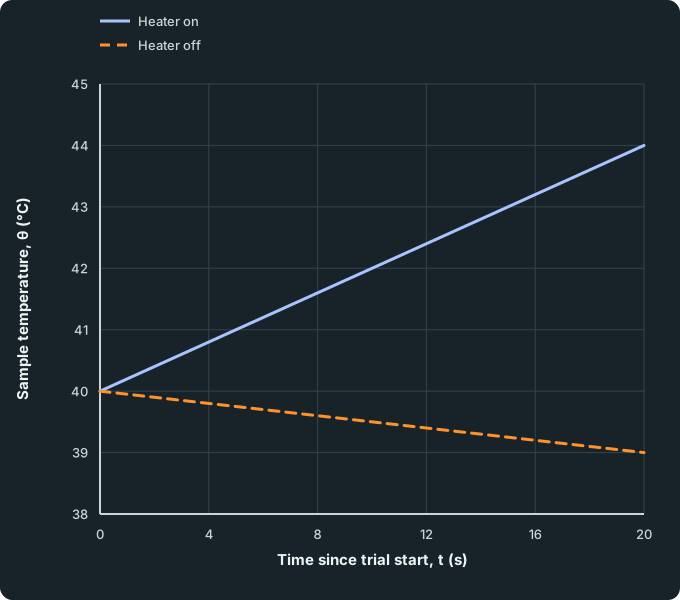
View figure data
| Time since trial start, t (s) | Heater on | Heater off |
|---|---|---|
| 0 | 40.0 | 40.00 |
| 1 | 40.2 | 39.95 |
| 2 | 40.4 | 39.90 |
| 3 | 40.6 | 39.85 |
| 4 | 40.8 | 39.80 |
| 5 | 41.0 | 39.75 |
| 6 | 41.2 | 39.70 |
| 7 | 41.4 | 39.65 |
| 8 | 41.6 | 39.60 |
| 9 | 41.8 | 39.55 |
| 10 | 42.0 | 39.50 |
| 11 | 42.2 | 39.45 |
| 12 | 42.4 | 39.40 |
| 13 | 42.6 | 39.35 |
| 14 | 42.8 | 39.30 |
| 15 | 43.0 | 39.25 |
| 16 | 43.2 | 39.20 |
| 17 | 43.4 | 39.15 |
| 18 | 43.6 | 39.10 |
| 19 | 43.8 | 39.05 |
| 20 | 44.0 | 39.00 |
Worked example 1
Specific heat capacity from the two slopes
Problem
For the trials in the graph, the heater power is 50.0 W, the sample has a mass of 0.400 kg, and the apparatus has a heat capacity of 40.0 J K⁻¹. Find the specific heat capacity of the sample and the power lost to the surroundings near 40 °C.
Show full solution
Slopes
Method
Read each temperature change over the 20 s shown.Reason
The plotted short straight sections approximate local gradients near 40 °C. The losses are taken as equal there.Working
Answer
sₕₑₐₜ = (+4.00)/20.0 = +0.200 K s⁻¹ and s_cool = (-1.00)/20.0 = -0.0500 K s⁻¹
Heat capacities
Reason
Subtracting the slopes removes the losses; the apparatus is then subtracted.Working
Answer
Cₜₒₜ = 50.0/(0.200-(-0.0500)) = 200 J K⁻¹, so c = (200-40.0)/0.400 = 400 J kg⁻¹ K⁻¹
Power lost
Working
Answer
H = -Cₜₒₜs_cool = 200 × 0.0500 = 10.0 W. Check: 50.0-10.0 = 40.0 W = 200 × 0.200.
Quick check
Using c = Pt/mΔθ alone would give 50.0/(0.400 × 0.200) = 625 J kg⁻¹ K⁻¹, much too large.
Guided practice 2
Heating and cooling at the same temperature
Problem
A 0.400 kg sample is heated at 60.0 W. At the same temperature, it warms at + 0.150 K s⁻¹ with the heater on and cools at -0.0500 K s⁻¹ with it off. The heat capacity of the apparatus is negligible. Find the specific heat capacity of the sample.
Find the specific heat capacity
Show the steps Optional working
Hints
Hint 1
the sign
sₕₑₐₜ-s_cool = 0.150-(-0.0500).
Show solution step by step
Heat capacity
Reason
The losses cancel because the slopes are at the same temperature.Working
Answer
C = 60.0/(0.150 + 0.0500) = 300 J K⁻¹
Specific heat capacity
Working
Answer
c = 300/0.400 = 750 J kg⁻¹ K⁻¹
Spot the mistake 3
The sign of the cooling slope
Problem
With a heater power of 72.0 W, a heating slope of + 0.250 K s⁻¹ and a cooling slope of -0.0500 K s⁻¹ at the same temperature, a learner calculates Cₜₒₜ = 72.0/(0.250-0.0500) = 360 J K⁻¹. Find the correct value.
Find the heat capacity
Show the steps Optional working
Show solution step by step
Correct denominator
Reason
The cooling slope is -0.0500, not + 0.0500.Working
Answer
0.250-(-0.0500) = 0.300 K s⁻¹
Heat capacity
Working
Answer
Cₜₒₜ = 72.0/0.300 = 240 J K⁻¹
Common mistake
The heater has to supply the energy that warms the sample and the energy that leaks away, so the correction must make the heat capacity smaller than P/sₕₑₐₜ = 288 J K⁻¹, not larger.
Try it yourself 4
Choosing the right cooling data
Problem
A 0.500 kg sample is heated at 90.0 W; the apparatus has a heat capacity of 150 J K⁻¹. Three temperature–time slopes were measured:
- heater on, at 40 °C: + 0.0800 K s⁻¹;
- heater off, at 40 °C: -0.0200 K s⁻¹;
- heater off, at 70 °C: -0.0600 K s⁻¹.
Find the specific heat capacity of the sample and the power lost at 40 °C.
Find both values
Show the steps Optional working
Hints
Hint 1
matching temperatures
The losses cancel only if both slopes are at the same temperature, so ignore the 70 °C reading.
Show solution step by step
Total heat capacity
Reason
Both slopes at 40 °C have the same losses.Working
Answer
Cₜₒₜ = 90.0/(0.0800 + 0.0200) = 900 J K⁻¹
Sample and losses
Working
Answer
c = (900-150)/0.500 = 1500 J kg⁻¹ K⁻¹ and H = 900 × 0.0200 = 18.0 W. The 70 °C cooling slope is larger because the sample loses energy faster when it is hotter; using it would give a wrong answer, about 986 J kg⁻¹ K⁻¹.
Check your understanding 1 Explain the correction
A student insulates a heater and sample, uses c = P/(msₕₑₐₜ), and says insulation makes any correction unnecessary. Explain why this can overestimate c. Describe how to use a cooling curve and the apparatus heat capacity to improve the result.
Show answer
Some heater power still leaves to the room, and some warms the apparatus. At the same temperature and surroundings, use the local signed heating and cooling gradients:
Subtract to obtain Cₜₒₜ = P/(sₕₑₐₜ-s_cool), then c = (Cₜₒₜ-Cₐₚₚ)/m. Check that your method matches temperatures, preserves the negative cooling sign, and removes apparatus capacity before dividing by sample mass. Insulation reduces losses; it does not remove the apparatus contribution.
Common mistakes
- Using c = Pt/mΔθ without allowing for losses and the apparatus, which makes c too large.
- Comparing heating and cooling slopes at different temperatures.
- Treating the cooling slope as positive when subtracting it.
- Dividing the total heat capacity by the sample’s mass without first subtracting the apparatus.
Spotted an error? Report a correction
Syllabus and review details
- GCE A-Level H2 Physics 2027 · 2027
Content Overview, PDF pages 9–10; Subject Content, PDF pages 11–30
Last reviewed: