Latent heat and multi-stage heating
Key idea: During an equilibrium phase change of a pure substance at fixed pressure, energy changes the state without changing temperature. The energy for mass m is mL.
Offline pages
Saved on this device only. Connect at least once every 30 days to confirm Premium. Sign-out or a change of account removes saved copies.
Loading guide controls…
Guided lessons · coming soon
Guided lesson
Guided steps
- Choose the changing phase and the mass that changes state.
- Predict what changes while solid remains at its melting point.
- Read the warming slopes and melting plateau width.
- Find the melting energy and specific latent heat.
- Follow warming, melting and liquid warming in order.
- Find latent heat and the energy released on freezing.
- Find the energy for melting at constant temperature.
- Find the final temperature and remaining ice after heating losses.
- Calculate latent heat and work, then explain the constant temperature.
- Find the energy released by condensation followed by cooling.
On this page
You stopped at:
ContinueAt atmospheric pressure, a pan of boiling water stays at 100 °C however high the gas is turned up; the extra energy just makes it boil away faster. While a substance melts or boils, the energy supplied changes its state instead of its temperature. The energy needed per kilogram is the specific latent heat.
Specific latent heat
The specific latent heat L of a substance is the energy needed to change the state of unit mass of it without any change in temperature:
L is measured in J kg⁻¹. The specific latent heat of fusion applies to melting (and the same energy is given out on freezing); the specific latent heat of vaporisation applies to boiling (and is given out on condensing). m is the mass that actually changes state, which may be less than the whole sample.
During melting at fixed pressure, the temperature, and so the mean kinetic energy of the molecules in this model, does not change. The energy changes their arrangement and increases their microscopic potential energy. Melting need not increase their average separation: ice becomes denser when it melts. Vaporisation needs much more energy than melting, because the molecules are pulled completely apart, and the gas also has to push back the atmosphere as it expands.
Check your understanding 1 Choose the energy account
A pure substance is held at its melting point while some solid remains. Energy continues to enter at fixed pressure. What changes first?
Show answer
More solid melts. Use Q = mL for the mass that changes phase, then use Q = mcΔθ only after the change of state is complete.
Heating curves
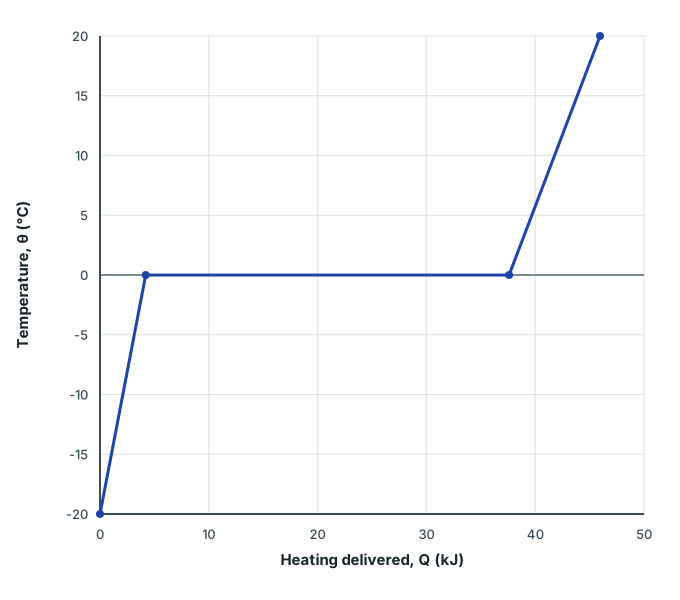
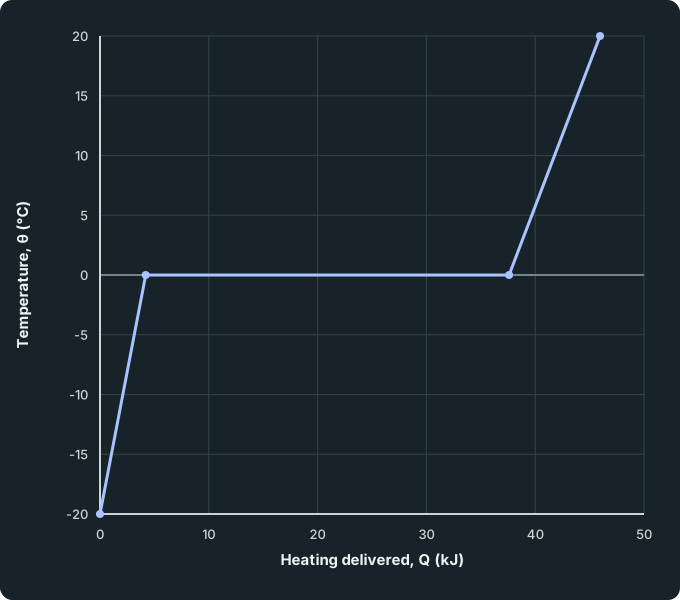
The graph shows the temperature of 0.100 kg of ice at -20 °C as energy is supplied to it until it is water at 20 °C. On the sloping parts, a single phase warms, and Q = mcΔθ with the specific heat capacity of that phase. On the flat part, ice and water are both present at 0 °C and the ice melts, using Q = mL. The energy for melting is the width of the flat part, not where it ends.
Heating ice, melting and warming water
Temperature rises from minus twenty to zero degrees Celsius by 4.20 kilojoules, stays at zero until 37.6 kilojoules, then reaches twenty degrees Celsius at 45.96 kilojoules.
Scroll across the figure to read all labels.
View figure data
| Heating delivered, Q (kJ) | Ice → mixture → water |
|---|---|
| 0.00 | -20 |
| 4.20 | 0 |
| 37.60 | 0 |
| 45.96 | 20 |
When the energy supplied may not be enough to finish a change of state, work through the stages in order: first warm the solid to its melting point, then see whether the energy left is enough to melt all of it. If not, the sample stays at the melting point as a mixture, and Q = mL gives the mass that has melted.
Check your understanding 2 Read the flat part
The heating curve above has a flat section from cumulative energy 4.20 kJ to 37.6 kJ. Find the energy used for melting and the specific latent heat for its 0.100 kg sample.
Show the steps Optional working
Show answer
Melting uses 37.6-4.20 = 33.4 kJ, so L = 33400/0.100 = 3.34 × 10⁵ J kg⁻¹. The 37.6 kJ coordinate also includes the earlier warming stage; it is not all latent heating.
Worked example 1
From ice to warm water
Problem
Find the energy needed to turn 0.100 kg of ice at -20 °C into water at 20 °C. Specific heat capacities: ice 2100 J kg⁻¹ K⁻¹, water 4180 J kg⁻¹ K⁻¹. Specific latent heat of fusion of ice: 3.34 × 10⁵ J kg⁻¹.
Show full solution
Warm the ice
Method
Use the specific heat capacity of ice from -20 °C to 0 °C.Reason
It stays solid until it reaches the melting point.Working
Answer
0.100 × 2100 × 20 = 4200 J
Melt the ice
Reason
At 0 °C the energy changes the state, not the temperature.Working
Answer
mL = 0.100 × 3.34 × 10⁵ = 33 400 J
Warm the water and add up
Working
Answer
0.100 × 4180 × 20 = 8360 J. Total: 4200 + 33 400 + 8360 = 4.60 × 10⁴ J
Quick check
On the graph, melting runs from 4.20 kJ to 37.6 kJ, a width of 33.4 kJ. Melting takes far more energy than either warming stage.
Guided practice 2
Melting and freezing
Problem
0.120 kg of a solid at its melting point melts completely when 18.0 kJ is supplied. Find its specific latent heat of fusion. How much energy is given out when the same mass of liquid freezes at that temperature?
Find both values
Show the steps Optional working
Hints
Hint 1
units
Convert 18.0 kJ to joules before dividing by the mass.
Show solution step by step
Specific latent heat
Reason
L is the energy per kilogram.Working
Answer
L = (18 000)/0.120 = 1.50 × 10⁵ J kg⁻¹
Freezing
Working
Answer
Freezing is the reverse change, so the liquid gives out 18.0 kJ: its microscopic potential energy falls as it becomes solid again.
Spot the mistake 3
No temperature change, no energy?
Problem
A learner says that melting 0.0500 kg of ice at 0 °C needs no energy, because mcΔθ = 0 when the temperature does not change. Find the energy actually needed. The specific latent heat of fusion of ice is 3.34 × 10⁵ J kg⁻¹.
Find the energy
Show solution step by step
The right equation
Reason
mcΔθ only applies within one phase.Working
Answer
Q = mL
Energy
Working
Answer
Q = 0.0500 × 3.34 × 10⁵ = 1.67 × 10⁴ J
Common mistake
A constant temperature means the mean kinetic energy of the molecules is constant, not that no energy is supplied. During melting, the energy increases their potential energy.
Try it yourself 4
Does all the ice melt?
Problem
0.0200 kg of ice at -10.0 °C is heated by a 50.0 W heater for 120 s. During this time, 800 J is lost to the surroundings. Find the final temperature and the mass of ice left. Specific heat capacity of ice: 2100 J kg⁻¹ K⁻¹; specific latent heat of fusion: 3.34 × 10⁵ J kg⁻¹.
Find both values
Show the steps Optional working
Show the steps Optional working
Hints
Hint 1
energy available
The heater supplies Pt, but 800 J of that is lost.
Hint 2
stages
Warm the ice to 0 °C first, then compare what is left with the energy needed to melt all of it.
Show solution step by step
Energy available
Reason
Losses do not reach the ice.Working
Answer
50.0 × 120-800 = 5200 J. Warming the ice to 0 °C uses 0.0200 × 2100 × 10.0 = 420 J, leaving 4780 J.
Melting
Working
Answer
Melting all of it would need 0.0200 × 3.34 × 10⁵ = 6680 J, more than 4780 J. So only 4780/(3.34 × 10⁵) = 0.0143 kg melts, leaving 0.00569 kg of ice, and the mixture stays at 0 °C.
Exam-style question 1
Boiling and the first law
Examination question
0.0400 kg of a liquid at its boiling point is supplied with 90.0 kJ and turns completely to vapour at a constant pressure of 100 kPa. Its volume increases by 0.0600 m³.
(a) Calculate the specific latent heat of vaporisation. [1 mark]
(b) Calculate the increase in internal energy of the substance. [3 marks]
(c) Explain why its temperature does not rise. [1 mark]
Write your answer before viewing the mark scheme
Show solution step by step
(a) Latent heat
1 markMethod
Divide the energy by the mass.Reason
All of the liquid changes state.Working
Answer
L = (90 000)/0.0400 = 2.25 × 10⁶ J kg⁻¹
(b) Internal energy
3 marksReason
The vapour expands against the outside pressure, so it does work.Working
Answer
Work done by the substance = pΔ V = (1.00 × 10⁵)(0.0600) = 6000 J, so W = -6000 J. Δ U = Q + W = 90 000-6000 = 8.40 × 10⁴ J.
(c) Temperature
1 markWorking
Answer
The energy separates the molecules, increasing their potential energy, while their mean kinetic energy, and so the temperature, stays the same.
Self-mark with the mark scheme
Tick each mark point that your answer includes.
Tick each point only if your answer states it clearly.
Check your understanding 3 Vapour becomes cooler liquid
A 0.0100 kg mass of water vapour at 100 °C condenses completely, then cools to 80.0 °C at atmospheric pressure. Find the total energy given out. Use Lᵥ = 2.26 × 10⁶ J kg⁻¹ and c_water = 4180 J kg⁻¹ K⁻¹.
Show the steps Optional working
Show answer
Condensation gives out 0.0100(2.26 × 10⁶) = 22600 J. Cooling the liquid gives out 0.0100(4180)(20.0) = 836 J. Total energy given out is 23436 J ≈ 2.34 × 10⁴ J. The signed heating into the water is negative, while the requested energy given out is its positive magnitude. Check the phase order and use the liquid’s heat capacity only for the cooling stage.
Common mistakes
- Using Q = mcΔθ during a change of state, which gives zero.
- Reading the energy for melting from the end of the flat part of a heating curve instead of its width.
- Assuming all the sample melts without checking that there is enough energy.
- Warming the water above the melting point while ice remains.
- Forgetting to convert kJ to J before dividing by the mass.
Spotted an error? Report a correction
Syllabus and review details
- GCE A-Level H2 Physics 2027 · 2027
Content Overview, PDF pages 9–10; Subject Content, PDF pages 11–30
Last reviewed: