Massless and low-speed energy limits
Key idea: The energy–momentum relation gives E = pc for zero rest mass. For a massive particle at low speed, total energy approaches mc² + ½mv²; the rest energy remains.
Offline pages
Saved on this device only. Connect at least once every 30 days to confirm Premium. Sign-out or a change of account removes saved copies.
Loading guide controls…
Guided lessons · coming soon
Guided lesson
Guided steps
- Before reading on, predict the total energy of a slow massive particle.
- Read why E = pc is exact when the rest mass is zero.
- Choose the condition, then find the photon's energy.
- Follow the expansion and notice which term is rest energy.
- Follow the expansion for a small momentum ratio.
- Derive the low-speed kinetic energy, then compare your steps.
- Compare the two kinetic-energy curves on the graph.
- Find both kinetic-energy ratios at 0.50c and the percentage difference.
- Compare a proton and a photon with the same momentum.
- Choose the right energy expression for each particle.
On this page
You stopped at:
ContinueThe energy–momentum relation, E² = (pc)² + (mc²)², covers both massive and massless particles. Its two required limits use different conditions: zero rest mass, or a massive particle moving slowly compared with light. Keep that distinction visible throughout each derivation.
Here E is total energy, p ≥ 0 is momentum magnitude and m is invariant rest mass. Use one inertial frame’s energy and momentum. The vacuum light speed is c; energy is in joules and momentum in kg m s⁻¹.
Check your understanding 1 Predict first
A massive particle moves at v≪ c. What does E² = (pc)² + (mc²)² give for its total energy?
Show answer
About mc² + (1/2)mv². At low speed pc≪ mc², so the rest energy dominates and the motion adds a small kinetic term. The section on low speed below derives this.
Massless means zero rest mass, not zero energy
Set the rest mass to zero in the energy–momentum relation:
Taking the positive-energy root, with momentum magnitude p ≥ 0, gives
This result is exact for a massless particle, such as a photon. It is not a low-speed approximation. A photon in vacuum travels at c and has no rest frame; the massive-particle expressions involving γ m cannot be evaluated by multiplying zero mass by an infinite Lorentz factor.
For a massive particle, E > pc. At sufficiently large momentum pc≫ mc², E ≈ pc can be an approximation even though m is still non-zero. State the condition rather than describing such a particle as massless.
Guided practice 1
A photon moving along the negative axis
Problem
Try this before viewing the solution
Hints
Hint 1
direction and magnitude
The energy relation uses p = |pₓ| here. The negative component tells you the direction.Hint 2
choose the physical square root
Set m = 0 and take positive energy after taking the square root.Show solution step by step
Apply zero rest mass
Method
Set m = 0 in the energy–momentum relation.Reason
The photon is massless; a rest-frame Lorentz factor is not available.Working
Answer
E² = (pc)².Take the positive root
Method
Use p = |pₓ| and E = pc.Reason
Energy is positive regardless of the chosen direction of the axis.Working
Answer
p = 2.4 × 10⁻²⁷ kg m s⁻¹.Calculate
Method
Multiply momentum magnitude by the vacuum light speed.Reason
Use c = 3.00 × 10⁸ m s⁻¹ and round the final answer to two significant figures.Working
Answer
E = (2.4 × 10⁻²⁷)(3.00 × 10⁸) = 7.2 × 10⁻¹⁹ J.
Quick check
Low speed retains rest energy
Now let m > 0 and v≪ c. Factor out the rest-energy scale:
For a small dimensionless quantity ε, the binomial approximation is square root of (1 + ε) ≈ 1 + ε/2. Here
because γ ≈ 1 at low speed. Substitution gives
Using p ≈ mv in this same regime,
The first term is rest energy; only the second is the leading kinetic-energy term. Subtracting mc² recovers K ≈ (1/2)mv². Do not divide by m in this derivation and then put m = 0: it was derived for a massive particle.
Worked example 2
A small momentum correction
Problem
Show full solution
Factor out rest energy
Method
Write the energy as a dimensionless square root.Reason
The small quantity must be a ratio with no units.Working
Answer
E/(mc²) = square root of (1 + 0.10²).Keep the leading correction
Method
Use square root of (1 + ε) ≈ 1 + ε/2 with ε = 0.010.Reason
The expansion parameter is the squared momentum ratio.Working
Answer
E/(mc²) ≈ 1 + 0.010/2 = 1.005.Separate kinetic energy
Method
Subtract the rest-energy ratio one.Reason
Total energy and kinetic energy are different quantities.Working
Answer
K/(mc²) ≈ 0.0050.
Quick check
Spot the mistake 3
Low-speed check
Learner claim
A learner says K = (γ-1)mc² cannot agree with K = (1/2)mv² because it contains rest-energy factors. Use the low-speed expansion to correct the claim.
Try this before viewing the solution
Show solution step by step
Expand gamma
Method
For a massive particle at v≪ c, retain the leading correction.
Reason
Expand (1-v²/c²)^(-1/2) to first order in v²/c².
Working
Answer
γ ≈ 1 + (1/2)v²/c²Subtract rest contribution
Method
γ-1 removes the leading one.Reason
Kinetic energy excludes rest energy.Working
Answer
γ-1 ≈ (1/2)v²/c²Cancel factors
Method
The c² factors cancel.Reason
The classical kinetic-energy scale remains.Working
Answer
K ≈ ((1/2)v²/c²)mc² = (1/2)mv²
Common mistake
The relativistic expression contains rest-energy units, but subtracting one from γ isolates the motion-dependent part.
Decide whether the approximation is accurate enough
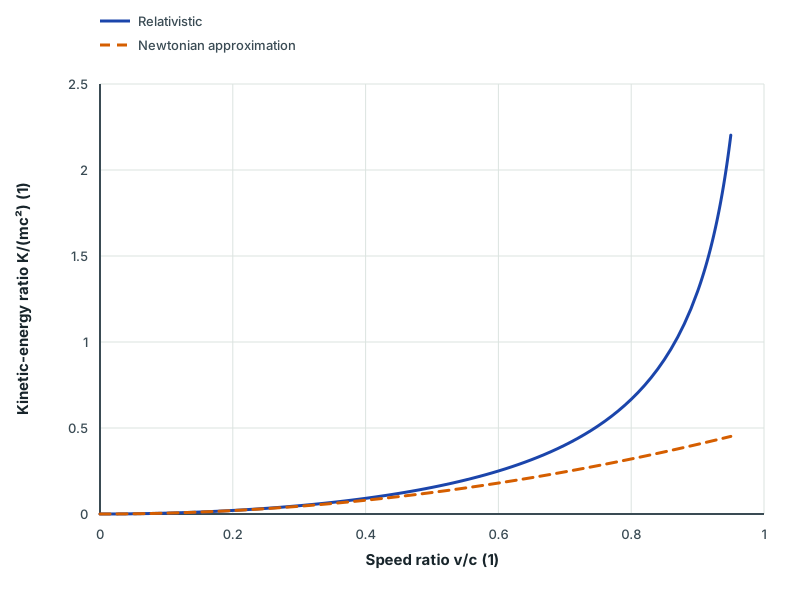
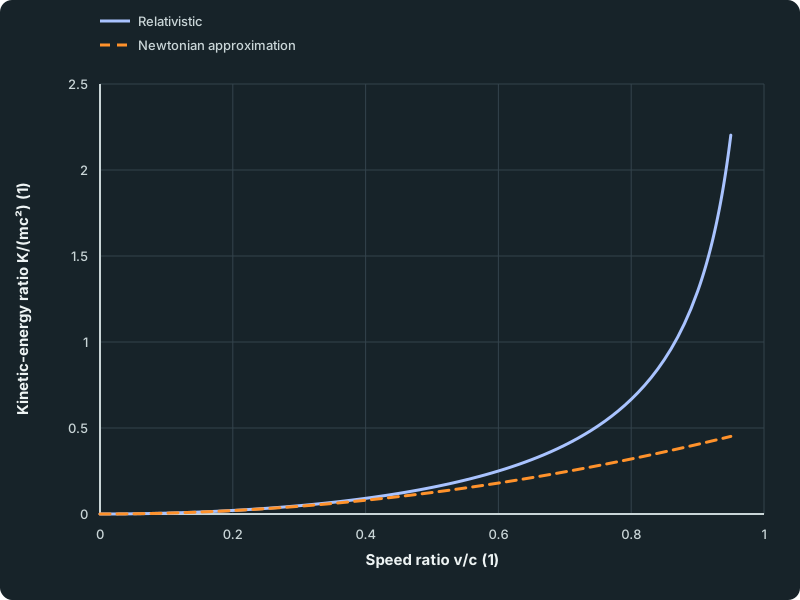
For a massive particle, write β = v/c and divide kinetic energy by the non-zero scale mc²:
Exact and Newtonian kinetic energy
Both curves begin at zero and agree closely at low speed. The exact kinetic-energy ratio rises increasingly above the Newtonian curve as speed approaches c. The normalisation requires m greater than zero.
Scroll across the figure to read all labels.
View figure data
| Speed ratio v/c (1) | Relativistic | Newtonian approximation |
|---|---|---|
| 0.000 | 0.00000000 | 0.0000000 |
| 0.010 | 0.00005000 | 0.0000500 |
| 0.020 | 0.00020006 | 0.0002000 |
| 0.030 | 0.00045030 | 0.0004500 |
| 0.040 | 0.00080096 | 0.0008000 |
| 0.050 | 0.00125235 | 0.0012500 |
| 0.060 | 0.00180487 | 0.0018000 |
| 0.070 | 0.00245904 | 0.0024500 |
| 0.080 | 0.00321544 | 0.0032000 |
| 0.090 | 0.00407477 | 0.0040500 |
| 0.100 | 0.00503782 | 0.0050000 |
| 0.110 | 0.00610546 | 0.0060500 |
| 0.120 | 0.00727871 | 0.0072000 |
| 0.130 | 0.00855863 | 0.0084500 |
| 0.140 | 0.00994645 | 0.0098000 |
| 0.150 | 0.01144347 | 0.0112500 |
| 0.160 | 0.01305112 | 0.0128000 |
| 0.170 | 0.01477094 | 0.0144500 |
| 0.180 | 0.01660460 | 0.0162000 |
| 0.190 | 0.01855389 | 0.0180500 |
| 0.200 | 0.02062073 | 0.0200000 |
| 0.210 | 0.02280718 | 0.0220500 |
| 0.220 | 0.02511546 | 0.0242000 |
| 0.230 | 0.02754791 | 0.0264500 |
| 0.240 | 0.03010705 | 0.0288000 |
| 0.250 | 0.03279556 | 0.0312500 |
| 0.260 | 0.03561628 | 0.0338000 |
| 0.270 | 0.03857224 | 0.0364500 |
| 0.280 | 0.04166667 | 0.0392000 |
| 0.290 | 0.04490299 | 0.0420500 |
| 0.300 | 0.04828484 | 0.0450000 |
| 0.310 | 0.05181608 | 0.0480500 |
| 0.320 | 0.05550083 | 0.0512000 |
| 0.330 | 0.05934343 | 0.0544500 |
| 0.340 | 0.06334853 | 0.0578000 |
| 0.350 | 0.06752103 | 0.0612500 |
| 0.360 | 0.07186616 | 0.0648000 |
| 0.370 | 0.07638947 | 0.0684500 |
| 0.380 | 0.08109688 | 0.0722000 |
| 0.390 | 0.08599464 | 0.0760500 |
| 0.400 | 0.09108945 | 0.0800000 |
| 0.410 | 0.09638841 | 0.0840500 |
| 0.420 | 0.10189911 | 0.0882000 |
| 0.430 | 0.10762960 | 0.0924500 |
| 0.440 | 0.11358851 | 0.0968000 |
| 0.450 | 0.11978502 | 0.1012500 |
| 0.460 | 0.12622896 | 0.1058000 |
| 0.470 | 0.13293084 | 0.1104500 |
| 0.480 | 0.13990188 | 0.1152000 |
| 0.490 | 0.14715414 | 0.1200500 |
| 0.500 | 0.15470054 | 0.1250000 |
| 0.510 | 0.16255494 | 0.1300500 |
| 0.520 | 0.17073226 | 0.1352000 |
| 0.530 | 0.17924856 | 0.1404500 |
| 0.540 | 0.18812114 | 0.1458000 |
| 0.550 | 0.19736868 | 0.1512500 |
| 0.560 | 0.20701137 | 0.1568000 |
| 0.570 | 0.21707109 | 0.1624500 |
| 0.580 | 0.22757154 | 0.1682000 |
| 0.590 | 0.23853850 | 0.1740500 |
| 0.600 | 0.25000000 | 0.1800000 |
| 0.610 | 0.26198664 | 0.1860500 |
| 0.620 | 0.27453185 | 0.1922000 |
| 0.630 | 0.28767225 | 0.1984500 |
| 0.640 | 0.30144802 | 0.2048000 |
| 0.650 | 0.31590339 | 0.2112500 |
| 0.660 | 0.33108717 | 0.2178000 |
| 0.670 | 0.34705334 | 0.2244500 |
| 0.680 | 0.36386181 | 0.2312000 |
| 0.690 | 0.38157925 | 0.2380500 |
| 0.700 | 0.40028008 | 0.2450000 |
| 0.710 | 0.42004774 | 0.2520500 |
| 0.720 | 0.44097604 | 0.2592000 |
| 0.730 | 0.46317094 | 0.2664500 |
| 0.740 | 0.48675258 | 0.2738000 |
| 0.750 | 0.51185789 | 0.2812500 |
| 0.760 | 0.53864364 | 0.2888000 |
| 0.770 | 0.56729031 | 0.2964500 |
| 0.780 | 0.59800693 | 0.3042000 |
| 0.790 | 0.63103709 | 0.3120500 |
| 0.800 | 0.66666667 | 0.3200000 |
| 0.810 | 0.70523372 | 0.3280500 |
| 0.820 | 0.74714139 | 0.3362000 |
| 0.830 | 0.79287493 | 0.3444500 |
| 0.840 | 0.84302445 | 0.3528000 |
| 0.850 | 0.89831599 | 0.3612500 |
| 0.860 | 0.95965450 | 0.3698000 |
| 0.870 | 1.02818479 | 0.3784500 |
| 0.880 | 1.10537980 | 0.3872000 |
| 0.890 | 1.19317232 | 0.3960500 |
| 0.900 | 1.29415734 | 0.4050000 |
| 0.901 | 1.30510835 | 0.4059005 |
| 0.902 | 1.31623013 | 0.4068020 |
| 0.903 | 1.32752706 | 0.4077045 |
| 0.904 | 1.33900371 | 0.4086080 |
| 0.905 | 1.35066482 | 0.4095125 |
| 0.906 | 1.36251527 | 0.4104180 |
| 0.907 | 1.37456017 | 0.4113245 |
| 0.908 | 1.38680479 | 0.4122320 |
| 0.909 | 1.39925462 | 0.4131405 |
| 0.910 | 1.41191535 | 0.4140500 |
| 0.911 | 1.42479291 | 0.4149605 |
| 0.912 | 1.43789345 | 0.4158720 |
| 0.913 | 1.45122337 | 0.4167845 |
| 0.914 | 1.46478934 | 0.4176980 |
| 0.915 | 1.47859830 | 0.4186125 |
| 0.916 | 1.49265747 | 0.4195280 |
| 0.917 | 1.50697439 | 0.4204445 |
| 0.918 | 1.52155690 | 0.4213620 |
| 0.919 | 1.53641319 | 0.4222805 |
| 0.920 | 1.55155182 | 0.4232000 |
| 0.921 | 1.56698170 | 0.4241205 |
| 0.922 | 1.58271216 | 0.4250420 |
| 0.923 | 1.59875295 | 0.4259645 |
| 0.924 | 1.61511427 | 0.4268880 |
| 0.925 | 1.63180678 | 0.4278125 |
| 0.926 | 1.64884166 | 0.4287380 |
| 0.927 | 1.66623063 | 0.4296645 |
| 0.928 | 1.68398594 | 0.4305920 |
| 0.929 | 1.70212050 | 0.4315205 |
| 0.930 | 1.72064781 | 0.4324500 |
| 0.931 | 1.73958209 | 0.4333805 |
| 0.932 | 1.75893826 | 0.4343120 |
| 0.933 | 1.77873206 | 0.4352445 |
| 0.934 | 1.79898001 | 0.4361780 |
| 0.935 | 1.81969956 | 0.4371125 |
| 0.936 | 1.84090909 | 0.4380480 |
| 0.937 | 1.86262800 | 0.4389845 |
| 0.938 | 1.88487679 | 0.4399220 |
| 0.939 | 1.90767711 | 0.4408605 |
| 0.940 | 1.93105191 | 0.4418000 |
| 0.941 | 1.95502546 | 0.4427405 |
| 0.942 | 1.97962350 | 0.4436820 |
| 0.943 | 2.00487335 | 0.4446245 |
| 0.944 | 2.03080403 | 0.4455680 |
| 0.945 | 2.05744640 | 0.4465125 |
| 0.946 | 2.08483331 | 0.4474580 |
| 0.947 | 2.11299978 | 0.4484045 |
| 0.948 | 2.14198315 | 0.4493520 |
| 0.949 | 2.17182335 | 0.4503005 |
| 0.950 | 2.20256308 | 0.4512500 |
At 0.10c, the ratios are about 0.005038 and 0.005000: the exact kinetic energy is about 0.76% above the Newtonian value. At 0.80c, they are 2/3 and 0.32, a substantial difference. The normalisation lets the same graph describe any non-zero rest mass.
There is no single speed cutoff for every calculation. “Low speed” means that the omitted terms are small enough for the precision required. The graph is sampled below c; a massive particle cannot have a finite-energy point at v = c.
Check your understanding 2 How good is ½mv² at half the speed of light?
At v = 0.50c, find Kᵣₑₗ/(mc²) and K_Newtonian/(mc²). By what percentage is the exact kinetic energy larger?
Show the steps Optional working
Show the steps Optional working
Show answer
γ = 1/square root of 0.75 = 1.1547, so Kᵣₑₗ/(mc²) = 0.155. The Newtonian ratio is 0.125. The exact value is about 24% larger, so (1/2)mv² is not accurate at 0.50c for most purposes.
Check your understanding 3 Choose the condition, not just the shorter formula
A proton and a photon have the same momentum magnitude. Which has the larger total energy? Is the proton’s energy exactly pc if its speed is close to c?
Show answer
The proton has non-zero rest mass, so its total energy is square root of ((pc)² + (mc²)²) > pc. The photon’s energy is exactly pc. For the proton, E ≈ pc can be a good approximation when pc≫ mc², but the rest-mass term remains non-zero and the equality is not exact.
Try it yourself 4
Choose from particle data
Problem
Three particles have these data: A: m = 0 and p > 0; B: m > 0 and v = 0.020c; C: m > 0 and v = 0.80c. Choose an expression for the total energy of A and B, and find C’s total energy as a multiple of mc². Explain on paper where an approximation is made and whether the rest-energy term is present; compare with the solution.
Try this before viewing the solution
Hints
Hint 1
read the regime first
Separate a condition on rest mass from a condition on speed. Then decide whether the square-root relation can be simplified exactly or approximately.
Show solution step by step
Particle A
Method
Use E = pc exactly.Reason
The rest mass is zero, while the stated momentum is non-zero.
Working
Answer
mc² = 0.Particle B
Method
Use E ≈ mc² + (1/2)mv² if leading-order low-speed accuracy is sufficient.
Reason
v²/c² = 0.0004 is small.Working
Answer
K ≈ (1/2)mv²; total energy still includes mc².
Particle C
Method
Use the exact relation, or equivalently E = γ mc².
Reason
v/c = 0.80 is not a low-speed regime.Working
Answer
E = (5/3)mc², including rest energy.
Quick check
Zero mass and small speed justify different limits. Neither permits you to treat the total energy of a massive particle as kinetic energy alone.
Common mistakes
- Treating E = pc as a low-speed result; it is exact only for a massless particle.
- Dropping the rest energy mc² when taking the low-speed limit of the total energy.
- Putting m = 0 into γ mc² for a photon.
- Calling a fast massive particle massless because E ≈ pc.
- Assuming a single speed below which Newtonian kinetic energy is always accurate enough.
Spotted an error? Report a correction
Syllabus and review details
- GCE A-Level H3 Physics 2027 · 2027
9814 additional Subject Content, PDF pages 9–13; the full 9478 profile is inherited separately