Investigating motion and balance
Key idea: Measure falling motion to find g from a graph. For balance, compare opposing moments; intersect plumb lines from different suspension points to find a lamina's centre of gravity.
Offline pages
Saved on this device only. Connect at least once every 30 days to confirm Premium. Sign-out or a change of account removes saved copies.
Loading guide controls…
Guided lessons · coming soon
Guided lesson
Guided steps
- Match the timing events to the measured distance.
- Follow how the graph’s gradient gives g.
- Estimate g, then choose how to improve the timing.
- Compare steady motion with acceleration.
- Use the motion to find the resultant force.
- Read how moments and suspension lines locate balance.
- Balance both moments and account for the ruler’s weight.
- Plan a clearer centre-of-gravity measurement and a check.
- Check the timing, forces and perpendicular distances.
On this page
You stopped at:
ContinueMotion and balance investigations ask different questions. For motion, measure how velocity changes. For balance, measure the forces and where they act. Match the evidence to the question before choosing a calculation.
Follow your teacher’s setup. Secure stands, use a catch tray for falling masses and keep hands and feet clear. Stabilise rulers and trolleys before changing loads. A written plan is preparation for supervised practical work.
Connect free-fall timing to a graph
The most direct method uses a data logger or light gates to record the falling object’s velocity at several times. The gradient of the velocity–time graph is the acceleration of free fall, g.
With only a stopwatch or a single timer, time a fall from rest through a measured distance s. With negligible air resistance, the velocity rises steadily from 0 to gt, so the distance fallen is the area of the triangle under the velocity–time graph:
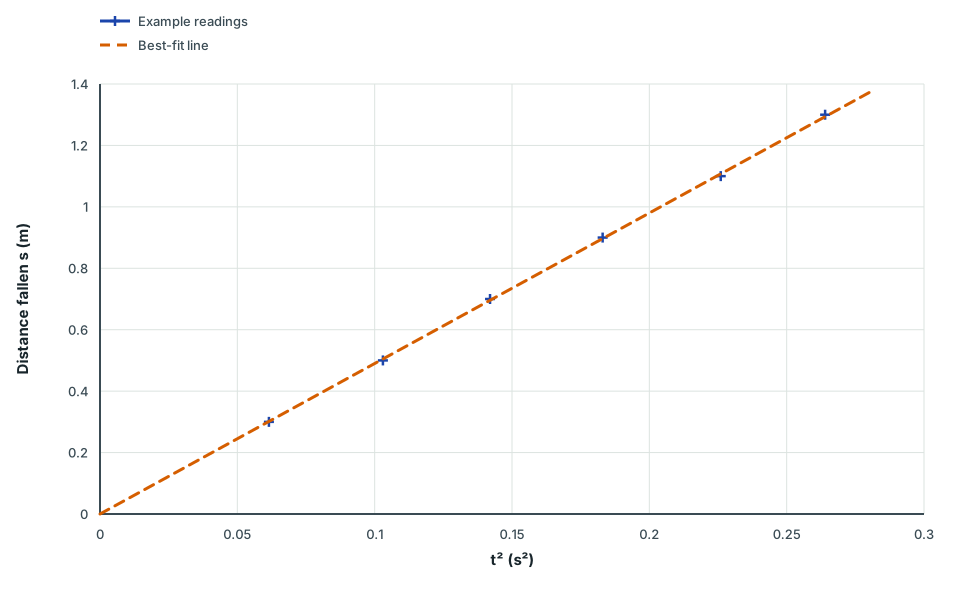
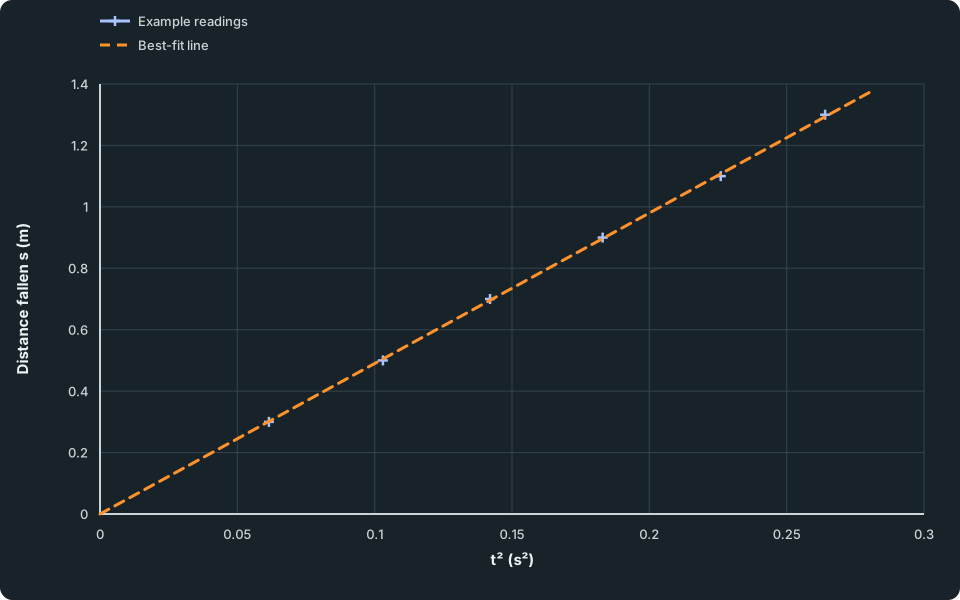
Plotting distance fallen against time squared therefore gives a straight line through the origin. Its gradient is g/2; multiplying by two estimates g.
Use electronic timing or a supplied data logger when appropriate. Measure the distance for the same start and stop events. If a ball starts timing only after passing a gate below its release point, it already has a speed: the released-from-rest equation does not apply directly between that gate and a later one.
Fall distance against time squared
Plotted points of fall distance s in m against t² in s² for distances from 0.300 m to 1.300 m, with a dashed best-fit straight line through the origin. The data table lists every plotted value.
Scroll across the figure to read all labels.
View figure data
| Series | t² (s²) | Distance fallen s (m) |
|---|---|---|
| Example readings | 0.0615 | 0.300 |
| Example readings | 0.1030 | 0.500 |
| Example readings | 0.1420 | 0.700 |
| Example readings | 0.1830 | 0.900 |
| Example readings | 0.2260 | 1.100 |
| Example readings | 0.2640 | 1.300 |
| Best-fit line | 0.0000 | 0.000 |
| Best-fit line | 0.2800 | 1.372 |
These are constructed teaching readings, not measured results from your own experiment. On the fitted line, the points (0.050 s², 0.245 m) and (0.250 s², 1.225 m) give a large gradient triangle: (1.225-0.245)/(0.250-0.050) = 4.90 m/s². Thus g = 9.80 m/s². Inspect the spread and intercept rather than forcing every experimental line through the origin.
Determination of the value of the acceleration of free fall
Method
Release an object from rest through a measured distance and use electronic timing or light gates to reduce reaction delay. Repeat at several distances or trials, then determine g from s = ½gt² or the gradient of an appropriate graph.
Why it works
A valid determination links a measured displacement to motion from rest. Electronic timing, a consistent release and multiple data points reduce timing uncertainty and test whether the chosen linearised relationship fits.
A mistake to avoid: Acceleration of free fall is found by dividing one measured distance by one fall time.
Check your understanding
If you plot distance against time squared, what does the gradient represent and how do you obtain g from it?
Show answer
For release from rest with negligible air resistance, s = ½gt². With s on the vertical axis and t² on the horizontal axis, gradient = g/2, so g is twice the gradient. A start gate below the release point does not start with zero speed.
Worked example 1
Obtain g from a graph
Problem
For an object released from rest, an s-against-t² best-fit line has gradient 4.85 m/s². Air resistance is negligible. Find g and explain why the gradient is not g itself.
Show full solution
Identify the model
Method
Use s = ½gt² for release from rest.Reason
With s on the vertical axis and t² on the horizontal axis, the coefficient of t² is the gradient.
Working
Answer
Gradient = ½g, so g = 2 × gradient.Calculate and evaluate
Method
Double the supplied gradient.Reason
A gradient has unit m/s² here, matching an acceleration.
Working
Answer
g = 2 × 4.85 = 9.70 m/s². Check the timing and calibration before judging the measurement’s accuracy.
Quick check
The plotted example elsewhere in this lesson has a different fitted gradient, 4.90 m/s², giving 9.80 m/s². Use the line and data actually supplied.
Check your understanding 1 A hand-timed fall
A student times a 1.00 m fall from rest as 0.60 s and uses g = 2s/t². Calculate the estimate, choose the effect of a time that is too large, and select an improvement that addresses timing. Use a rounded value to two significant figures or your unrounded calculation.
Show answer
g = 2 × 1.00/0.60² = 5.56 m/s², or 5.6 m/s² to two significant figures. A time that is too large increases the denominator and makes g too small. Use suitable electronic release/detection, measure the matching distance, repeat at several distances and use a best-fit graph. Check detector delays: electronic timing does not make all timing errors disappear.
Observe forces through their effects
Balanced forces give zero acceleration. An object can be stationary or move at constant velocity. Compare repeated velocity measurements on a fixed-mass trolley before and after changing its resultant force. Keep track conditions fixed; friction contributes to the resultant force.
Investigation of the effects of balanced and unbalanced forces
Method
Apply known forces to a trolley or object while controlling mass and resistance. Measure motion before and after changing the resultant force, and compare balanced-force trials with unbalanced-force trials using repeated speed or acceleration data.
Why it works
Balanced forces give zero resultant force and therefore no acceleration; the object may be stationary or move at constant velocity. An unbalanced force changes velocity, so the investigation must measure motion rather than merely observe that forces are present.
A mistake to avoid: Balanced forces mean the object must be at rest, while any moving object has an unbalanced force.
Check your understanding
A trolley moves at constant velocity. What does this tell you about its resultant force, and what measurement would show that the forces have become unbalanced?
Show answer
Constant velocity means zero acceleration and therefore zero resultant force. Individual forces may still act and balance. Measure velocity at successive times after changing the resultant force; a change in velocity shows acceleration.
Spot the mistake 2
Can balanced forces act on a moving trolley?
Problem
A trolley covers equal distances in equal times along a straight track. A student says its motion proves there is a forward resultant force. Choose the motion described by these readings, state the resultant force for constant velocity, and choose a measurement for an unbalanced-force trial.
Try before revealing the solution
Show solution step by step
Interpret the motion
Method
Equal distances in equal times on a straight track indicate constant velocity.
Reason
Resultant force determines acceleration, rather than whether an object is moving.
Working
Answer
Constant velocity means zero acceleration; within the measurement precision the resultant force is zero.
Test a change
Method
Apply a different resultant force while keeping the trolley mass fixed, then measure how velocity changes.
Reason
Use acceleration readings to tell whether the forces balance.
Working
Answer
Measure speed at several times with an appropriate sensor. Compare repeated trials while keeping track conditions the same; account for friction.
Common mistake
Steady velocity means zero resultant force. Individual forces may still act and balance each other.
Measure turning effects and a centre of gravity
A moment uses the perpendicular distance from the pivot to the line of action of the force. Draw that line first when the force is angled. For a horizontal body at rest, include all relevant moments, including its own weight where needed, and compare total clockwise and anticlockwise moments.
Suspend a lamina freely and draw the vertical shown by a plumb line. Its centre of gravity lies on that line. Repeat from another suspension point; the intersection of the lines estimates the centre of gravity.
The principle of moments
Method
Balance a rigid body about a known pivot, measure each force and its perpendicular distance from the pivot, then compare total clockwise and anticlockwise moments. Repeat with different loads and positions while checking that the body is horizontal and stationary.
Why it works
Moment = force × perpendicular distance from the pivot to the force's line of action. Equilibrium requires zero resultant force and equal total clockwise and anticlockwise moments, within measurement uncertainty.
A mistake to avoid: Moment is force multiplied by the distance along the ruler from its end.
Check your understanding
A force acts at an angle to a ruler. Which distance must you measure before calculating its moment?
Show answer
Use the shortest, perpendicular distance from the pivot to the force’s line of action. A distance measured along a sloping ruler is not automatically that distance. Include the ruler’s own weight when its centre of gravity is away from the pivot.
Guided practice 3
Balance opposite moments
Problem
A horizontal, uniform ruler pivots at its centre, so its weight produces no moment about the pivot. A downward 3.0 N force acts 0.20 m to the left. A downward 2.0 N force acts on the right. Where should it act to balance the ruler? Give the left moment, the required distance on the right and the reason the ruler’s weight contributes no moment in this arrangement.
Try before revealing the solution
Hints
Hint 1
Find the decisive relationship
Write the two opposite moments before solving for distance.
Show solution step by step
Choose the distance
Method
Use perpendicular distance to each force’s line of action.
Reason
The forces are vertical and the ruler horizontal, so the measured horizontal distances are perpendicular.
Working
Answer
Left moment = 3.0 N × 0.20 m = 0.60 N m.Match the turning effects
Method
Set the clockwise moment equal to the anticlockwise moment.
Reason
The pivot supplies an upward force; rotational balance also needs the opposite turning effects to cancel.
Working
Answer
2.0 N × d = 0.60 N m, so d = 0.30 m to the right. Check: 2.0 × 0.30 = 0.60 N m.
Quick check
If the pivot is away from the centre of gravity, include the ruler’s weight and its moment. Distance along a sloping ruler may not be the perpendicular distance.
Try it yourself 4
Locate a centre of gravity
Problem
Two suspension points on an irregular lamina are only a few millimetres apart. Their drawn vertical lines nearly coincide, and the student chooses a centre guessed from the outline. Explain a better determination and a check.
Try before revealing the solution
Plan or sketch the improved determination on paper or here. Compare how your method produces a clear intersection and checks it; you don’t need to type up an answer written on paper.
Hints
Hint 1
Choose the relevant evidence
Which direction does the weight act when the lamina hangs freely? What makes two drawn lines intersect clearly?
Show solution step by step
Use gravity’s direction
Method
Suspend the lamina freely and use a plumb line through the suspension point to draw a vertical.
Reason
At rest, the centre of gravity lies vertically below that point.
Working
Answer
Let the lamina and plumb line settle before marking; keep them free of the stand.
Obtain independent lines
Method
Repeat from well-separated points and use the intersection.
Reason
Nearly coincident lines give a poorly defined intersection, so a small marking error can shift it greatly.
Working
Answer
Draw at least two well-separated suspension lines, preferably a third as a check. A centre guessed from the outline need not be the measured centre of gravity. Use the suspension evidence rather than the guess.
Check the estimate
Method
Balance the lamina on a suitable small support at the estimated point under supervision.
Reason
Balance provides a different physical check of the intersection.
Working
Answer
If it tips consistently, inspect line alignment and the suspension method rather than simply averaging arbitrary centres.
Quick check
Compare all three parts: freely suspended and settled with a plumb line; distinct vertical lines from well-separated suspension points; a third line or supervised physical balance check.
Secure the stand and handle pins and masses as instructed. The method locates a physical balance point, not a shape guessed by eye.
Determination of the position of the centre of gravity of a plane lamina
Method
Suspend the plane lamina freely from one point and draw the vertical line indicated by a plumb line. Repeat from at least two well-separated suspension points; the line intersection estimates the centre of gravity, which can be checked by balancing there.
Why it works
When the lamina hangs freely, its centre of gravity lies vertically below the suspension point. Multiple lines provide independent evidence and reveal drawing or alignment uncertainty.
A mistake to avoid: The centre of gravity is always the geometric centre, even for an irregular lamina.
Check your understanding
Why should the two suspension points on a lamina be well separated rather than close together?
Show answer
Well-separated points usually produce lines that cross at a clearer angle, so small tracing errors have less effect on the estimated intersection. Let the lamina hang freely, use the plumb line and add a third suspension as a check.
Common mistakes
- Using g = 2s/t² when timing starts after the object is already moving.
- Forcing every graph line through the origin instead of drawing the best-fit line through the points.
- Saying a moving object must have a resultant force on it. At constant velocity the resultant force is zero.
- Measuring a moment arm along a sloping ruler instead of perpendicular to the force’s line of action.
- Writing “measure carefully” as an improvement. Name the error, its effect, and a method that reduces it.
Spotted an error? Report a correction
Syllabus and review details
- SEC G3 Physics 2027 · 2027
Content Structure, PDF page 9; Subject Content, PDF pages 10–28
Last reviewed: