Kinetic particle model of matter
Key idea: States, particle explanations, temperature, internal energy and constant-temperature changes of state.
Continue where you stopped
The core idea
Syllabus and review details
Build the particle model first: states, particle explanations, temperature, internal energy and constant-temperature changes of state. Thermal equilibrium, conduction, convection and radiation come in the following lesson.
- K326 / K327 Science Physics componentK326 / K327 · 2027Checked against the syllabus · complete topic coverageK326/K327 2027 syllabus, Kinetic Particle Model of Matter topic 7
Start with observable properties
Compare what each state does before explaining why. “Fixed” refers to the sample’s own shape or volume under ordinary conditions.
| Property | Solid | Liquid | Gas |
|---|---|---|---|
| Shape | fixed | takes container shape | fills container |
| Volume | fixed | fixed | not fixed |
| Compression | very difficult | very difficult | readily compressed |
| Flow | does not flow | flows | flows |
Explain properties with four particle features
These particle models are schematic, not to scale. Circles represent particles; the gaps are spaces between particles, not pockets of air. The same-sized circles help distinguish a change in spacing from a change in particle size.
A complete particle explanation names the particles’ arrangement, motion, separation and the relative forces between them.
Solid
- closely packed in an ordered arrangement;
- vibrate about fixed positions;
- strong attractive forces resist separation.
Therefore: fixed shape and volume; almost incompressible.
Liquid
- close together but not in fixed positions;
- move and slide past one another;
- attractions keep the particles close.
Therefore: fixed volume but changes shape and flows.
Gas
- far apart with no regular arrangement;
- move rapidly and randomly;
- forces are negligible except during close encounters.
Therefore: fills its container and is compressible.
Temperature tracks average particle kinetic energy
When a body’s temperature rises, the average kinetic energy of all its particles increases. “Average” matters: particles do not all move with the same kinetic energy.
Compare the average and the whole sample separately
A 100 g sample and a 200 g sample of the same liquid are both at 25 °C. Their particles have the same average kinetic energy in this model. The 200 g sample contains twice as many particles, so its total particle kinetic energy is twice as large. More particles do not make the temperature higher.
Your turn: two samples of the same gas have different temperatures, but their amounts are unknown. Which sample has greater average particle kinetic energy? Can you also rank their total particle kinetic energies?
Check the two comparisons
The hotter sample has greater average particle kinetic energy. Total kinetic energy also depends on how many particles are present, so the temperatures alone do not determine its ranking.
Internal energy is a total microscopic energy store
A system’s internal energy is the sum of:
Total particle kinetic energy
Energy associated with the random motion of all particles.
Total particle potential energy
Energy associated with particle positions and forces between them.
Internal energy is a total, so it depends on both particle-scale energies and how many particles the system contains. Two samples can have the same temperature but different internal energies.
During a state change, energy transfers without changing temperature
For a pure substance at constant pressure at its change-of-state temperature, melting, solidification, boiling and condensation occur while the temperature remains constant.
Read temperature first, then explain the energy change
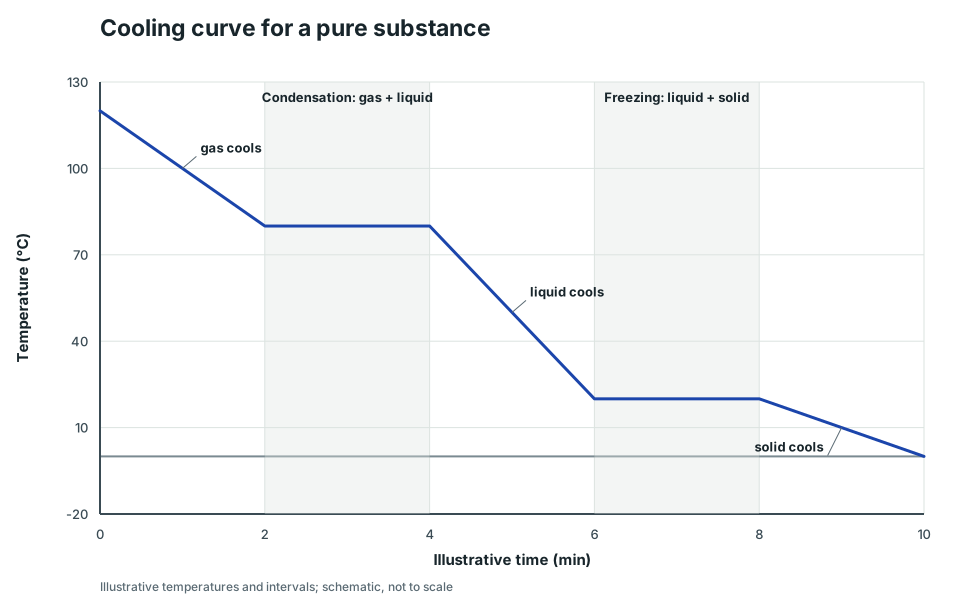
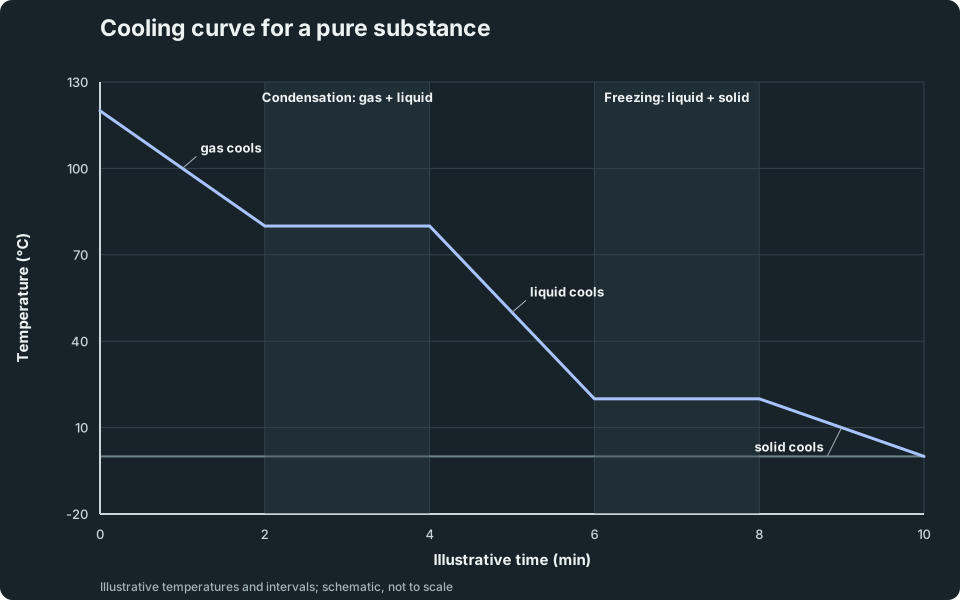
Cooling curve for a pure substance
Schematic temperature–time graph falling from gas to solid. A plateau at 80 degrees Celsius marks condensation and a plateau at 20 degrees Celsius marks freezing. The temperatures and time intervals are illustrative and not to scale.
Scroll across the graph to read all labels.
View figure data
| Illustrative time (min) | Temperature |
|---|---|
| 0 | 120 |
| 2 | 80 |
| 4 | 80 |
| 6 | 20 |
| 8 | 20 |
| 10 | 0 |
This illustrative curve follows a pure substance as energy leaves at constant pressure. Read time horizontally and temperature vertically. On a downward slope, temperature falls, so average particle kinetic energy decreases. At the horizontal section at 80 °C, gas and liquid coexist: condensation releases energy while average kinetic energy stays constant. Particle potential energy decreases as particles become more strongly bound. The later plateau at 20 °C represents solidification.
The graph records temperature, not internal energy. A horizontal temperature line does not mean the internal-energy store is unchanged or that particles have stopped. Reversing the process requires energy input: during melting or boiling the potential contribution increases at constant temperature.
Your turn: a pure liquid is freezing while energy transfers to its cooler surroundings. Before opening the explanation, state what happens to its temperature, average particle kinetic energy and particle potential energy.
Compare your explanation
At constant pressure, temperature and average particle kinetic energy remain constant during freezing. Particle potential energy decreases, so internal energy decreases even though the temperature does not. The particles continue to move.
Melting and boiling
Energy is transferred to the substance.
Particle separation or arrangement changes, increasing the potential-energy part of the internal store. Average kinetic energy and temperature stay constant.
Solidification and condensation
Energy is transferred from the substance.
Particles become more strongly bound or ordered, decreasing the potential-energy part of the internal store. Temperature stays constant during the change.
Common particle-model mistakes
- “Particles expand when a substance is heated.”
- The particles themselves are not drawn larger; their motion and average separation can change.
- “Liquid particles have no forces between them.”
- Attractions keep liquid particles close even though they can move past one another.
- “Temperature and internal energy are the same.”
- Temperature relates to an average. Internal energy totals microscopic kinetic and potential energy.
- “A flat temperature section means heating stopped.”
- Energy can still transfer while particle potential energy and state change.
Worked particle-model reasoning
1. Why a gas is easier to compress
Observation: a gas can be compressed much more than a liquid.
Gas particles are far apart, with large empty spaces between them.
Compression reduces those spaces. Liquid particles are already close together, so there is little space to remove.
2. Heating water without a state change
A beaker of liquid water warms from 20 °C to 45 °C. Describe the microscopic change.
Energy is transferred to the water.
The average kinetic energy of its particles increases, so its temperature rises.
The sample remains liquid; this is not a change-of-state interval.
3. Melting at constant temperature
Ice at its melting point receives energy but its temperature stays constant. Explain.
The transferred energy changes particle arrangement and increases particle potential energy.
Average particle kinetic energy does not increase during melting, so temperature remains constant until the change is complete.
Independent self-check
- Compare the shape, volume and compressibility of a liquid and a gas.
- Explain why a liquid flows but is difficult to compress using arrangement, motion and separation.
- State what rises microscopically when a body’s temperature rises.
- Describe the two components of internal energy.
- Explain why temperature stays constant while a pure substance boils.
Check your answers
- A liquid has fixed volume, takes the container’s shape and is difficult to compress. A gas has neither fixed shape nor fixed volume and is readily compressed.
- Liquid particles are close together, so little compression is possible, but they are not fixed and can slide past one another, so the liquid flows.
- The average kinetic energy of all particles rises.
- Total kinetic energy from random particle motion plus total potential energy between particles.
- Transferred energy changes particle separation and potential energy; average kinetic energy stays constant, so temperature stays constant.
If an answer was incomplete, label the missing part: observable property, arrangement, motion, separation, force, average kinetic energy, or potential energy. Re-read that section, then try the fresh question without looking back.
Try this next
A sealed sample changes from liquid to solid while releasing energy. Explain why its temperature can remain constant during the change.
Show answer
Particle arrangement changes and the potential-energy part of internal energy decreases. The average kinetic energy is unchanged during solidification, so the temperature remains constant until the change is complete.
Practise this topic
Start with the 12-question course check. Use the feedback to revisit the matching explanation, then return later and try a fresh question.
Guided practice: average or total?
A small and a large water sample are at the same temperature. Complete both statements: their particles have the same ______ kinetic energy, but the samples can have different ______ energy.
Check the reasoning
Use average kinetic energy for temperature and internal energy for the total microscopic kinetic and potential energy of each sample.
Check your understandingPractise what you missed
Use the feedback to revisit one explanation, then return later and try a different question to see what has stuck.
Continue with the next resource in this course.
Course and syllabus information
- Course
- SEC G3 Combined Science Physics component
- Edition
- SEC G3 Combined Science Physics component 2027