Thermodynamic cycles
Use the first law on closed cycles to relate net heat transfer and net work, and interpret cycle direction on a PV diagram.
Offline pages
Saved on this device only. Connect at least once every 30 days to confirm Premium. Sign-out or a change of account removes saved copies.
On this page
You stopped at:
ContinueA thermodynamic cycle restores the working substance’s complete state. Its state changes sum to zero, but heat and work transfers need not. A pressure–volume loop gives the net boundary work when the path is mechanically quasistatic; its direction supplies the sign.
Use the first law and piston work. For a closed system with negligible bulk energy changes, Δ U = Q + Wₒₙ and Wₒᵤₜ = -Wₒₙ. Heat is positive into the working substance. A return to only one measured quantity, such as temperature, is not enough to establish a complete state return.
Integrate a state change and a path transfer differently
Internal energy is a state function, so a complete cycle has ∮ dU = 0. Integrating the first law then gives 0 = Qₙₑₜ + W_(on,net), Qₙₑₜ = W_(out,net). The net heat is the sum of signed heat transfers. It is not the absorbed heat alone. Net work includes output on expansion and input on compression, plus any other work channels in the chosen boundary.
For a mechanically quasistatic path with only pressure–volume work, δ Wₒᵤₜ = P dV, where P is the pressure at the moving boundary. Thus W_(out,net) = ∮ P dV. On a simple loop with volume increasing to the right and pressure increasing upwards, clockwise traversal gives positive output: expansion occurs above the compression path. Counterclockwise traversal gives negative output, so work must be supplied. For repeated or intersecting loops, add signed contributions rather than treating every enclosed region as positive area.
Signed work over an engine cycle
Worked example 1
Net heat and signed work
Problem
Show full solution
Calculate signed net heat
Method
Subtract the rejected heat magnitude from the absorbed heat.Reason
Heat into the working substance is positive; heat leaving it is negative.Working
Answer
Qₙₑₜ = Qᵢₙ-Qₒᵤₜ = 400 JUse the cycle condition
Method
Set Δ U_cycle = 0 in the first law.Reason
Internal energy is a state function and the working substance returns to its initial state.Working
Answer
0 = Qₙₑₜ + W_(on,net) ⇒ W_(on,net) = -400 JState both work conventions
Working
Answer
The net work done on the system is -400 J, so W_(out,net) = +400 J The negative work-on sign is consistent with an engine delivering energy to its surroundings.
Read one complete loop
Signed work on a rectangular pressure–volume cycle
A is at 1 L and 100 kPa, B at 1 L and 300 kPa, C at 3 L and 300 kPa, and D at 3 L and 100 kPa. Vertical legs have no volume change. Expansion runs rightwards along the top; compression runs leftwards along the bottom. Their difference is the signed loop area.
Scroll across the figure to read all labels.
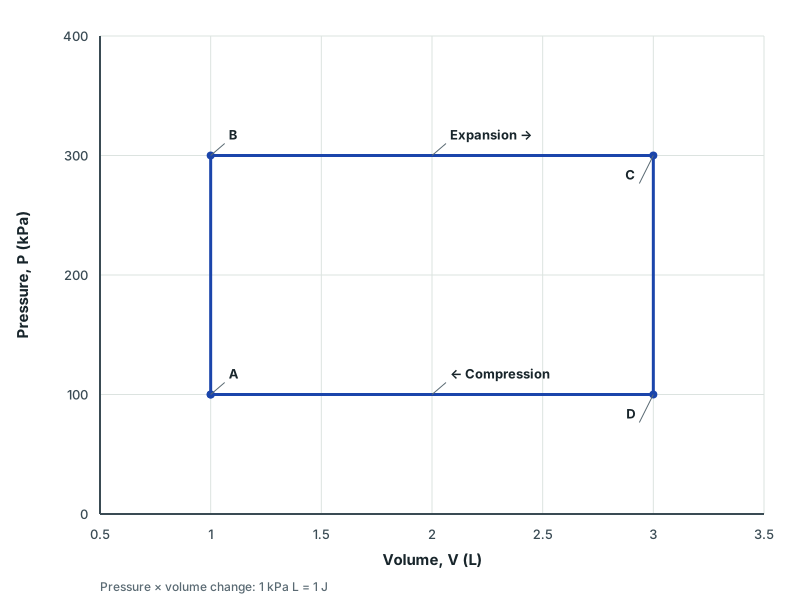
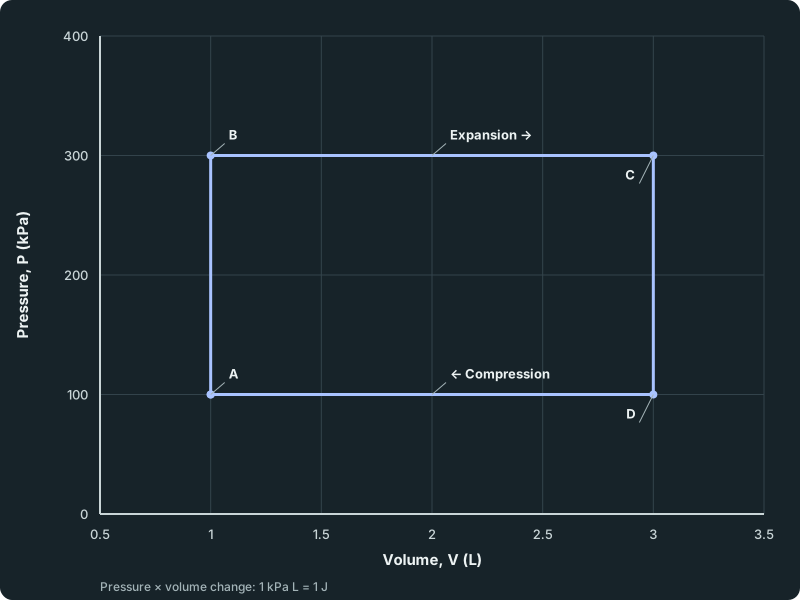
View figure data
| Volume, V (L) | Pressure, P (kPa) |
|---|---|
| 1 | 100 |
| 1 | 300 |
| 3 | 300 |
| 3 | 100 |
| 1 | 100 |
The specified traversal is A → B → C → D → A. Vertical legs change pressure at constant volume and do no pressure–volume work. Expansion B → C gives 300 kPa × 2 L = 600 J; compression D → A gives 100 kPa × (-2 L) = -200 J. Their sum is 400 J, matching the rectangle’s area. Here 1 kPa L = 1 J because the factors of 1000 cancel.
A constant-volume leg can still transfer heat and change internal energy; zero work does not imply zero heat. Over this complete cycle, net heat into the gas is 400 J and net work on it is −400 J. The graph and cycle balance do not identify the separate absorbed and rejected heat magnitudes without a caloric model.
Guided practice 2
Find signed work on a cycle with a sloping leg
Problem
A fixed amount of ideal gas follows a mechanically quasistatic cycle A → B → C → A, with only pressure–volume work and negligible bulk energy changes. In coordinates (volume in L, pressure in kPa), A is (2,100), B is (2,400) and C is (5,100). The B → C path is a straight line. Find its work output, the signed output on C → A and net cycle work output. On paper, sketch the direction, check the enclosed area and state signed net heat and work on the gas.
Work through the model, then compare your reasoning
Hints
Hint 1
Check the model
Write the endpoints of each leg in traversal order. A volume change is signed; the sloping leg does not use a single endpoint pressure.Show solution step by step
Evaluate each nonvertical leg
Method
Use average pressure for the straight line and constant pressure for the return.Reason
These are integrals over two distinct pressure paths.Working
Answer
A → B has dV = 0, so its work is zero. For B → C, Wₒᵤₜ = [(400 + 100)/2](5-2) = 750 J. For C → A, Wₒᵤₜ = 100(2-5) = -300 J.
Check the closed-loop account
Method
Sum signed work and compare with the triangular area.Reason
The state return removes net internal-energy storage, not the individual transfers.Working
Answer
W_(out,net) = 750-300 = 450 J. The enclosed area is (1/2)(5-2)(400-100) = 450 J, traversed clockwise. Hence W_(on,net) = -450 J and Qₙₑₜ = +450 J. Reversing the traversal of the same mechanically quasistatic paths would reverse the work sign; it does not establish that every actual process is thermodynamically reversible.
State what the loop does not show
An irreversible fast process can lack a unique equilibrium gas pressure throughout; drawing a smooth equilibrium line between its endpoints does not make the line its work path. Use a justified boundary-work model or the measured external transfers. Even a mechanically quasistatic loop can generate entropy through friction or finite-temperature heat transfer.
A pressure–volume loop shows that work channel. If electrical or shaft work also crosses the boundary, include it before equating total net work with net heat. The cycle energy balance remains valid; the claim that its entire work is the diagram area has changed assumptions.
Add a work channel that the pressure–volume loop omits
Check your understanding 1
A closed system completes the rectangular mechanically quasistatic cycle shown above, giving 400 J of net pressure–volume work output. During the same complete cycle, it also receives 150 J of electrical work. There are no other work channels or bulk energy changes. Find total signed work on the system, total net work output and signed net heat. A colleague reads the loop area and reports 400 J of net heat: what assumption did they overlook?
Show answer
Pressure–volume work on the system is −400 J; electrical work on it is +150 J. Thus total W_(on,net) = -400 + 150 = -250 J, and total net work output is +250 J. With Δ U = 0, net heat is Qₙₑₜ = -W_(on,net) = +250 J. The 400 J area represents pressure–volume work only. Equating that area with net heat would assume it was the sole work channel, contrary to the stated electrical input.
Practice set
Check your understanding 2
A cycle has net heat input 250 J. Find the net work W done on the system.
Show hint
Show answer
Check your understanding 3
A system delivers 150 J of net work over a complete cycle. Find ∮δ Q.
Show hint
Show answer
Check your understanding 4
Must the internal-energy change over a complete thermodynamic cycle be zero? Explain.
Show hint
Consider whether internal energy depends on the route or on the state.
Show answer
Yes. The initial and final states are identical, and internal energy is a state function. Heat and work individually need not be zero because they describe transfers along the path.
What to keep
A complete state return gives zero net internal-energy change. Sum signed heat and every work channel. For a justified pressure–volume work path, the signed loop area gives boundary work; loop direction, units and omitted channels all matter.
Spotted an error? Report a correction
Syllabus and review details
No official syllabus alignment is listed for this lesson.