Isothermal processes
Analyze ideal-gas isothermal processes, derive logarithmic work, and relate heat transfer to work through the first law.
Offline pages
Saved on this device only. Connect at least once every 30 days to confirm Premium. Sign-out or a change of account removes saved copies.
On this page
You stopped at:
ContinueAn isothermal process keeps temperature constant. For a fixed amount of ideal gas, that also keeps internal energy constant, but it does not determine heat or work individually. To calculate them, identify the mechanical path and the heat exchange that maintains the temperature.
Build on the ideal gas law and pressure–volume work. Use Q > 0 into the gas and Wₒₙ > 0 for work into it, so Δ U = Q + Wₒₙ and Wₒᵤₜ = -Wₒₙ. Assume fixed amount, only pressure–volume work and negligible changes in bulk kinetic and potential energy.
Separate the state constraint from the work model
For an ideal gas, U = U(T) at fixed amount. Thus unchanged temperature gives Δ U = 0 and the first law gives Q = Wₒᵤₜ = -Wₒₙ. During expansion against a load, heat enters to replace the energy leaving as work. During compression, heat leaves while work enters. A real substance can change internal energy at fixed temperature; the ideal-gas energy assumption matters.
In a reversible isothermal piston model, pressure is defined at every state and the opposing load differs only infinitesimally from the gas pressure. Contact with a reservoir maintains temperature with an infinitesimal thermal difference in the reversible limit. Moving slowly alone does not remove friction or guarantee that limit.
Using P = nRT/V along that path, W_(out,rev) = ∫_Vᵢ^VfnRT/V dV = nRT ln Vf/Vᵢ. The logarithm acts on a dimensionless ratio. Expansion makes it positive, compression negative, and unchanged volume gives zero. Pressure decreases during expansion, so multiplying initial pressure by the entire volume change would overestimate this work.
Read the curve and its assumptions
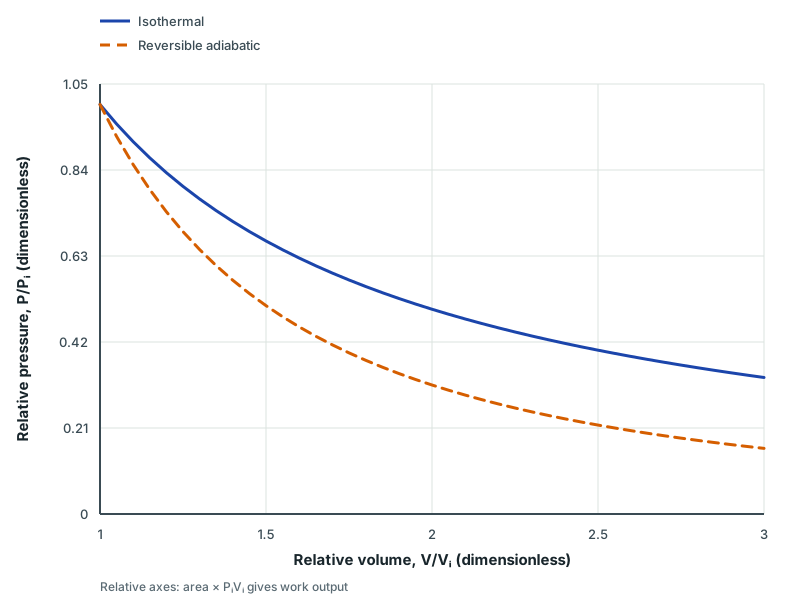
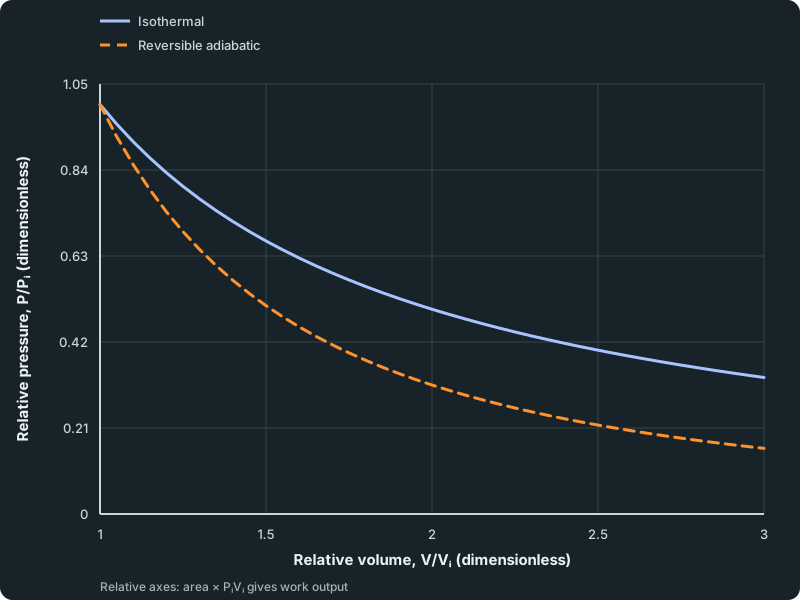
Two reversible expansions from one initial state
From relative volume one to three, the solid isothermal curve falls from relative pressure one to one third. The dashed reversible monatomic adiabatic curve falls from one to about 0.160. Work output is the area under the selected curve over its volume interval, multiplied by the initial pressure–volume product.
Scroll across the figure to read all labels.
View figure data
| Relative volume, V/Vᵢ (dimensionless) | Isothermal | Reversible adiabatic |
|---|---|---|
| 1.00 | 1.0000 | 1.0000 |
| 1.05 | 0.9524 | 0.9219 |
| 1.10 | 0.9091 | 0.8531 |
| 1.15 | 0.8696 | 0.7922 |
| 1.20 | 0.8333 | 0.7380 |
| 1.25 | 0.8000 | 0.6894 |
| 1.30 | 0.7692 | 0.6458 |
| 1.35 | 0.7407 | 0.6064 |
| 1.40 | 0.7143 | 0.5708 |
| 1.45 | 0.6897 | 0.5383 |
| 1.50 | 0.6667 | 0.5088 |
| 1.55 | 0.6452 | 0.4817 |
| 1.60 | 0.6250 | 0.4569 |
| 1.65 | 0.6061 | 0.4340 |
| 1.70 | 0.5882 | 0.4130 |
| 1.75 | 0.5714 | 0.3935 |
| 1.80 | 0.5556 | 0.3754 |
| 1.85 | 0.5405 | 0.3587 |
| 1.90 | 0.5263 | 0.3431 |
| 1.95 | 0.5128 | 0.3286 |
| 2.00 | 0.5000 | 0.3150 |
| 2.05 | 0.4878 | 0.3023 |
| 2.10 | 0.4762 | 0.2904 |
| 2.15 | 0.4651 | 0.2792 |
| 2.20 | 0.4545 | 0.2687 |
| 2.25 | 0.4444 | 0.2588 |
| 2.30 | 0.4348 | 0.2495 |
| 2.35 | 0.4255 | 0.2407 |
| 2.40 | 0.4167 | 0.2324 |
| 2.45 | 0.4082 | 0.2246 |
| 2.50 | 0.4000 | 0.2172 |
| 2.55 | 0.3922 | 0.2101 |
| 2.60 | 0.3846 | 0.2034 |
| 2.65 | 0.3774 | 0.1971 |
| 2.70 | 0.3704 | 0.1910 |
| 2.75 | 0.3636 | 0.1853 |
| 2.80 | 0.3571 | 0.1798 |
| 2.85 | 0.3509 | 0.1746 |
| 2.90 | 0.3448 | 0.1696 |
| 2.95 | 0.3390 | 0.1648 |
| 3.00 | 0.3333 | 0.1602 |
The isothermal curve uses the starting temperature throughout. Its area over a stated volume interval gives reversible work output, in units of the initial product PᵢVᵢ on these relative axes. The comparison curve belongs to a reversible monatomic adiabatic expansion: it cools and ends at a different pressure and temperature. Equal final volumes do not make those the same final state.
A different resisting load gives different work
For a piston against a specified constant external pressure, the mechanical work output is Pₑₓₜ(Vf-Vᵢ). If heat exchange keeps the gas isothermal and it reaches the same final equilibrium state, Pₑₓₜ = nRT/Vf. The finite initial pressure difference makes this path irreversible; use the load for its work rather than substituting a reversible equilibrium curve. The two routes can have identical endpoints and different heat and work transfers.
Guided practice 1
Compare two expansions between the same states
Problem
A 0.50 mol ideal gas expands isothermally at 300 K from 10 L to 20 L. In route A, it drives a reversible piston. In route B, it drives a constant external load equal to its final equilibrium pressure. Temperature is maintained by heat exchange throughout, and only pressure–volume work occurs. Use R = 8.314 J/(mol K). Find the external pressure in B and each work output. Explain why both routes have zero internal-energy change but different heat inputs.
Work through the model, then compare your reasoning
Hints
Hint 1
Check the model
The endpoint state equation supplies the load in B. It does not make that irreversible path a reversible isotherm.Show solution step by step
Determine the endpoint load
Method
Use Pₑₓₜ = nRT/Vf.Reason
Mechanical equilibrium at the end fixes the constant load.Working
Answer
Pₑₓₜ = 0.50(8.314)(300)/0.020 = 62355 Pa = 62.355 kPa. Initial gas pressure is twice that value, so the initial driving difference is finite.
Use each route’s work model
Method
Integrate the reversible pressure, but multiply the constant load by displacement in B.Reason
Work is a path transfer, not an endpoint property.Working
Answer
WA = 0.50(8.314)(300) ln 2 = 864.423… J. WB = 62355(0.020-0.010) = 623.55 J. Both have Δ U = 0, so QA = WA and QB = WB. The identical state change does not make the heat transfers equal. The ideal constant-load description excludes additional energy storage in the piston; its final mechanical transients are not a separate output here.
Free expansion needs endpoint reasoning
In an insulated rigid enclosure, gas released into an evacuated compartment does no external boundary work and receives no heat. With no other energy transfers, Δ U = 0, so an ideal gas has equal initial and final equilibrium temperatures. During the rapid release there need not be one equilibrium pressure or temperature for the whole gas. Do not draw a reversible isotherm through those intermediate states just because the endpoints have equal temperatures. The MIT comparison of free and reversible expansion makes this endpoint distinction explicit.
Work and heat during isothermal expansion
Worked example 2
Doubling the gas volume
Problem
Show full solution
Evaluate logarithmic work
Method
Use Wₒᵤₜ = nRT ln(Vf/Vᵢ).Reason
Pressure decreases during isothermal expansion, so constant-pressure work cannot be used. The litre units cancel in the volume ratio.Working
Answer
Wₒᵤₜ = (1)(8.314)(300) ln 2 ≈ 1.73 × 10³ JBalance heat against work
Working
Answer
W ≈ -1.73 × 10³ J, Q ≈ +1.73 × 10³ J The work output is + 1.73 × 10³ J. Since ideal-gas internal energy stays constant, heat input replaces all the energy delivered as work.
Return the gas without erasing the surroundings
Check your understanding 1
A 0.50 mol ideal gas at 300 K freely expands into vacuum inside an insulated rigid enclosure, doubling its occupied volume. It is then compressed reversibly at 300 K back to its original volume, with only pressure–volume work. Use R = 8.314 J/(mol K). Find heat and work input for each stage and for the combined return to the starting state. Does returning the gas also restore the surroundings?
Show answer
Free expansion has Q₁ = W_(on,1) = 0 and unchanged endpoint temperature. The reversible return requires W_(on,2) = nRT ln 2 = 864.423… J and releases Q₂ = -864.423… J. Over the combined process, the gas has Δ U = 0 but has received work and released equal heat. The surroundings have supplied work and gained heat, so they have not returned to their original state. Reversibility concerns both the system and surroundings, not merely matching the gas’s endpoints.
Practice set
Check your understanding 2
In an ideal-gas isothermal process, work done on the gas is W = -250 J. Find signed Q.
Show hint
Constant ideal-gas temperature means Δ E = 0.
Show answer
Q = -W = +250 J. Heat enters to replace the energy delivered as work, rather than increasing temperature.
Check your understanding 3
A reversible isothermal ideal-gas compression has Vf/Vᵢ = 0.5. Is work done on the gas positive or negative?
Show hint
Show answer
Check your understanding 4
For the same n,T, compare work magnitudes for reversible isothermal ideal-gas expansions with Vf/Vᵢ = 3 and Vf/Vᵢ = 2.
Show hint
Compare logarithms, not volume ratios directly.
Show answer
The ratio of magnitudes is ln 3/ln 2 ≈ 1.58. The threefold expansion gives more work, but not 3/2 times as much, because pressure changes during the path.
What to keep
For a fixed amount of ideal gas, unchanged temperature gives unchanged internal energy. Heat balances work, whose value still depends on the mechanical path. Use logarithmic work only for the reversible isothermal model; identical free-expansion endpoint temperatures do not establish an equilibrium path.
Spotted an error? Report a correction
Syllabus and review details
No official syllabus alignment is listed for this lesson.