Motion and forces
Displacement, velocity and acceleration, motion graphs, the constant-acceleration equations, momentum and Newton's laws of motion, for H2 Physics.
Offline pages
Saved on this device only. Connect at least once every 30 days to confirm Premium. Sign-out or a change of account removes saved copies.
Before you begin
Describe motion with signed quantities and graphs, then explain changes in motion with momentum and Newton’s laws.
Be comfortable with: scalars and vectors, because displacement, velocity, acceleration, momentum and force are all vectors with signs.
Learning goals
- Interpret position, displacement, velocity and acceleration using equations and graphs.
- Derive the uniformly accelerated motion equations from the definitions of velocity and acceleration.
- Derive and apply uniformly accelerated motion equations with a stated sign convention.
- Explain inertia and momentum, then apply Newton's laws using free-body diagrams.
Syllabus statements covered
- show an understanding of and use the terms position, distance, displacement, speed, velocity and acceleration
- use graphical methods to represent distance, displacement, speed, velocity and acceleration
- identify and use the physical quantities from the gradients of position–time or displacement–time graphs and areas under and gradients of velocity–time graphs, including cases of non-uniform acceleration
- derive, from the definitions of velocity and acceleration, equations which represent uniformly accelerated motion in a straight line
- solve problems using equations which represent uniformly accelerated motion in a straight line, e.g. for bodies falling vertically without air resistance in a uniform gravitational field
- show an understanding that mass is the property of a body which resists change in motion (inertia)
- define and use linear momentum as the product of mass and velocity
- state and apply each of Newton’s laws of motion: 1st law: a body at rest will stay at rest, and a body in motion will continue to move at constant velocity, unless acted on by a resultant external force; 2nd law: the rate of change of momentum of a body is (directly) proportional to the resultant force acting on the body and is in the same direction as the resultant force; 3rd law: the force exerted by one body on a second body is equal in magnitude and opposite in direction to the force simultaneously exerted by the second body on the first body
- recall the relationship resultant force F = ma, for a body of constant mass, and use this to solve problems
How the ideas connect
- Describe the motion
Use displacement, velocity and acceleration, with a chosen positive direction.
Step 1 - Read the graphs
Connect gradients and signed areas to changes in motion. Use constant-acceleration equations only when acceleration is constant.
Step 2 - Explain the change
Add the forces on one body. The resultant force determines how its momentum changes.
Step 3
Lessons
Work through them in order.
Core lessons
- Describing motionDefine displacement, velocity and acceleration, read motion graphs from their gradients and areas, and derive the constant-acceleration equations.
- Inertia, momentum and Newton's lawsRelate mass to inertia, define linear momentum, and state and apply Newton's three laws of motion.
- Using F = ma: slopes, lifts and connected bodiesApply F = ma to one body at a time for blocks on slopes, people in lifts and bodies joined by a string.
- Reading motion graphsRead displacement, velocity and acceleration from motion graphs using gradients, areas and tangents.
- Constant-acceleration equationsDerive the constant-acceleration equations, choose signed values and interpret turning points and two possible times.
Practise and check
Or choose
Topic reference
Quick reference
Read the graph
Gradient of displacement–time = velocity. Area under velocity–time = displacement.
Use a tangent for an instantaneous gradient. Displacement is in m; velocity in m s⁻¹.
Common pitfall
Area below the time axis is negative for displacement. Distance uses the magnitudes of the areas.
Check the condition
v = u + at and s = ut + (1/2)at²
Use signed values and constant acceleration. Time is in s; acceleration in m s⁻².
Common pitfall
An object can have zero velocity at an instant and still have non-zero acceleration.
Choose one body
∑ F = ma for constant mass.
Add all external forces on the chosen body. Force is in N; mass in kg.
Common pitfall
A third-law pair acts on two different bodies. It does not cancel in one body’s force diagram.
Complete quick-reference table
| Idea | Relation | Notes |
|---|---|---|
| displacement–time graph | gradient = velocity | use a tangent for an instantaneous value |
| velocity–time graph | gradient = acceleration; area = displacement | area below the axis is negative |
| acceleration–time graph | area = change in velocity | |
| constant acceleration | v = u + at | |
| s = (1/2)(u + v)t | ||
| s = ut + (1/2)at² | ||
| v² = u² + 2as | only while a is constant | |
| free fall | a = g = 9.81 m s⁻² downward | no air resistance |
| momentum | p = mv | a vector, in kg m s⁻¹ |
| Newton’s second law | F = (Δ p)/(Δ t); F = ma for constant mass | F is the resultant force |
Velocity–time graphs: compare shapes
Two velocity–time series from zero to five seconds. One rises from one to eleven metres per second with constant gradient two metres per second squared. The other remains at six metres per second.
Scroll across the figure to read all labels.
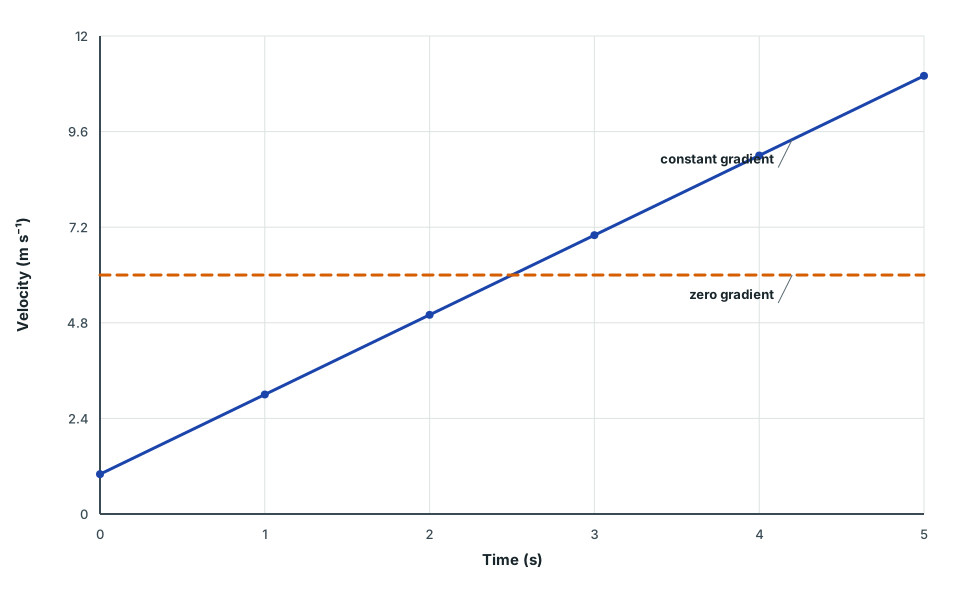
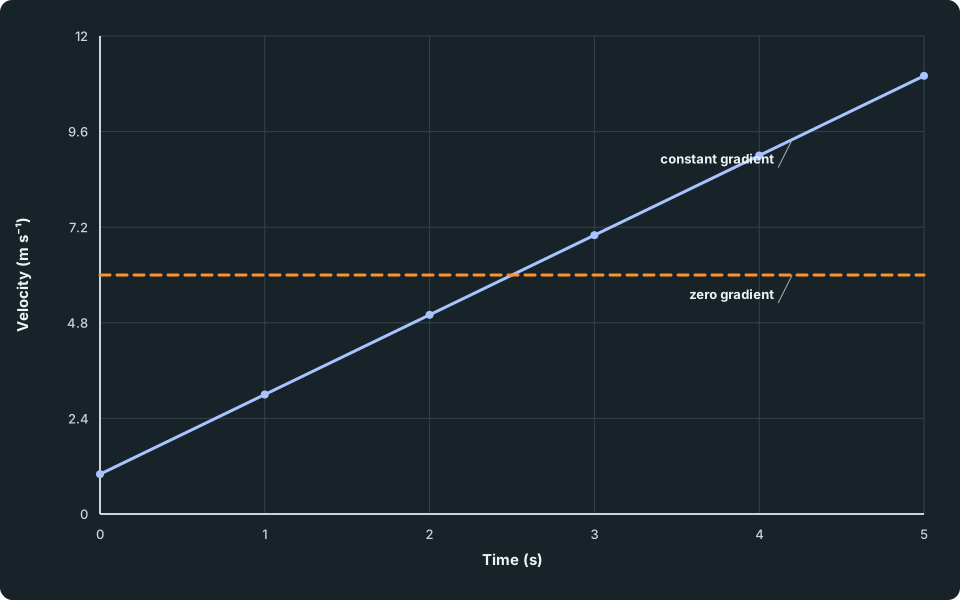
View figure data
| Time (s) | Constant acceleration, a = 2 m s⁻² | Constant velocity, a = 0 m s⁻² |
|---|---|---|
| 0 | 1 | 6 |
| 1 | 3 | 6 |
| 2 | 5 | 6 |
| 3 | 7 | 6 |
| 4 | 9 | 6 |
| 5 | 11 | 6 |
Core knowledge to remember
Definitions and core knowledge
- Displacement is the change in position, with a direction. Distance is the total path length.
- Velocity is the rate of change of displacement; acceleration is the rate of change of velocity.
- Mass is the property of a body that resists change in its motion: its inertia.
- Linear momentum is the product of mass and velocity.
- Newton’s first law: a body at rest will stay at rest, and a body in motion will continue to move at constant velocity, unless acted on by a resultant external force.
- Newton’s second law: the rate of change of momentum of a body is proportional to the resultant force acting on the body and is in the same direction as the resultant force.
- Newton’s third law: the force exerted by one body on a second body is equal in magnitude and opposite in direction to the force simultaneously exerted by the second body on the first body.
Common mistakes
More mistakes to check
- Reading the height of a graph when the question needs its gradient or area.
- Cancelling areas above and below the time axis when finding a distance.
- Using the constant-acceleration equations over an interval in which the acceleration changes.
- Saying the acceleration is zero at the top of a vertical throw.
- Using one force instead of the resultant force in F = ma.
- Treating two forces on the same body as a third-law pair.
- Thinking a moving body needs a resultant force to keep moving at constant velocity.
- Assuming the normal force always equals the weight.