Periodic Motion
Key idea: Describe free oscillations, define period, frequency, angular frequency and phase, and plan reliable timing measurements (A Level Physics).
Continue where you stopped
The core idea
On this page
Learning objectives
- Use oscillation quantities and describe free oscillations and their investigation.
- Relate displacement, velocity, acceleration and phase in simple harmonic motion.
1. Definitions (Must Know)
A. Periodic motion
Periodic motion is motion that repeats itself after a fixed time interval.
B. Period, T (s)
The period, T, is the time taken for one complete cycle.
C. Frequency, f (Hz)
The frequency, f, is the number of cycles per second.
Relationship: T = 1/f and f = 1/T
D. Angular frequency, ω (rad s⁻¹)
Angular frequency, ω, is the rate of change of phase: ω = 2π f = 2π/T
E. Displacement and amplitude
- displacement, x (m): distance from equilibrium (can be positive or negative)
- amplitude, x₀ (m): maximum magnitude of displacement
F. Phase and phase difference
- phase, φ (rad): where you are within a cycle
- phase difference, Δφ (rad): how far one oscillation leads/lags another
G. Free oscillation
An ideal free oscillation repeats about equilibrium with no periodic driving and no energy gained from or lost to the environment. A restoring force still acts; “free” does not mean force-free.
See: Phase Difference.
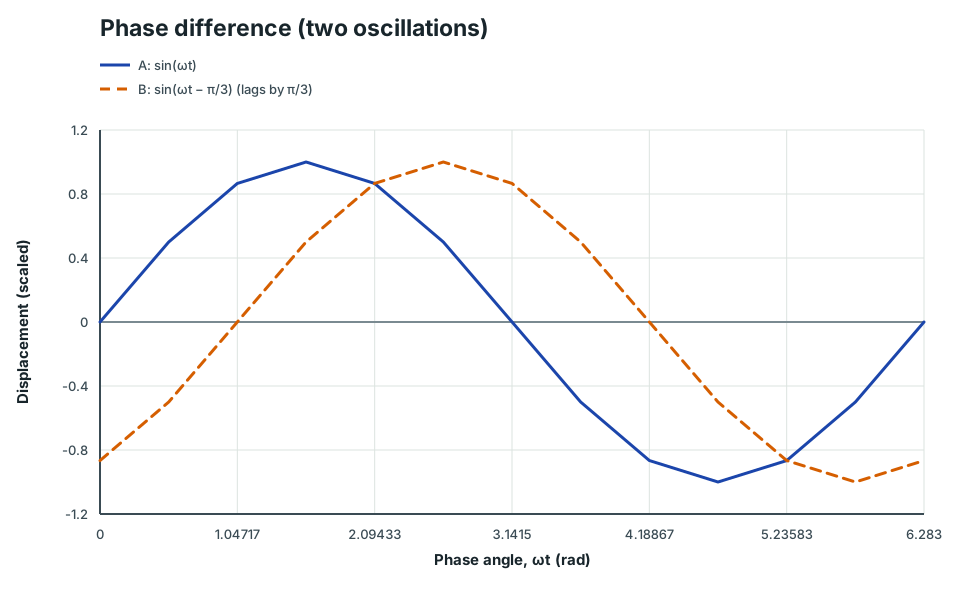
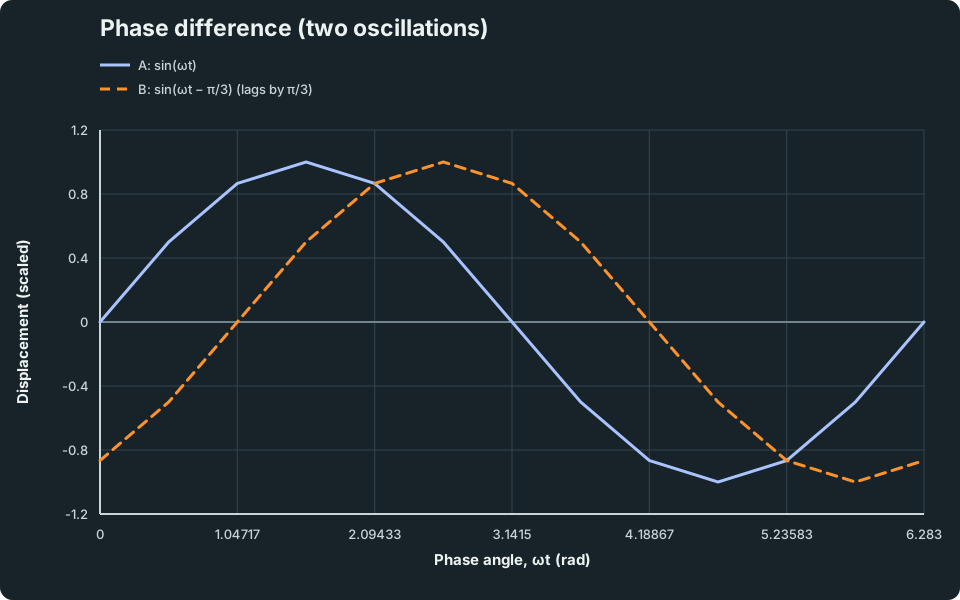
Phase difference (two oscillations)
Two sine waves with the same frequency. Oscillation B lags oscillation A by a constant phase difference.
Scroll across the graph to read all labels.
View figure data
| Phase angle, ωt (rad) | A: sin(ωt) | B: sin(ωt − π/3) (lags by π/3) |
|---|---|---|
| 0 | 0 | -0.866 |
| 0.524 | 0.5 | -0.5 |
| 1.047 | 0.866 | 0 |
| 1.571 | 1 | 0.5 |
| 2.094 | 0.866 | 0.866 |
| 2.618 | 0.5 | 1 |
| 3.142 | 0 | 0.866 |
| 3.665 | -0.5 | 0.5 |
| 4.189 | -0.866 | 0 |
| 4.712 | -1 | -0.5 |
| 5.236 | -0.866 | -0.866 |
| 5.76 | -0.5 | -1 |
| 6.283 | 0 | -0.866 |
2. Key Ideas (What Earns Marks)
- Always include units:
- T in seconds, f in hertz, ω in rad s⁻¹.
- Convert “revolutions per second” or “cycles per second” directly to frequency.
- Use ω = 2π f when you see sine/cosine SHM forms like sin(ω t).
- Measure several cycles and divide by the number of cycles to reduce the percentage timing uncertainty in T.
3. Detailed Explanations
A. Why ω = 2π f
One complete cycle corresponds to a phase change of 2π radians.
If there are f cycles per second, the phase changes by 2π f radians per second: ω = 2π f
B. Where these terms show up in SHM
In simple harmonic motion, displacement is often written in the form: x = x₀ sin(ω t + φ₀)
You do not need to memorise every variant. You mainly need:
- x₀ is the amplitude
- ω sets the period (T = 2π/ω)
- φ₀ sets the starting point
See: Simple Harmonic Motion and SHM Graphs.
C. Investigating an oscillator
Use a motion sensor or video tracking to record displacement against time. Read T between equivalent points such as successive maxima, or time N complete cycles and calculate T = t/N. Repeat the measurement and compare the periods; amplitude should be kept within any approximation stated for the oscillator.
The displacement–time graph establishes periodicity. To establish SHM, you must additionally show that acceleration is proportional to -x, for example with a straight-line a–x graph through the origin.
4. Common Mistakes
- Using T = 2π f (wrong; it is ω = 2π f and T = 1/f).
- Mixing up f (Hz) and ω (rad s⁻¹).
- Forgetting that phase must be in radians in expressions like sin(ω t).
- Calling a motion SHM merely because it repeats.
5. Exam Tips
- If you are given x = x₀ sin(ω t), read off ω directly and find T using T = 2π/ω.
- If you are given “rpm”, convert to Hz first: f = rpm/60.
- In an investigation, time several complete cycles rather than one whenever practical.
6. Worked Examples
Modelled example 1
Convert between T and f
Problem
Study the worked solution
Use reciprocal quantities
Method
Use f = 1/T.Reason
Frequency counts cycles per second while period is seconds per cycle.Working
f = 1/TEvaluate and interpret
Method
Obtain 2.5 Hz.Reason
The oscillator completes 2.5 cycles per second.Working
f = 1/0.40 = 2.5 Hz
Guided practice 2
Find ω from T
Problem
Try this before viewing the solution
Hints
Hint 1: convert cycles to phase
View solution step by step
Choose the relation
Method
Use ω = 2π/T.Reason
Angular frequency is phase change per second.Working
ω = 2π/TEvaluate
Method
Obtain 10π rad s⁻¹, or 31.4 rad s⁻¹.Reason
A complete cycle advances phase by 2π radians.Working
ω = 2π/0.20 = 10π rad s⁻¹
Common misconception 3
Convert rpm to ω
Learner claim
Try this before viewing the solution
View solution step by step
Repair the time unit
Method
Convert 1800 rpm to 30 Hz.Reason
Angular frequency is required per second, not per minute.Working
f = 1800/60 = 30 HzConvert cycles to radians
Method
Obtain 60π rad s⁻¹ ≈ 188 rad s⁻¹.Reason
Each revolution corresponds to 2π radians.Working
ω = 2π f = 2π(30) = 60π rad s⁻¹
Examiner practice 4
Read T, f, and ω from an SHM equation
Examination question
Try this before viewing the solution
View solution step by step
Read the amplitude
1 markMethod
x₀ = 0.050 m.Reason
The coefficient outside the sine is the maximum displacement.Working
x₀ = 0.050 m.Read angular frequency
1 markMethod
ω = 8 rad s⁻¹.Reason
The coefficient of t is angular frequency.Working
ω = 8 rad s⁻¹.Find the period
1 markMethod
T = 0.785 s.Reason
Use T = 2π/ω.Working
T = 2π/8 = 0.785 sFind the frequency
1 markMethod
f = 1.27 Hz.Reason
Use f = 1/T = ω/(2π).Working
f = 8/2π = 1.27 Hz
Self-mark with the mark scheme
Compare your response with each mark point. Select a point only when your response contains that evidence.
Self-mark the four quantities and units.
Challenge 5
Phase difference to time delay
Independent transfer
Try this before viewing the solution
Hints
Hint 1: convert phase to a cycle fraction
View solution step by step
Find the period
Method
T = 0.20 s.Reason
The oscillations complete 5.0 cycles per second.Working
T = 1/f = 0.20 sConvert phase fraction to time
Method
Obtain Δ t = 0.033 s.Reason
A phase difference of π/3 is one sixth of a full 2π cycle.Working
Δ t = ((π/3)/2π)(0.20) = 0.033 sInterpret the lag
Method
B reaches each matching phase point 0.033 s after A.Reason
“B lags A” fixes the order, not just the delay magnitude.Working
A leads; B follows.
7. Mind Stretchers
Mind stretcher 1: What does “phase constant” change?Extension
Two SHM motions have the same x₀ and ω, but different φ₀.
What is the same, and what is different?
Show Answer
Same: amplitude and period/frequency (since x₀ and ω are unchanged).
Different: where the motion starts at t = 0 (the displacement/velocity at t = 0).
Mind stretcher 2: How many cycles occur in a time interval?Extension
An oscillator has frequency f = 12 Hz. How many complete cycles occur in 3.0 s?
Show Answer
Number of cycles: N = ft = (12)(3.0) = 36
Continue with the next resource in this course.
Course and syllabus information
- Course
- GCE A-Level H2 Physics
- Edition
- GCE A-Level H2 Physics 2027