Apparent weight
Distinguish weight from a scale reading, use signed acceleration in lift problems and recognise when contact with the scale is lost.
On this page
What a scale measures
Your weight, W = mg, is the gravitational force on you. Your apparent weight is the supporting force measured by a scale. In this lesson, a person stands on a horizontal scale, so that force is the upward normal contact force, R.
The scale pushes up on the person; the person pushes down on the scale with an equal force. These are a Newton’s third-law pair acting on different bodies. A scale calibrated to display kilograms converts the measured force to a mass estimate by dividing by its calibration value of g; that displayed estimate can change without the person’s mass changing. The examples below use force readings in newtons.
Weightlessness means zero apparent weight, R = 0. In free fall with air resistance neglected, gravity still acts, but the person and scale fall together without a supporting force.
Choose the person as the body
Assume the person stands on the scale without moving relative to it and experiences no other vertical contact forces. The two vertical forces on the person are R upwards and mg downwards. Use an inertial frame fixed to the ground and take upwards as positive.
Relate the reading to acceleration
Core equation (upwards positive)
Apply Newton’s second law to the person:
R-mg = ma, R = m(g + a).
While the person remains supported and moves with the lift, a is also the lift’s acceleration. It is a signed component, not a speed.
Interpreting the cases
| Motion condition | Signed acceleration | Scale reading |
|---|---|---|
| Accelerating upwards | a > 0 | R > mg |
| Accelerating downwards, with magnitude less than g | -g < a < 0 | 0 < R < mg |
| At rest or moving vertically at constant velocity | a = 0 | R = mg |
| Free fall, neglecting air resistance | a = -g | R = 0 |
Velocity and acceleration can point in opposite directions. A lift moving downwards but slowing has upward acceleration and a reading above mg. A lift moving upwards but slowing has downward acceleration and a reading below mg.
Visual: how R changes with acceleration
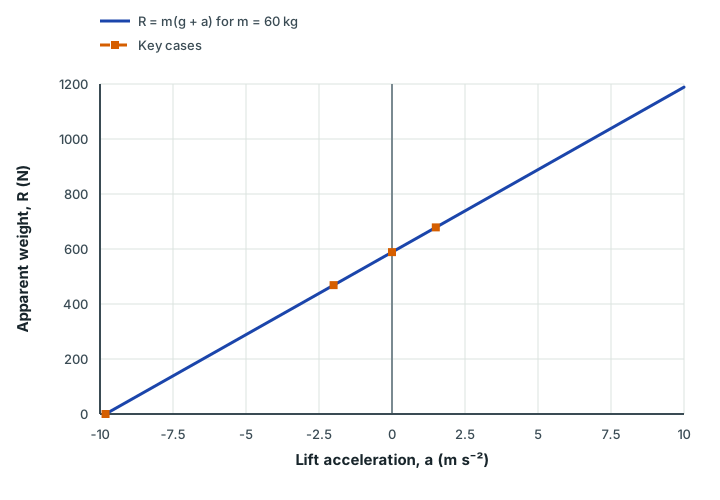
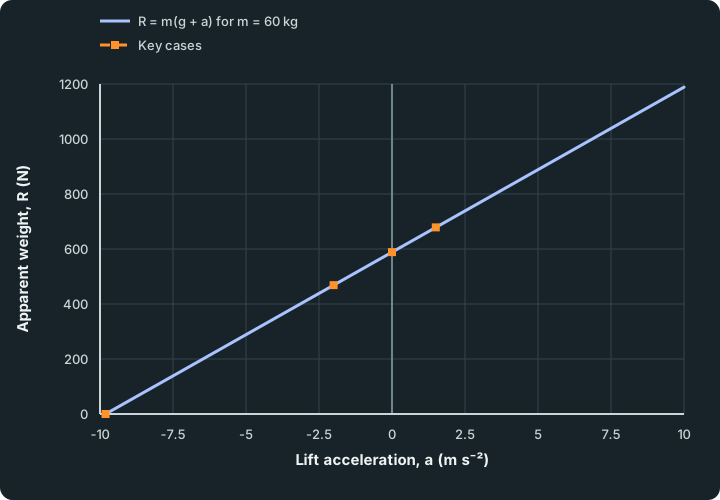
For a fixed mass and uniform g, the supported-person model gives a straight line. It stops at a = -g, R = 0: the scale underneath the person can push upwards, but cannot pull them downwards.
Apparent weight vs lift acceleration
The straight line runs from zero normal force at a = −9.81 m s⁻² to 1188.6 N at a = 10 m s⁻². It passes through 588.6 N at zero acceleration. The person remains supported for a > −g.
Scroll across the figure to read all labels.
View figure data
| Series | Lift acceleration, a (m s⁻²) | Apparent weight, R (N) |
|---|---|---|
| R = m(g + a) for m = 60 kg | -9.81 | 0 |
| R = m(g + a) for m = 60 kg | 10 | 1189 |
| Key cases | -9.81 | 0 |
| Key cases | 0 | 588.6 |
| Key cases | 1.5 | 678.6 |
| Key cases | -2 | 468.6 |
If a prescribed lift acceleration would give R < 0, the person cannot continue moving with the scale under these assumptions. They lose support, their own acceleration becomes -g if weight is their only force, and the scale reading is zero. The floor and person then have different accelerations. Extra restraints or contact with another surface would require a new force diagram.
Keep weight, motion and contact separate
- A higher scale reading does not mean the person’s mass or g has increased.
- Moving upwards does not automatically mean a higher reading: find the acceleration direction.
- At an instant of zero velocity, the person may still have non-zero acceleration.
- A negative result for R signals loss of support in this model; it is not a negative scale reading.
A reliable calculation
State the chosen body, forces and positive direction. Start with R-mg = ma, substitute the signed acceleration and check R ≥ 0. When finding acceleration from a reading, translate the sign into an explicit direction.
Worked examples
Worked example 1
Lift accelerating upwards
Problem
Worked solution
Identify the scale reading
Method
The scale reads the upward normal reaction R, not the person’s weight mg.Reason
A scale measures the contact force it exerts on the person.Working
R upward, mg downwardApply Newton's second law
Method
R = m(g + a).Reason
Taking upward as positive, the resultant upward force produces the stated positive acceleration.Working
R-mg = ma ⇒ R = m(g + a)
Calculate the reading
Method
R ≈ 7.55 × 10² N.Reason
The upward acceleration requires the normal reaction to exceed the person’s weight.Working
R = 65.0(9.81 + 1.80) = 754.65 N ≈ 755 N
Guided practice 2
Lift accelerating downwards
Problem
Try this before viewing the solution
Hints
Hint 1: give acceleration its sign
Show solution step by step
Use the signed acceleration
Method
a = -2.00 m s⁻².Reason
The chosen positive direction remains upward throughout the calculation.Working
a = -2.00 m s⁻²Calculate the normal reaction
Method
R ≈ 4.53 × 10² N.Reason
A downward resultant requires the upward scale force to be less than weight.Working
R = m(g + a) = 58.0(9.81-2.00) = 452.98 N ≈ 453 N
Spot the mistake 3
Free fall (weightlessness)
Learner claim
Try this before viewing the solution
Show solution step by step
Retain the gravitational force
Method
The person’s weight mg still acts downward.Reason
Free fall is acceleration caused by gravity, not absence of gravity.Working
∑ Fy = -mg when upward is positive.Use free-fall acceleration
Method
The normal reaction is zero.Reason
Both person and scale accelerate downward at g, so the scale does not need to push on the person.Working
R-mg = m(-g) ⇒ R = 0
Interpret the reading
Method
The scale reads 0 N.Reason
Apparent weight is the normal contact force.Working
R = 0 N while W = mg remains non-zero.
Exam-style question 1
Find the lift’s acceleration from a scale reading
Examination question
Try this before viewing the solution
Show solution step by step
Write the force equation
1 markMethod
R-mg = ma with upward positive.Reason
The scale reaction is upward and weight is downward.Working
R-mg = maSubstitute the reading
1 markMethod
450-588.6 = 60a.Reason
The stated scale reading is R.Working
450-60(9.81) = 60a
Calculate signed acceleration
1 markMethod
a = -2.31 m s⁻².Reason
The negative result is relative to the upward-positive convention.Working
a = (-138.6)/60 = -2.31 m s⁻²
State magnitude and direction
1 markMethod
The lift accelerates downward at 2.31 m s⁻².Reason
A complete vector answer translates the sign into a direction.Working
|a| = 2.31 m s⁻², downward.
Self-mark with the mark scheme
Compare your response with each mark point. Select a point only when your response contains that evidence.
Self-mark the force equation, substitution, signed value, and stated direction.
Try it yourself 4
Moving downward but slowing down
Problem
Try this before viewing the solution
Hints
Hint 1: separate velocity from acceleration
Show solution step by step
Infer the acceleration direction
Method
The acceleration is upward.Reason
The downward velocity is decreasing in magnitude, so acceleration opposes it.Working
a = +1.20 m s⁻² for upward positive.Calculate the scale reading
Method
R ≈ 771 N.Reason
The upward acceleration requires R to exceed mg even though the lift is moving downward.Working
R = m(g + a) = 70(9.81 + 1.20) = 770.7 N
Use the sign and test contact
Check your understanding 1: Moving upwards but slowing
A person stands on a scale in a lift moving upwards but slowing. They remain supported. Is R greater than, equal to or less than mg?
Show answer
The acceleration is downwards, so a < 0 with upwards positive. Therefore R = m(g + a) < mg. The upward velocity does not change this conclusion.
Mind stretcher 1: Can a scale reading be negative?Extension
Suppose an unrestrained lift floor accelerates downwards at 1.2g. A calculation assuming the person moves with it gives R = -0.2mg. What has failed?
Show answer
The assumption of continued support has failed. The scale cannot pull the person downwards. They lose support, so R = 0; neglecting air resistance, the person’s acceleration is -g, while the floor’s prescribed acceleration is -1.2g. Do not keep substituting the floor’s acceleration into the person’s force equation after contact is lost.
Related reading: force over a stopping time
Impulse collects the effect of a force over a time interval. See Momentum and impulse for force–time areas and average force.
Syllabus and review details
- GCE A-Level H2 Physics 2027 · 2027
Content Overview, PDF pages 9–10; Subject Content, PDF pages 11–30
Last reviewed: