G3 Physics and O-Level Magnetism & Electromagnetism Hub
G3 Physics and O-Level hub for magnetic fields, electromagnets, motors, electromagnetic induction, generators and transformers.
Learning goals
- State the properties of magnets
- Describe induced magnetism
- Distinguish temporary and permanent magnets
- Determine magnetic-field direction with a compass or bar magnet
- Interpret bar-magnet field patterns
- Draw the magnetic field pattern around a bar magnet and between the poles of two bar magnets
- Interpret the field pattern around a straight current-carrying wire
- Draw the magnetic field pattern around a straight current-carrying wire
- Interpret the field pattern around a current-carrying solenoid
- Draw the magnetic field pattern around a current-carrying solenoid
- Relate current magnitude and direction to magnetic field
- Describe electromagnet applications
- Describe experiments showing the force on a current-carrying conductor in a magnetic field
- Describe magnetic force on a charged-particle beam
- Predict force reversal when current or field reverses
- Use Fleming’s left-hand rule
- Explain the turning effect on a current-carrying coil
- Explain how current and turns increase the turning effect
- Describe split-ring commutator action
- Describe the effect of winding a motor coil on a soft-iron cylinder
- Deduce that a changing magnetic field can induce an e.m.f.
- Deduce that induced e.m.f. opposes the change producing it
- Deduce factors affecting induced e.m.f. magnitude
- Describe a simple a.c. generator and slip rings
- Sketch a simple a.c. generator voltage–time graph
- Describe a simple iron-cored transformer
- Apply ideal-transformer equations
- Explain cable loss and high-voltage transmission
Follow this hub from magnet properties and field mapping through electromagnets and motors to generators, transformers and power transmission.
Before you begin:
- Core Exam Skills (units, graphs, command words)
- Current Electricity (Understanding current flow)
- Forces (Fields exert forces on conductors)
Follow this order:
Lessons
Magnetism and fields
Magnetism Basics
Classify magnetic materials and predict attraction or repulsion from facing poles.
Properties of Magnets
Use the two-end sure test, explain compass alignment, and predict poles after cutting.
Magnetic Fields
Defining field direction and plotting field lines accurately with a compass.
Induced Magnetism
Predicting induced poles, testing for a magnet, and magnetising a rod with a d.c. solenoid.
Temporary and Permanent Magnets
Compare magnetic retention and choose soft iron or suitable steel for a device.
Electromagnetism and the motor effect
Field from Currents
Reading dot/cross current symbols and applying the right-hand grip rule.
Field in a Solenoid
Identifying poles, the nearly uniform internal field, and electromagnet strength.
Electric Bell
Tracing the complete make-and-break cycle through the core, armature, contact and spring.
Circuit Breaker
Using a simplified magnetic-trip model and distinguishing MCB overcurrent protection from RCD operation.
Force on Conductor
Applying Fleming’s left-hand rule to conventional current, field and force.
D.C. Motor
Explain the force couple, split-ring current reversal, soft-iron cylinder, and factors that increase turning effect.
Induction and the generator effect
E.M. Induction
Distinguishing induced e.m.f. from current and applying Lenz's law.
A.C. Generator
How rotation produces alternating current (slip rings).
Transformers
Turns ratio, ideal power, and reducing cable heating losses.
What you will learn
| You need to be able to… | Main lesson |
|---|---|
| describe magnet properties and distinguish induced, temporary and permanent magnetism | Magnetism Basics, Properties of Magnets, Induced Magnetism and Temporary and Permanent Magnets |
| determine field direction with a compass and draw field patterns | Magnetic Fields |
| describe the fields around a straight wire and a solenoid | Field from Currents and Field in a Solenoid |
| explain applications of electromagnets | Electric Bell and Circuit Breaker |
| investigate magnetic force and use Fleming’s left-hand rule | Force on a Conductor |
| explain the turning effect, split ring and soft-iron cylinder in a motor | D.C. Motor |
| explain induction, its direction and the factors affecting induced e.m.f. | Electromagnetic Induction |
| explain an a.c. generator and interpret its voltage–time graph | A.C. Generator |
| explain transformers and high-voltage power transmission and use the ideal equations | Transformers |
Use the Magnetism & Induction Lab alongside the first four lessons:
- Bar magnet: predict the north end of a compass at three positions.
- Straight wire: read the shown current direction, then predict the circular field direction at the labelled probes.
- Solenoid: predict its north pole, then reverse the current and check the pole swap.
- Motor effect: predict the force, then reverse only current, only field, and both.
Finish with the Magnetism Quiz and Magnetism Structured Practice.
Revision
Quick Reference
| Rule / Device | Key Function | Direction Rule |
|---|---|---|
| Field from Wire | Magnetic field around current | Right-Hand Grip Rule |
| Motor Effect | Force on current in field | Fleming’s Left-Hand Rule |
| Generator Effect | Induced e.m.f. from motion (cutting flux) | Fleming’s Right-Hand Rule |
| Lenz’s Law | Induced effects oppose the change that produced them | Direction opposes change |
| Transformer | Vₛ/Vₚ = Nₛ/Nₚ | Step-up vs Step-down |
Transformers (ideal)
- Voltage ratio: Vₛ/Vₚ = Nₛ/Nₚ
- Current ratio: Iₛ/Iₚ = Nₚ/Nₛ
- Power (ideal): Vₚ Iₚ = Vₛ Iₛ
Device explanation template
For an electric bell, relay or magnetic-trip question, write a complete cause-and-effect chain:
- State what changes the current in the coil.
- State how the coil’s magnetic field or pull changes.
- Name the moving part: armature or latch.
- State exactly what happens to the contact.
- Finish with the device outcome: the bell cycle repeats, or the breaker stays open until reset.
Do not merge the devices: a bell repeatedly opens and recloses its own coil circuit, whereas a circuit breaker releases a latch so its protected contacts open. An RCD/RCCB uses a different leakage-current imbalance principle.
Quick facts to remember
- Magnetic Field Lines: Always point from North to South (outside the magnet).
- Hard vs Soft Magnetic Materials: Steel (hard) is hard to magnetise/demagnetise; Iron (soft) is easy.
- Solenoid Field: Inside the solenoid, the field is strong and uniform.
- Fleming’s Left-Hand Rule: Thumb (Force), First finger (Field), Second finger (Current).
- Fleming’s Right-Hand Rule: Use for generators/induction direction (motion, field, induced current).
- Lenz’s Law: In a closed circuit, the induced current produces an effect that opposes the change that caused it.
- Split-Ring Commutator: Reverses current direction in the coil every half-turn to keep the motor spinning in one direction.
Electromagnet strength (typical question)
- Increase number of turns on the coil.
- Increase current through the coil.
- Use a soft iron core (easy to magnetise/demagnetise).
How to increase induced e.m.f. (Faraday idea)
- Increase the rate of change: move magnet/coil faster (greater rate of cutting flux).
- Use a stronger magnet / stronger magnetic field.
- Increase number of turns in the coil.
- Increase coil area (where relevant) and keep it perpendicular to the field for maximum change.
- Ensure there is relative motion or a changing magnetic field (no change → no induced e.m.f.).
Transformer questions (exam template)
- Identify if it is step-up (Vₛ > Vₚ) or step-down (Vₛ < Vₚ).
- Use Vₛ/Vₚ = Nₛ/Nₚ to find an unknown.
- If current is involved, use Vₚ Iₚ = Vₛ Iₛ (ideal) to find Iₛ or Iₚ.
- For fixed transmitted power, a step-up transformer increases V and decreases I (ideal). With the same cable resistance, this reduces Pₗₒₛₛ = I²R.
Visual Snapshots (graphs)
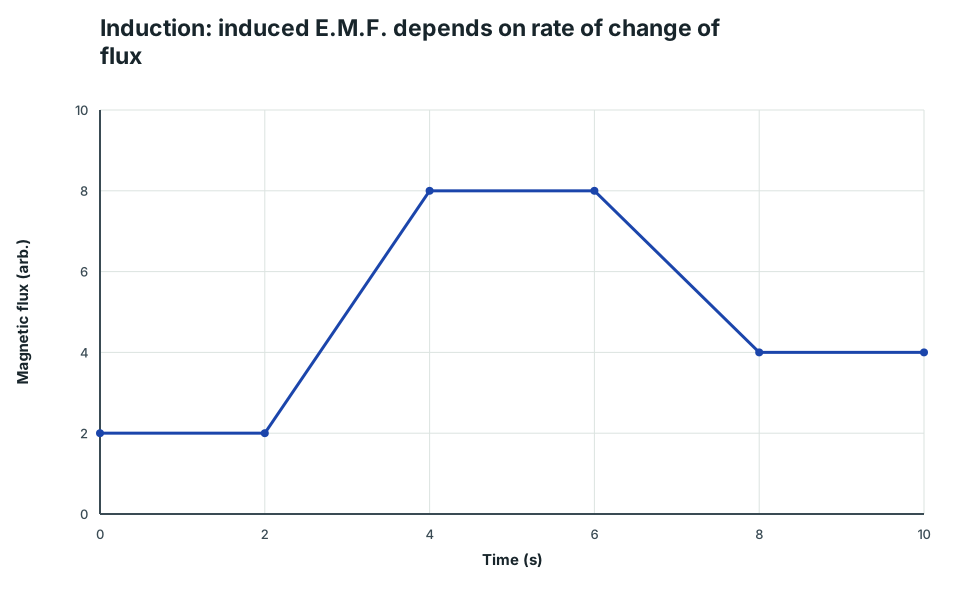
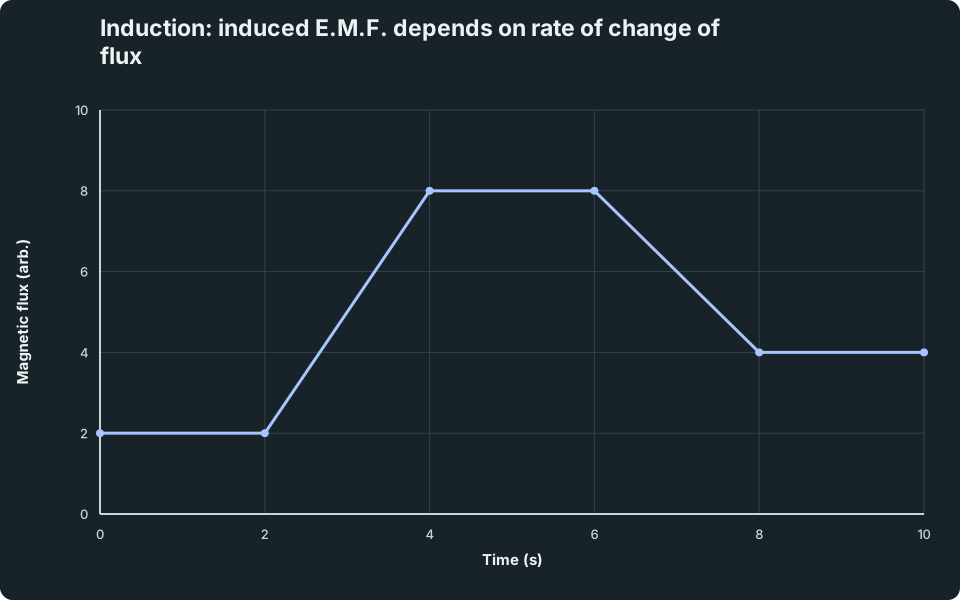
These are schematic. Use them to connect “change” to “induced voltage/current”.
Induction: induced E.M.F. depends on rate of change of flux
Magnetic flux versus time with flat and sloping sections to illustrate when induced e.m.f. is zero or non-zero (depends on rate of change of flux).
Scroll across the graph to read all labels.
View figure data
| Time (s) | Flux |
|---|---|
| 0 | 2 |
| 2 | 2 |
| 4 | 8 |
| 6 | 8 |
| 8 | 4 |
| 10 | 4 |
Top Exam Traps
- Rule Confusion: Use the LEFT hand for Motors (Force/Motion) and the RIGHT hand for Induction/Generators.
- Field lines are loops: Outside a magnet, field lines go N → S; inside the magnet they go S → N to form continuous loops.
- Slip Rings vs Split-Rings: Slip rings (continuous) are for A.C. Generators; Split-rings (broken) are for D.C. Motors.
- Transformers & D.C.: Transformers do NOT work with steady D.C. because there is no changing magnetic field to induce a voltage in the secondary coil.
- Lenz’s Law: When a magnet enters a coil, the coil creates a pole that repels it; when it leaves, the coil creates a pole that attracts it to oppose the motion.
- Primary vs secondary: Primary is connected to the input supply; secondary is the output. Don’t swap Vₚ, Nₚ with Vₛ, Nₛ.
- Step-up vs step-down: In an ideal transformer, step-up increases voltage but decreases current (and vice versa).
Practice
Use the Magnetism check for magnet properties and magnetic fields, then the Electromagnetism check for fields from currents, magnetic force and the motor effect. Return to the lesson each check identifies whenever a direction rule or explanation is incomplete.
Finish with the Magnetism structured questions for device explanations, transformer calculations and direction reasoning.
Continue learning
- Magnetism Quiz for rapid concept checks.
- Magnetism Structured Practice for explanation and calculation practice.
Continue with the next resource in this course.
Course and syllabus information
- Course
- SEC G3 Physics
- Edition
- SEC G3 Physics 2027