Background radiation and count-rate
Key idea: A detector counts background radiation as well as radiation from the source. Subtract the background count rate to find the count rate due to the source alone.
Offline pages
Saved on this device only. Connect at least once every 30 days to confirm Premium. Sign-out or a change of account removes saved copies.
Loading guide controls…
Guided lessons · coming soon
Guided lesson
Guided steps
- Recognise background even with no test source nearby.
- Calculate count-rate and compare it with source activity.
- Follow the conversion between counts per minute and second.
- Calculate the background rate in both units.
- Match recording conditions and average the fluctuating background.
- Follow how subtracting background gives the source contribution.
- Find both rates before subtracting.
- Explain the distance effect and choose fair comparison conditions.
- Explain why moving the detector leaves source activity unchanged.
- Calculate both rates and explain the negative difference.
- Review count-rate units and fair comparisons.
On this page
You stopped at:
ContinueSwitch on a radiation detector with no test source nearby, and it still clicks every so often. We are all exposed to a low level of radiation all the time, from the ground, the air, space and even our own bodies. This background radiation contributes to detector readings even before a test source is introduced. To estimate the test source’s contribution, measure the background under matched conditions and subtract its count-rate.
Where background radiation comes from
Background radiation is the ionising radiation that is present in the environment all the time. Most of it comes from natural sources:
- radon gas, which is radioactive and seeps out of rocks and soil into the air, and into buildings;
- rocks and building materials, such as granite, which contain small amounts of radioactive elements;
- cosmic rays, high-energy radiation from space, which is stronger at high altitude;
- food, drink and our own bodies, which contain small amounts of radioactive isotopes such as potassium-40 and carbon-14.
A background reading can also include ionising radiation from human activity when it is present, such as medical X-ray equipment in use or radioactive materials. The mixture depends on the measurement location.
Background levels vary with the environment and location; even at fixed conditions, counts in short equal intervals fluctuate because radiation detections are random.
Counts and count-rate
A radiation detector, such as a Geiger–Müller tube connected to a counter, records a count each time it detects radiation. The total number of counts depends on how long you count for, so readings are compared as a count-rate:
Count-rate is given in counts per second (cps) or counts per minute (cpm). It is a rate of detected events, not necessarily the source’s total decay rate: geometry, absorption and detector response affect how much radiation is recorded.
Worked example 1
From counts to count-rate
Problem
A detector records 120 counts in 2.0 minutes. Find the count-rate in counts per minute and in counts per second.
Show full solution
Counts per minute
Method
Divide the number of counts by the time in minutes.
Reason
A rate is the number of counts in each unit of time.
Working
Answer
120/2.0 = 60 cpm
Counts per second
Method
Divide the rate in counts per minute by 60.Reason
There are 60 seconds in a minute, so each second gets one sixtieth of the counts.
Working
Answer
60/60 = 1.0 cps
Quick check
60 cpm and 1.0 cps are the same count-rate in different units.
Check your understanding 1 A background count
With no source present, a detector records 90 counts in 3.0 minutes. Find the background count-rate in counts per minute and in counts per second.
Show the steps Optional working
Show answer
Correcting a reading for background
When a source is placed near the detector, the detector still picks up the background as well. So the reading with the source present is the source’s contribution plus the background. For supplied readings or a teacher-controlled demonstration, estimate the detector count-rate due to the test source:
- With the test source set aside under the teacher’s procedure, measure the background count-rate with the same detector and location. Count for a long time, or take several readings and average them, because the background fluctuates.
- The teacher places the test source at the fixed measurement position; record the count-rate again in the same units. Keep detector settings, counting geometry and relevant conditions fixed.
- Subtract:
The graph shows four constructed one-minute background readings. They go up and down because decays are random, so a single short reading is not a reliable value for the background. The four readings total 140 counts in 4 minutes, an average of 35 cpm.
Background readings fluctuate around an average
Four separate background counts above and below a horizontal reference at 35 counts per one-minute recording. The values are an illustrative dataset, not measured laboratory data.
Scroll across the figure to read all labels.
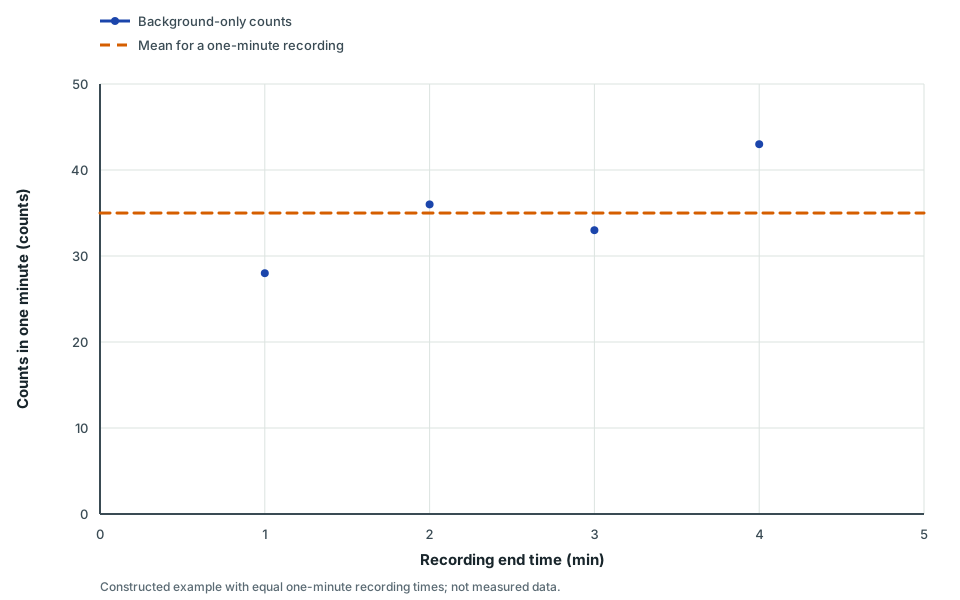
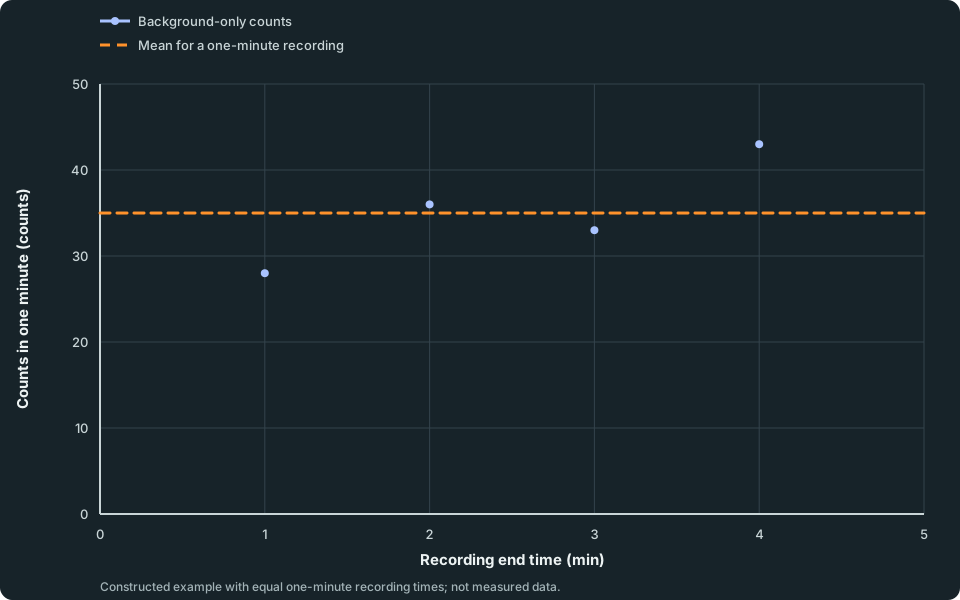
View figure data
| Series | Recording end time (min) | Counts in one minute (counts) |
|---|---|---|
| Background-only counts | 1 | 28 |
| Background-only counts | 2 | 36 |
| Background-only counts | 3 | 33 |
| Background-only counts | 4 | 43 |
| Mean for a one-minute recording | 0 | 35 |
| Mean for a one-minute recording | 5 | 35 |
Worked example 2
Correcting a reading for background
Problem
The background count-rate is 35 cpm. With a source in front of the detector, the count-rate is 215 cpm. Find the count-rate due to the source.
Show full solution
Interpret the reading
Method
The 215 cpm is the source and the background together.
Reason
The detector cannot tell background radiation from the source’s radiation.
Working
Answer
measured = source + background
Subtract the background
Method
Take 35 cpm away from 215 cpm.
Reason
The difference estimates the detected source contribution under matched conditions; both measured rates fluctuate.
Working
Answer
215-35 = 180 cpm
Quick check
The corrected count-rate must be smaller than the measured count-rate.
Check your understanding 2 Different counting times
With no source present, a detector records 150 counts in 5.0 minutes. With a source present, it records 480 counts in 2.0 minutes. Find the count-rate due to the source, in counts per minute.
Show the steps Optional working
Show answer
Background: 150/5.0 = 30 cpm. With the source: 480/2.0 = 240 cpm. Due to the source: 240-30 = 210 cpm.
Subtracting the counts directly, 480-150, would be wrong, because they were recorded over different times.
Check your understanding 3 Moving the detector
A learner moves a detector further from a source and finds that the count-rate falls. The learner concludes that the source is now decaying more slowly. Choose why count-rate falls and what must stay fixed for a later decay comparison.
Show answer
No. Moving the detector away means less of the radiation reaches it, so it records fewer counts. Moving the detector does not change the source’s average decay activity; actual counts still fluctuate. To follow how a source decays, keep the distance and everything else about the arrangement the same.
Check your understanding 4 Explain the distance effect
Explain why moving the detector farther away reduces its count-rate without changing the source’s average activity. Why must geometry and detector settings stay fixed for a later decay comparison?
Show answer
A smaller fraction of the emitted radiation reaches the detector when it is farther away. Moving the detector does not change how many nuclei decay per second on average. A count-rate change can therefore come from the arrangement rather than the source. Keep distance, orientation and detector settings fixed for a fair decay comparison. Check that you separate detected radiation from the source’s activity.
Check your understanding 5 Can a subtraction be negative?
Background gives 150 counts in 5.0 min. Near a weak source, the same detector records 36 counts in 1.5 min under matched conditions. Calculate both count-rates and their difference. Does a negative difference mean negative activity? How should the measurement be improved?
Assume the source does not shield background radiation and detector settings stay fixed.
Show the steps Optional working
Show answer
Background is 150/5.0 = 30 cpm; the source-present reading is 36/1.5 = 24 cpm. Their estimated difference is −6 cpm. The source does not have negative activity: short random measurements can give a total reading below a separately estimated background. These data do not resolve a positive source contribution. Repeat longer matched recordings and estimate background consistently, keeping geometry and detector settings fixed. Check both time divisions, the subtraction sign and the distinction between a noisy estimate and a physical negative decay rate.
Common mistakes
- Forgetting to subtract the background before using a reading.
- Subtracting counts recorded over different times instead of subtracting count-rates.
- Expecting the reading to fall to zero when a source is removed or shielded. It falls to the background level.
- Using one short background reading. The background fluctuates, so count for longer or average several readings.
- Treating a lower count-rate at a greater distance as slower decay.
Spotted an error? Report a correction
Syllabus and review details
- SEC G3 Physics 2027 · 2027
Content Structure, PDF page 9; Subject Content, PDF pages 10–28
Last reviewed: