Radioactivity and the nuclear atom
Atoms and isotopes, nuclide notation, decay, half-life, detectors, hazards, fission and fusion for G3 Pure and O-Level Physics.
Offline pages
Saved on this device only. Connect at least once every 30 days to confirm Premium. Sign-out or a change of account removes saved copies.
Before you begin
Radioactivity is about what goes on inside the nucleus of an atom. The lessons start with protons, neutrons and the notation for a nucleus, then follow what happens when an unstable nucleus decays: the alpha, beta-minus and gamma radiation it gives out, how its activity halves in each half-life, and how to correct readings for background radiation. They finish with how radiation is used and how to work with it safely, and with the fission and fusion of nuclei as sources of energy.
Be comfortable with: static electricity, because the atom is held together by electric charge, and the electromagnetic spectrum, because gamma rays are part of it.
Learning goals
- Describe atomic composition
- Use proton number, nucleon number and isotope
- Use and interpret nuclide notation
- Use nuclide equations for radioactive decay
- Explain random and spontaneous nuclear decay
- Describe alpha, beta-minus and gamma radiation
- Compare ionising effect and penetrating power
- Explain background radiation
- Use half-life in tables and decay curves
- State radioactivity applications and hazards
- Evaluate uses and hazards using half-life and radiation properties
- Relate fission and fusion to nuclear-energy release
Syllabus statements covered
- describe the composition of an atom in terms of a positive nucleus (with protons and neutrons) and negatively charged electrons
- use the terms proton (atomic) number Z, nucleon (mass) number A and isotope
- use and interpret the term nuclide and use the nuclide notation ᴬZX
- show an understanding that nuclear decay is a random and spontaneous process whereby an unstable nucleus loses energy by emitting radiation
- show an understanding of the nature of alpha (α), beta (β), and gamma (γ) radiation (including ionising effect and penetrating power) [β-particles are assumed to be β– particles only]
- use equations involving nuclide notation to represent changes in the composition of the nucleus when radioactive emissions occur
- show an understanding of background radiation
- use the term half-life in simple calculations, which might involve information in tables or decay curves
- discuss the applications (e.g. medical and industrial uses) and hazards of radioactivity based on: (i) half-life of radioactive materials, (ii) penetrating abilities and ionising effects of radioactive emissions
- state the meaning of nuclear fusion and nuclear fission and relate these nuclear processes with the release of energy from nuclear fuels (recall of the energy-mass equivalence and details of technologies in nuclear power plants are not required).
Lessons
Work through them in order.
Foundations
Decay and radiation
- Radioactive decayExplain what random and spontaneous decay mean, and what happens in the nucleus in each kind of emission.
- Alpha, beta and gamma radiationCompare alpha, beta-minus and gamma radiation by their nature, ionising effect and penetrating power.
- Background radiation and count-rateName the sources of background radiation, and correct detector readings for it.
- Half-life and decay curvesUse half-life in calculations from tables and decay curves, correcting for background.
Applications and energy
- Uses of radiation: choosing a sourceChoose a source for a medical or industrial use from its penetrating power, ionising effect and half-life.
- Radiation hazards and protectionExplain how radiation harms living cells, tell irradiation from contamination, and work safely with sources.
- Radiation detectorsUse a GM tube, film badge and cloud chamber, and identify radiations with absorbers.
- Nuclear fission and fusionDefine fission and fusion, and relate both to the release of energy from nuclear fuel.
Practise and check
Or choose
Topic reference
Quick reference
| Radiation | What it is | Written as | Charge | Ionising effect | Penetrating power | Stopped by | Effect on the nucleus |
|---|---|---|---|---|---|---|---|
| alpha (α) | helium nucleus | ⁴₂He | + 2 | strong | low | paper, a few cm of air | A-4, Z-2 |
| beta-minus (β⁻) | electron from nucleus | ⁰₋₁e | -1 | moderate | moderate | a few mm of aluminium | A same, Z + 1 |
| gamma (γ) | electromagnetic wave | γ | 0 | weak | high | intensity reduced by thick lead or concrete | no change |
| Quantity or idea | Key relationship |
|---|---|
| nuclide notation | X with nucleon number A and proton number Z: A = nucleon number, Z = proton number, neutrons N = A-Z |
| nuclear equations | top numbers balance; bottom numbers balance |
| half-life | fraction left after n half-lives = (1/2)ⁿ |
| background correction | corrected count-rate = measured count-rate - background count-rate |
Radioactive decay curve: activity falls exponentially
Constructed mean-decay model for one isotope. The activity fraction is 1/2, 1/4 and 1/8 after one, two and three half-lives.
Scroll across the figure to read all labels.
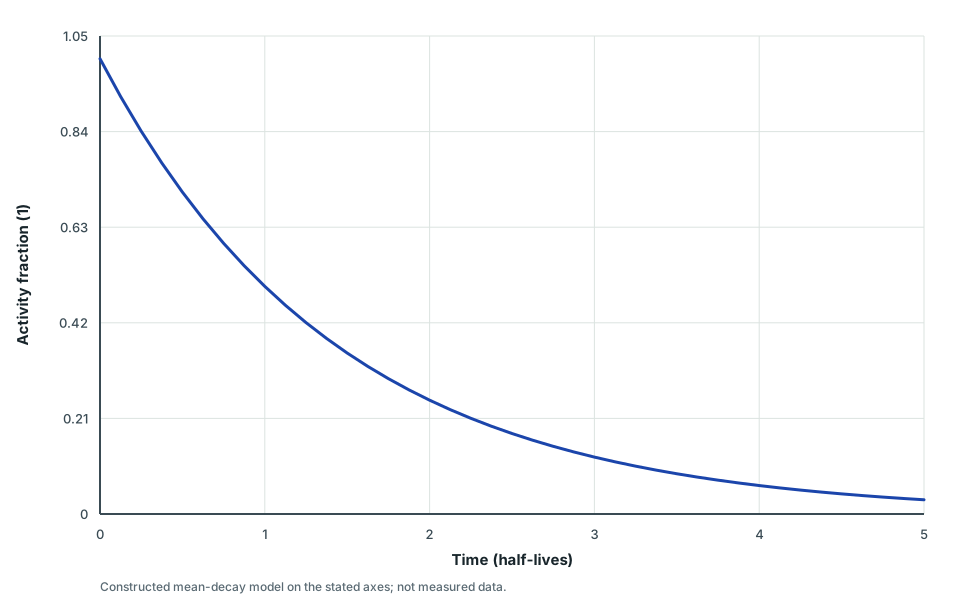
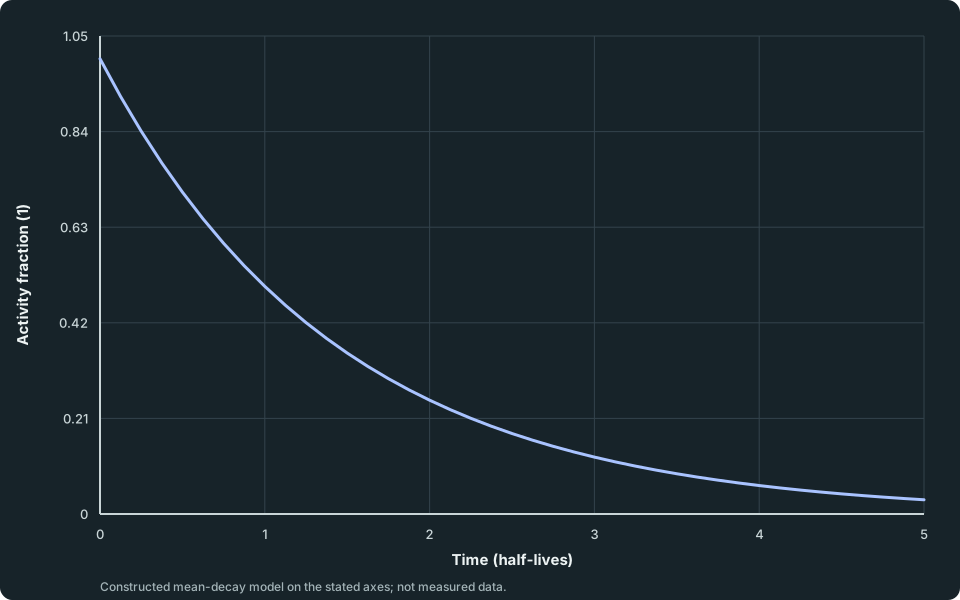
View figure data
| Time (half-lives) | Mean activity fraction |
|---|---|
| 0.000 | 1.00000 |
| 0.125 | 0.91700 |
| 0.250 | 0.84090 |
| 0.375 | 0.77111 |
| 0.500 | 0.70711 |
| 0.625 | 0.64842 |
| 0.750 | 0.59460 |
| 0.875 | 0.54525 |
| 1.000 | 0.50000 |
| 1.125 | 0.45850 |
| 1.250 | 0.42045 |
| 1.375 | 0.38555 |
| 1.500 | 0.35355 |
| 1.625 | 0.32421 |
| 1.750 | 0.29730 |
| 1.875 | 0.27263 |
| 2.000 | 0.25000 |
| 2.125 | 0.22925 |
| 2.250 | 0.21022 |
| 2.375 | 0.19278 |
| 2.500 | 0.17678 |
| 2.625 | 0.16210 |
| 2.750 | 0.14865 |
| 2.875 | 0.13631 |
| 3.000 | 0.12500 |
| 3.125 | 0.11463 |
| 3.250 | 0.10511 |
| 3.375 | 0.09639 |
| 3.500 | 0.08839 |
| 3.625 | 0.08105 |
| 3.750 | 0.07433 |
| 3.875 | 0.06816 |
| 4.000 | 0.06250 |
| 4.125 | 0.05731 |
| 4.250 | 0.05256 |
| 4.375 | 0.04819 |
| 4.500 | 0.04419 |
| 4.625 | 0.04053 |
| 4.750 | 0.03716 |
| 4.875 | 0.03408 |
| 5.000 | 0.03125 |
Core knowledge to remember
- An atom has a small, positive nucleus of protons and neutrons, with electrons outside it. Isotopes of an element have the same number of protons but different numbers of neutrons.
- Radioactive decay is random and spontaneous: an unstable nucleus loses energy by emitting radiation, at a time that cannot be predicted and without any trigger.
- In beta-minus decay, a neutron in the nucleus changes into a proton and an electron, and the electron is emitted.
- Alpha radiation is the most ionising and least penetrating; gamma radiation is the least ionising and most penetrating.
- The half-life is the time for half the radioactive nuclei in a sample to decay, and for its activity to halve. It is the same for every sample of an isotope.
- Background radiation, mainly from radon gas, rocks, cosmic rays and food, is always present and must be subtracted from detector readings.
- A source is chosen for a job by its penetrating power, its ionising effect and its half-life. The same properties decide how dangerous it is and how to protect against it.
- Fission is the splitting of a heavy nucleus into smaller nuclei; fusion is the joining of light nuclei into a heavier nucleus. Both release energy.
Common mistakes
- Saying the proton number goes down in beta-minus decay. A neutron becomes a proton, so Z goes up by 1.
- Balancing only the top numbers in a nuclear equation.
- Halving a count-rate without first subtracting the background.
- Taking away the same number in each half-life instead of the same fraction.
- Saying alpha radiation is harmless. It is the most dangerous once alpha-emitting material is inside the body.
- Saying lead stops all gamma rays. It reduces their intensity.
- Thinking an irradiated object becomes radioactive. Only contamination leaves radioactive material behind.
- Mixing up fission (splitting heavy nuclei) and fusion (joining light nuclei).