Thermal physics
The particle model, thermal processes, internal energy, heat capacity, changes of state, latent heat and cooling curves for G3 Pure and O-Level Physics.
Offline pages
Saved on this device only. Connect at least once every 30 days to confirm Premium. Sign-out or a change of account removes saved copies.
Before you begin
Thermal physics explains temperature, heating and changes of state with one idea: matter is made of particles that are always moving and attract one another. The lessons build that particle model first, use it for the three ways energy is transferred by heating, then calculate the energy needed to change a temperature or a state.
Be comfortable with: energy stores and transfers and density, because heating is an energy transfer and convection is driven by density changes.
Learning goals
- Compare physical properties of solids, liquids and gases
- Explain state properties using particle arrangement, motion, forces and separation
- Infer random molecular motion from a Brownian-motion experiment
- Relate temperature rise to increased average kinetic energy of particles
- Explain gas pressure using particle collisions with container walls
- Explain heating from higher to lower temperature until thermal equilibrium
- Describe conduction in solids through particle vibration and mobile electrons
- Describe convection in fluids through density changes and bulk motion
- Explain that energy transfer by electromagnetic radiation needs no material medium
- Explain how surface colour, texture, temperature and area affect radiation transfer rate
- Apply conduction, convection and radiation in everyday systems
- Describe internal energy as the total kinetic energy of the particles' random motion plus the total potential energy between them
- Apply energy transferred = mass × specific heat capacity × temperature change
- Describe melting, solidification, boiling and condensation as energy transfers without a change in temperature
- Apply energy transferred for a change of state = mass × specific latent heat
- Explain latent heat using particle behaviour
Syllabus statements covered
- compare the physical properties of solids, liquids and gases
- use the kinetic particle model to describe the different states of matter (solids, liquids and gases), relating their physical properties to the arrangement and motion of the particles (e.g. molecules, atoms) and the forces and distances between particles
- infer from a Brownian motion experiment the evidence for the random movement of molecules in a liquid or gas
- relate the rise in temperature of a body to the increase in average kinetic energy of all the particles in the body
- explain the pressure of a gas in terms of the motion of its particles
- show an understanding that energy is transferred (by heating) from a region of higher temperature to a region of lower temperature until thermal equilibrium is achieved between the two regions
- describe, in microscopic terms, how conduction occurs in solids (via vibration of atoms/molecules and movement of electrons)
- describe, in terms of density changes, how convection occurs in fluids
- explain that energy transfer by electromagnetic radiation does not require a material medium and that this rate of energy transfer to/from a body is affected by its: (i) surface colour and texture (ii) surface temperature (iii) surface area
- apply the concepts of conduction, convection and radiation in everyday examples
- describe internal energy as an energy store that is made up of the total kinetic energy associated with the random motion of the particles and the total potential energy between the particles in the system
- define heat capacity and specific heat capacity
- recall and apply the relationship energy transfer (by heating) = mass × specific heat capacity x change in temperature to new situations or to solve related problems
- describe melting/solidification and boiling/condensation as processes of energy transfer without a change in temperature
- explain the difference between boiling and evaporation
- define latent heat and specific latent heat
- recall and apply the relationship energy transfer (by heating for a change of state) = mass × specific latent heat to new situations or to solve related problems
- explain latent heat in terms of behaviour of particles in a body
- sketch and interpret a cooling curve
Lessons
Work through them in order.
Kinetic model and temperature
- States of matter and the particle modelExplain shape, volume and compressibility using particle arrangement, separation and motion.
- Brownian motion: observation and explanationUse observed smoke-particle motion as evidence for the random motion of unseen molecules.
- Gas pressure and particle collisionsExplain gas pressure as particles hitting the walls, and predict how heating or squeezing a gas changes it.
- Internal energy, heating and temperatureExplain internal energy, and why a hotter object need not have more internal energy than a cooler one.
- Thermal equilibriumExplain why energy transfers from a hotter object to a cooler one until their temperatures are equal.
Thermal processes
- Energy transfer by conductionExplain conduction by particle vibrations and free electrons, and why metals conduct best.
- Energy transfer by convectionExplain how density changes set up convection currents in liquids and gases.
- Energy transfer by radiationExplain infrared radiation and how surface colour, texture, temperature and area affect its rate.
Thermal properties and calculations
- Heat capacity and specific heat capacityCalculate the energy for a temperature change using heat capacity and specific heat capacity.
- Melting and solidificationExplain why a pure substance melts and freezes at a constant temperature while energy is transferred.
- Boiling and condensationExplain why boiling happens at a constant temperature and why condensing vapour releases energy.
- Evaporation and coolingExplain surface evaporation, its cooling effect and the effects of temperature, area, air flow and humidity.
- Latent heat and specific latent heatCalculate the energy needed to melt or boil a mass using specific latent heat.
- Cooling curves and changes of stateSketch and interpret a cooling curve, explaining each sloping and flat section.
Practical skills
Beyond the syllabus
Practise and check
Or choose
- Thermal processes topic check
- Thermal properties of matter topic check
- Particle model written questions
- Thermal processes written questions
- Thermal properties written questions
- All practice for kinetic particle model of matter
- All practice for thermal processes
- All practice for thermal properties of matter
Topic reference
Quick reference
| Quantity or idea | Equation or rule | Unit |
|---|---|---|
| heat capacity of a body | C = Q/Δθ | J K⁻¹ |
| specific heat capacity | Q = mcΔθ (temperature changes, no change of state) | J kg⁻¹ K⁻¹ |
| specific latent heat | Q = ml (change of state, temperature constant) | J kg⁻¹ |
| energy from a heater | E = Pt | J |
| direction of heating | from higher to lower temperature, until thermal equilibrium | — |
Heating curve for a pure substance
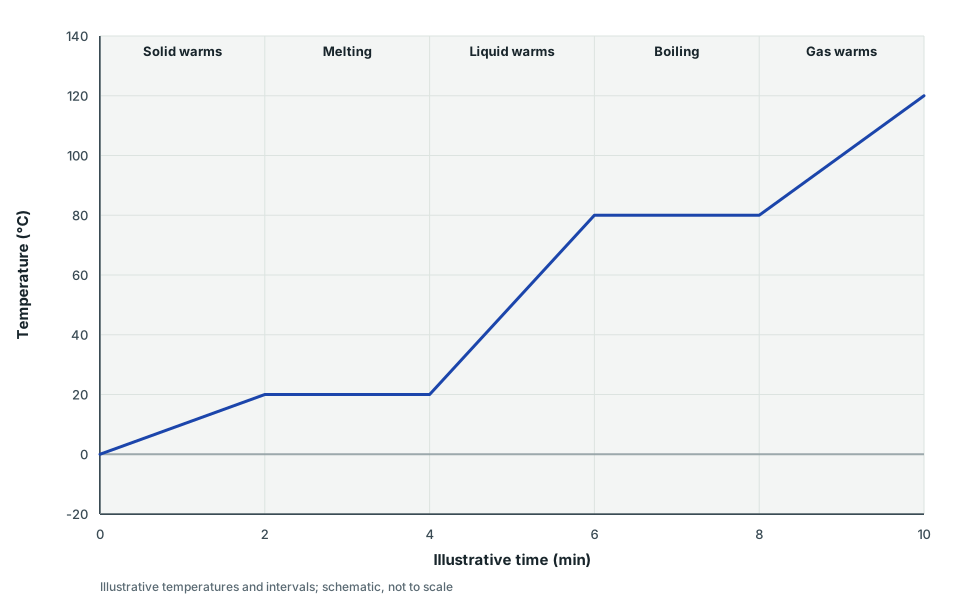
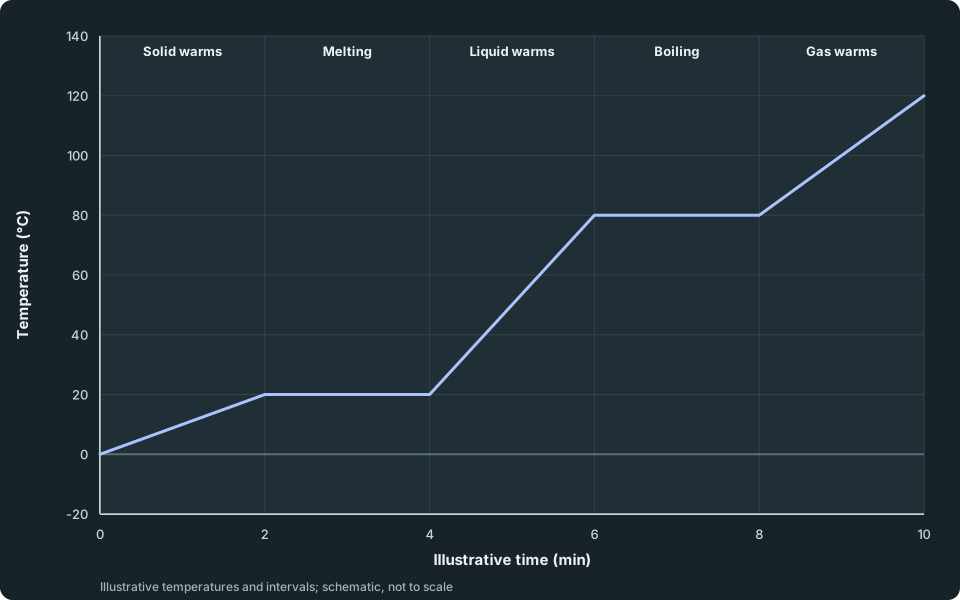
Temperature rises as solid warms to a melting plateau at 20 °C, then liquid warms to a boiling plateau at 80 °C, then gas warms. The temperatures and times are illustrative, not measured.
Scroll across the figure to read all labels.
View figure data
| Illustrative time (min) | Temperature |
|---|---|
| 0 | 0 |
| 2 | 20 |
| 4 | 20 |
| 6 | 80 |
| 8 | 80 |
| 10 | 120 |
Core knowledge to remember
- In the kinetic particle model, solid particles vibrate about fixed positions, liquid particles are close together but move past one another, and gas particles are far apart and move randomly.
- A rise in temperature means a rise in the average kinetic energy of the particles.
- Brownian motion of smoke particles is evidence for the random motion of the air molecules that hit them.
- Gas pressure is caused by gas particles hitting the walls of their container.
- Internal energy is the total kinetic energy of the random motion of the particles plus the total potential energy between them.
- Thermal equilibrium: energy is transferred by heating from a region of higher temperature to one of lower temperature until both are at the same temperature.
- Conduction passes energy by vibrating particles and, in metals, free electrons; convection is caused by density changes in a fluid; radiation is electromagnetic waves and needs no medium.
- Heat capacity is the energy needed to raise the temperature of a body by 1 K. Specific heat capacity is the energy needed to raise the temperature of 1 kg of a substance by 1 K.
- Latent heat is the energy absorbed or released during a change of state without a change in temperature. Specific latent heat is the energy needed to change the state of 1 kg of a substance without a change in temperature.
- During melting and boiling the temperature stays constant because the energy increases the potential energy of the particles, not their kinetic energy.
Common mistakes
- Treating temperature and internal energy as the same thing. Temperature relates to the average kinetic energy; internal energy is a total.
- Saying no energy is transferred during a flat section of a heating or cooling curve.
- Using the final temperature instead of the temperature change in Q = mcΔθ, or forgetting to convert grams to kilograms.
- Writing “heat rises” instead of explaining that warm fluid expands, becomes less dense and rises.
- Saying a vacuum stops radiation. It stops conduction and convection only.
- Calling the visible smoke particle in Brownian motion a molecule.
- Confusing boiling, which happens throughout a liquid at its boiling point, with evaporation, which happens at the surface at any temperature.