UY1: Centre Of Mass Of A Cone
Derive the centre of mass of a uniform solid cone using disk integration and geometric similarity.
On this page
You stopped at:
ContinueThis page is the archived worked-example derivation in the UY1 mechanics pathway.
- Mechanics hub: UY1 Mechanics
- University hub: University Physics (Year 1)
1) At a glance
- Prerequisite: CM integral, volume elements, similar triangles.
- Outcomes: derive CM location of a uniform solid cone.
- Key result:
z_CM = 3h/4measured from the apex along the symmetry axis (equivalently h/4 from the base).
- Always state the reference point: here z = 0 at the apex and z = h at the base. - Don’t confuse the slice radius r(z) = (R/h)z with the cone’s base radius R.
2) Setup (model, assumptions, coordinates/signs)
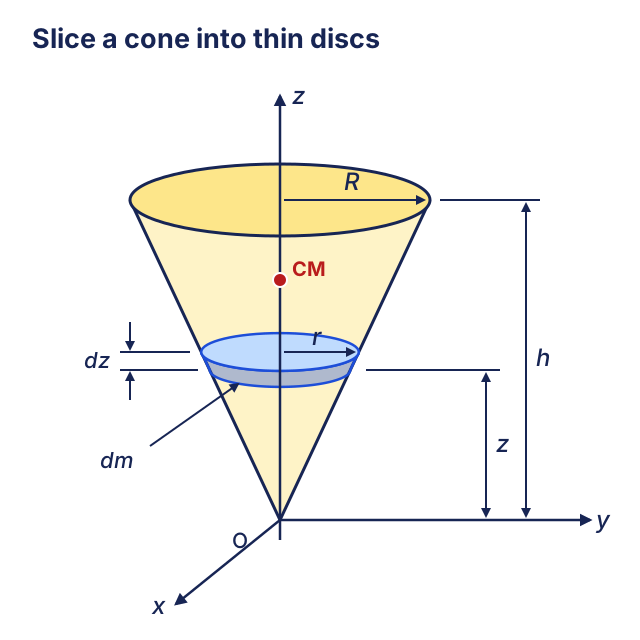
- Uniform solid cone of height h, base radius R, constant density ρ.
- Place apex at z = 0 and base at z = h.
- By symmetry:
x_CM = 0, y_CM = 0So only z_CM is needed.
- Radius at height z from similar triangles:
r(z) = (R/h)z
3) Core method / derivation
z_CM = 1/M∫ z dm
Take a thin disk of thickness dz at height z:
Total mass:
Checks:
- Units: z_CM has units of length.
- Sign: z_CM > 0 along the chosen positive axis.
- Limits: for fixed h, changing ρ does not change CM location.
Intuition:
- Slices near the base have much larger area (∝ z²), so they contribute more mass and pull the CM toward the base.
4) Worked example
Worked example 1
Locate the centre of mass of a cone
Problem
A uniform solid cone has height h = 20 cm. Where is its centre of mass?
Show full solution
Use the derived result
Method
Apply z_CM = (3/4)h, measured from the apex.Reason
Each disc slice has mass proportional to z², so the mass is concentrated towards the base.Working
Answer
z_CM = (3/4)(20 cm) = 15 cm.
State the answer
Working
Answer
The centre of mass is on the axis, 15 cm from the apex, which is 5 cm above the base.
5) Practice set
Check your understanding 1
A uniform solid cone has h = 0.80 m. How far above the base is its centre of mass?
Show hint
First find 3h/4 from the apex.
Show answer
From the apex, z_CM = (3/4)(0.80) = 0.60 m, so it is 0.80-0.60 = 0.20 m above the base: a quarter of the height.
Check your understanding 2
The base radius of a uniform cone doubles while its height stays fixed. Does z_CM change?
Show hint
Look at the final formula: which dimensions appear in it?
Show answer
No. Every slice’s mass scales by the same factor, 4, so the weighting along z is unchanged and z_CM = (3/4)h depends only on h.
Check your understanding 3
True or false: a thin hollow conical shell has the same centre of mass as a solid cone of the same height.
Show hint
How does the mass of each slice grow with z for a shell compared with a solid?
Show answer
False. For the shell, the mass of each ring grows only in proportion to z, not z², so the mass is less concentrated towards the base. Its centre of mass is at (2/3)h from the apex, not (3/4)h.
6) Summary + next steps
- Symmetry reduces the problem to one coordinate.
- Disk slicing with r(z) = (R/h)z gives z_CM = 3h/4 from apex.
- Always report reference point (apex or base) explicitly.
Next steps:
- Motion Of A System Of Particles
- Moment Of Inertia (CM is used in the parallel-axis theorem)
- Rocket Propulsion
- Back To Mechanics (UY1)
Spotted an error? Report a correction
Syllabus and review details
No official syllabus alignment is listed for this lesson.
Last reviewed: