UY1: Sample questions for centre of mass (Set 1)
UY1 practice set on centre of mass with short hints and worked answers, including particle and lamina examples.
Continue where you stopped
The core idea
On this page
Learning objectives
- Use vector and differential or integral calculus to express physical change and accumulation.
- Use complex numbers, linear algebra, and differential equations to solve coupled physical models.
- Choose an efficient mathematical method and validate the result physically.
This page is the archived bridge question set in the UY1 mechanics pathway.
- Mechanics hub: UY1 Mechanics
- University hub: University Physics (Year 1)
- Practice route: UY1 Assessment Map and UY1 Mechanics Expansion Quiz
1) At a glance
- Prerequisite: weighted averages, basic CM formulas, symmetry.
- Outcomes: choose a correct model quickly and solve CM questions with sign/units checks.
- Key result: for composite bodies, treat removed parts as negative mass.
- For cut-outs/holes, use a negative mass and keep the position sign (left/right, up/down).
- Don’t cancel masses too early: keep ∑ mᵢ and ∑ mᵢxᵢ symbolic, then simplify.
- Check a limiting case: hole size → 0 should give the full-body CM.
2) Setup (model, assumptions, coordinates/signs)
- Choose an origin and axes before writing equations.
- Use one consistent unit system.
- For composite bodies:
with mᵢ < 0 for cut-out sections.
- For uniform laminae, mass is proportional to area.
3) Core method / derivation
General problem-solving pipeline:
- Break body into simple known pieces.
- Assign each piece a signed mass (positive for present material, negative for holes).
- Write CM equations for x (and y if needed).
- Check signs and limits (if hole size → 0, result should return to full-body CM).
Quick checks:
- Units: final CM coordinate must be in length units.
- Sign: if mass removed on the right, CM should shift left.
- Limit: tiny cut-out gives tiny shift.
4) Worked example
Two point masses: 2 kg at x = 0 and 6 kg at x = 4 m.
CM is closer to the heavier mass, as expected.
5) Practice set (hints + answers)
-
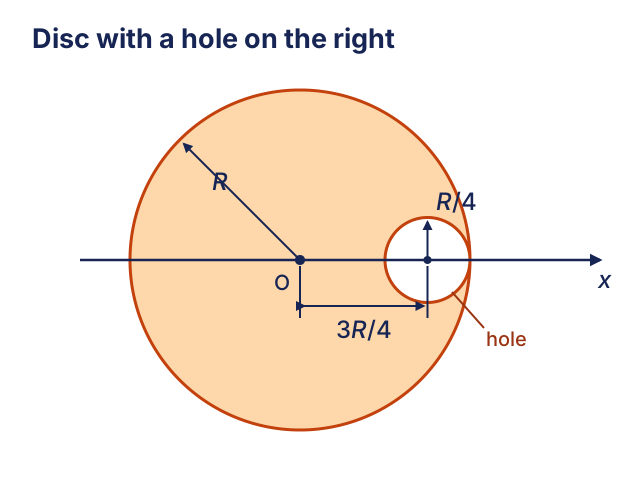
A circular pizza of radius R has a circular hole of radius R/4 removed from the right side (hole center on the horizontal diameter, tangent internally).
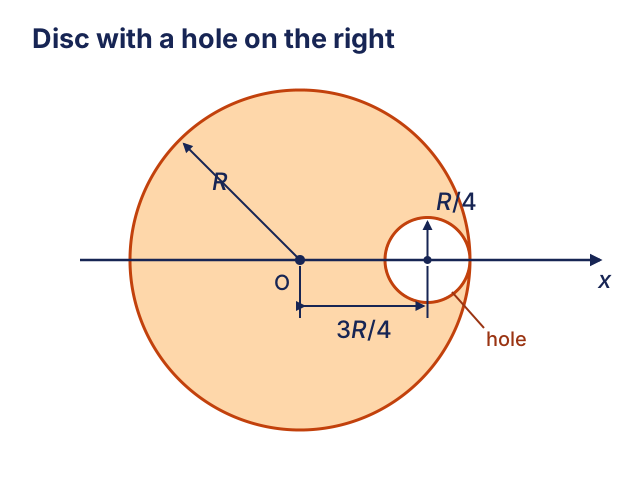
The hole touches the disc's right edge from the inside, so its centre lies 3R/4 to the right of O. Hint: treat hole as negative mass at x = +3R/4, full disk CM at x = 0. Answer:
x_CM = (M(0)-(M/16)(3R/4))/(M-M/16) = -R/20So CM is shifted left by R/20.
-
Equal masses at (0,0), (4,0), (0,2). Find CM. Hint: average coordinates. Answer: (x_CM,y_CM) = (4/3,2/3).
-
Uniform rod from x = 0 to x = L has extra point mass m at x = L. Rod mass is 2m. Find CM. Hint: rod CM at L/2. Answer:
6) Summary + next steps
- Composite-body CM problems are bookkeeping with signed masses.
- The fastest error checks are units, sign, and limiting behavior.
- If symmetry exists, exploit it first.
Next steps: